Over on YouTube Tech Minds has uploaded a new video where he reviews the MLA-30 active HF loop antenna. In the past we have posted about the MLA-30 antenna a several times on the blog as it is the cheapest active loop antenna available on the market, can be powered by the RTL-SDR Blog V3's bias tee, and generally loop antennas can give good HF performance in a small package. In the video he compares the MLA-30 against an end-fed halfwave antenna and concludes that the MLA-30 works well at the lower frequencies, but not so well in the higher bands.
As part of his Masters in Design Studies studies Daniel Tompkins created an art installation called "signs of life" which was focused around his interest in weather satellite reception with an SDR.
FM radio headphones were given out at the door. Each set was tuned beforehand to receive a broadcast from my pre-programmed station.
Visitors were then invited to walk around the room, contemplating the artifacts of the exhibit. A V-dipole at one end of the room captures the broadcast and displays a real-time spectrogram of the radio waves on a small display.
Across the room, a satellite dish points back, creating an alignment across the projected GOES-16 "full-disk" image animation of the Earth. Along the back wall, a few dozen images show demodulated signals from the NOAA 15/18/19 satellites as they passed over Cambridge, Massachusetts in the months of October and November 2018.
The experience demonstrated my interest in tapping into an invisible (wireless) environment of digital information. A USB, software-defined radio (SDR) dongle helped me reach the satellites.
In listening to the transmission, the visitors are engaging in a shared experience, but are somehow still alone and unable to communicate while wearing their headphones. The performance of the exhibition is designed to be a place which simulates the real disconnection of techno-humanity. The "reflecting pool" of the earth spinning on the floor might provide a metaphorical reflection of humanity and progress.
Daniel Tompkins GOES-16/NOAA Art Installation
This installation reminds us of the "Holypager" live art piece which used a HackRF to receive and print out live pager messages with an aim to demonstrate the amount of personal data being sent publicly over pagers. Another related art piece was the "Ghosts in the Air Glow" project by Amanda Dawn Christie, which saw the HAARP Auroral research facility used to transmit various art pieces to be received from all over the world by people with HF radios.
Trunked radio systems for voice communications can be easily found when browsing the spectrum with an SDR. Listening to a voice communication is easy, but actually following a conversation along is almost impossible to do manually. This is because in a trunking system the frequency in use during a conversation can change often. The frequency of the voice is dictated by a control channel that all radios listen to. This allows multiple talk groups (Police, EMS, business etc) to share one chunk of the spectrum without having to allocate fixed channels for each user.
Over on his blog Andrew Nohawk has uploaded an excellent guide that explains trunked radio, how it works, how to use radioreference to look up trunked radio frequencies in your area, and how to use an RTL-SDR to listen in. He then shows how to use a program called "trunk-recorder" which will automatically record and upload trunked radio conversations to a site like openmhz.com for sharing.
The SDR-Kits L-band Patch antenna is a modified GPS antenna designed for receiving Inmarsat satellite stations such as AERO and STD-C. They have another version for receiving Iridium frequencies as well. The patch costs £12.90 inc VAT in UK, or approx US$14 for non-UK customers.
Over on his channel Frugal Radio has uploaded a video where he tests this patch antenna with an RTL-SDR Blog V3. The built in bias tee on the V3 is used to power the antenna. In the video he shows how he's able to receive and decode AERO using the JAERO decoding software and how he uses a a metal backing to improve reception.
In political news 75 year old Buffalo protestor Martin Gugino has been generating controversy due to a video of him being pushed to the ground by a police officer, then subsequently lying motionless while bleeding from the head and being ignored by other officers.
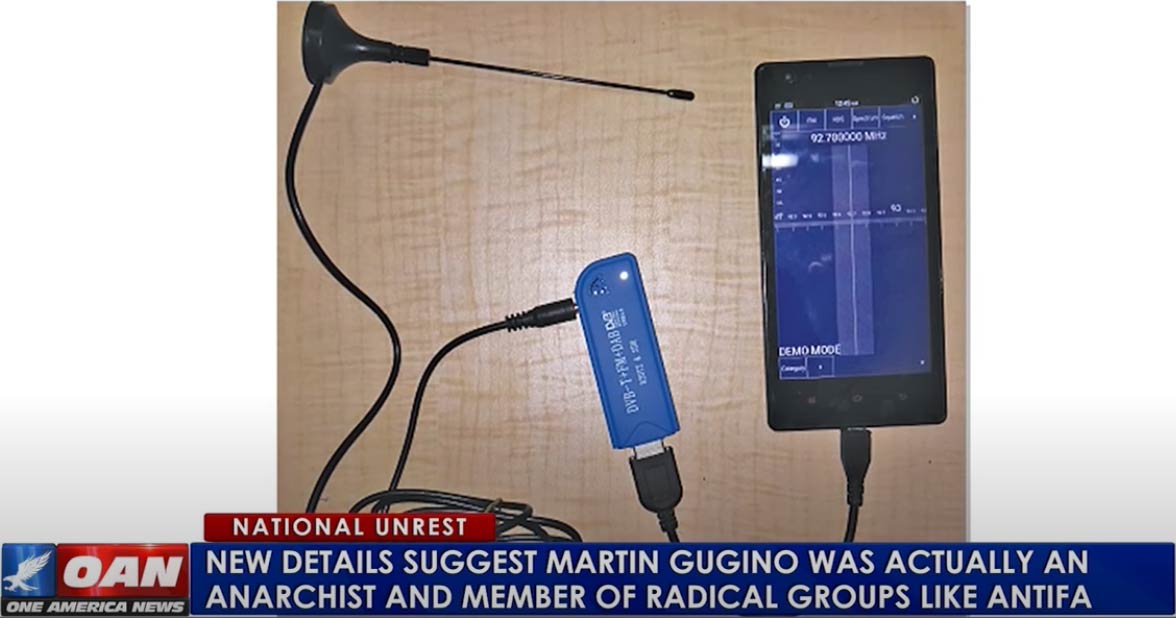
Trump's tweet reads "Buffalo protester shoved by Police could be an ANTIFA provocateur. 75 year old Martin Gugino was pushed away after appearing to scan police communications in order to black out the equipment @OANN
I watched, he fell harder than was pushed. Was aiming scanner. Could be a set up?".
We're not entirely sure where this theory from OAN came from as there is no need to get so close in order to listen to police radio communications, since if unencrypted, they can be listened to from anywhere in the city. It's also unclear as to what microphones police would be using, and how these could be "skimmed" with an RTL-SDR. As for blacking out the equipment, an RTL-SDR cannot transmit so it would be impossible to use to jam the radios. An illegal jammer could be used after scanning, but police frequencies are already well known anyway, and there would be no need to scan for them so close even if low power comm links were used.
The video also shows that he appears to be filming police badge numbers with his phone before he was pushed, so it is unlikely that he was using an RTL-SDR and running SDR Touch at the same time as the camera app. No cables, antenna or dongle can be seen in the video either.
EDIT: Please note that this is not a political post or blog. We only post it to highlight the severe lack of understanding that can surround SDR and our technical hobbies. Comments inciting violence against protestors or anyone are NOT OK, and will be removed. Please keep discussions technical and civil in nature.
OAN indicates that Martin Gugino may have used an RTL-SDR "capture scanner" on police
Over on Facebook Job Geheniau has recently been sharing how he's taken an image of our galaxy (the Milky Way) with a radio telescope consisting of a 1.5 meter dish, RTL-SDR and a few filters and LNAs. In the past we've posted several times about others observing the Hydrogen line with an RTL-SDR, and we have a tutorial here showing how to observe it on a budget.
In this case, Job went a step further than just a single measurement. He used a used a motorized dish and RTL-SDR to scan the entire Milky Way over one month, resulting in a full radio image of the galaxy. As his posts and pdf document are on Facebook and not visible to those without Facebook accounts, we asked for permission to reproduce some of them here for all to see. We have also mirrored his PDF file here, which contains more information about his radio telescope, results and setup.
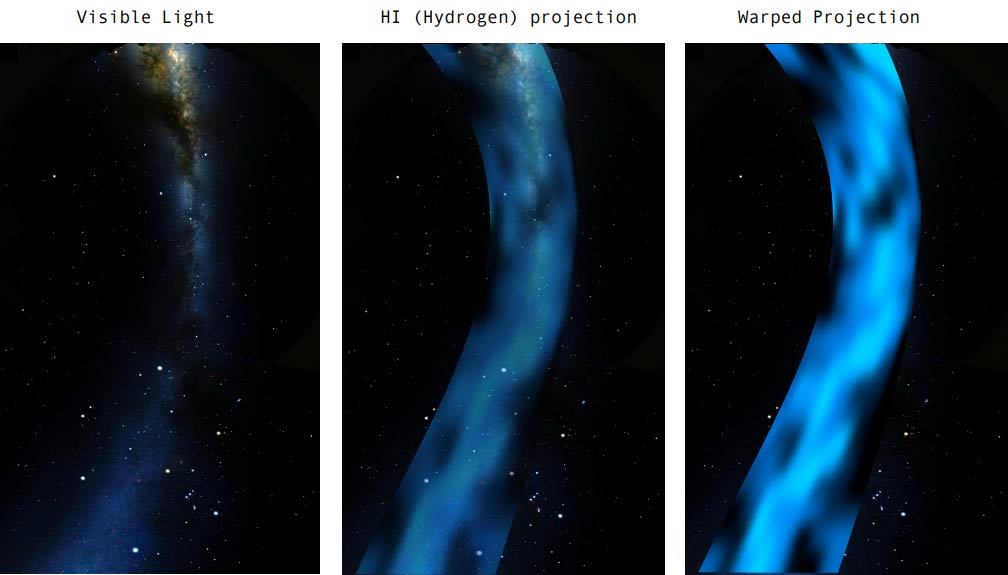
To make a very long story short. After a month of angel patience (and that says something to me) I managed to take a 'picture' of our entire galaxy (galaxy) in neutral hydrogen! I attach some pictures. If you are more interested, please come after this and PDF with explanation. It was a hell of a job I can tell you. But here's the ' picture s' of the house (230 million light years wide) in which we live and in which we all have a big mouth......
Hydrogen Line Image of the Milky Way produced by Job Geheniau
For the Scientists among us... a beautiful plot of the Milky Way Graphically explained in neutral hydrogen....... In short, summarized... if you look up on a beautiful summer evening you will see a beautiful galaxy, this is graphically the same but then on a different frequency than the eye can perceive. own dates of course.....
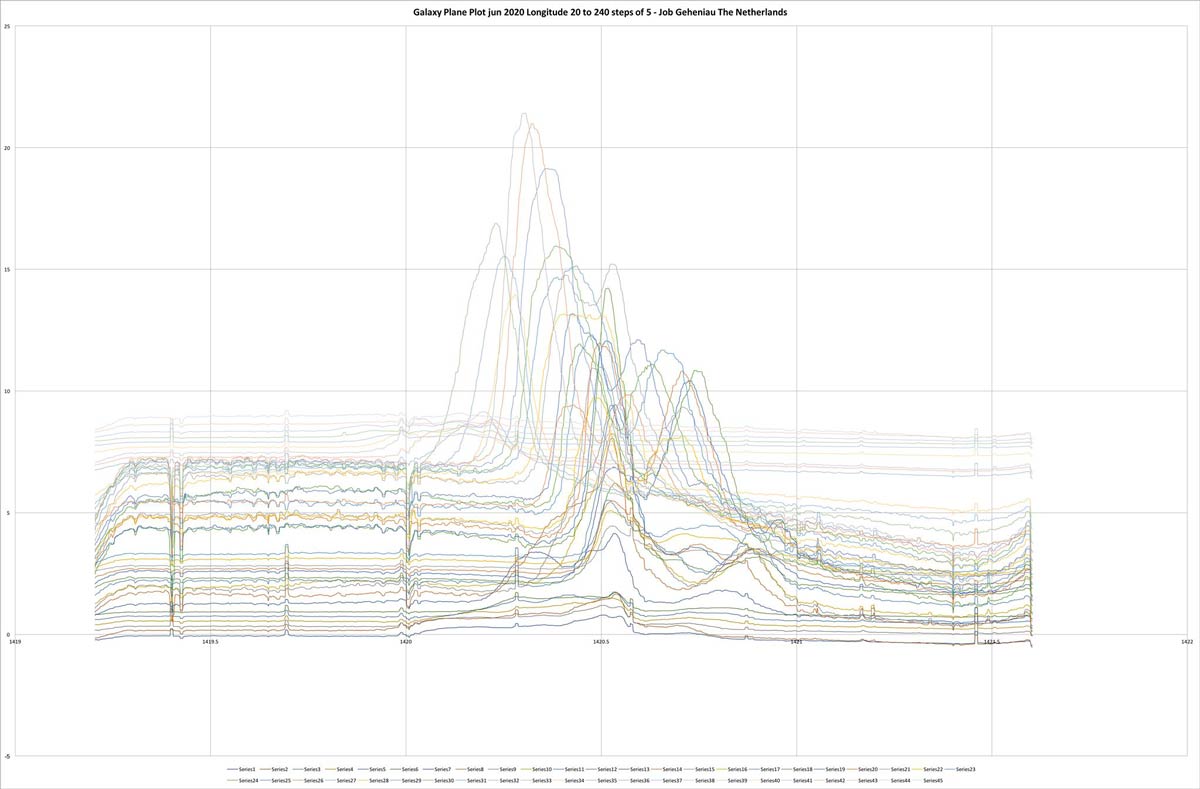
A composite of Hydrogen Line readings at different points of the Milky Way produced by Job GeheniauAn image of the Galactic Plane (longitude 20 to 240 steps of 5 degrees and latitude 0)
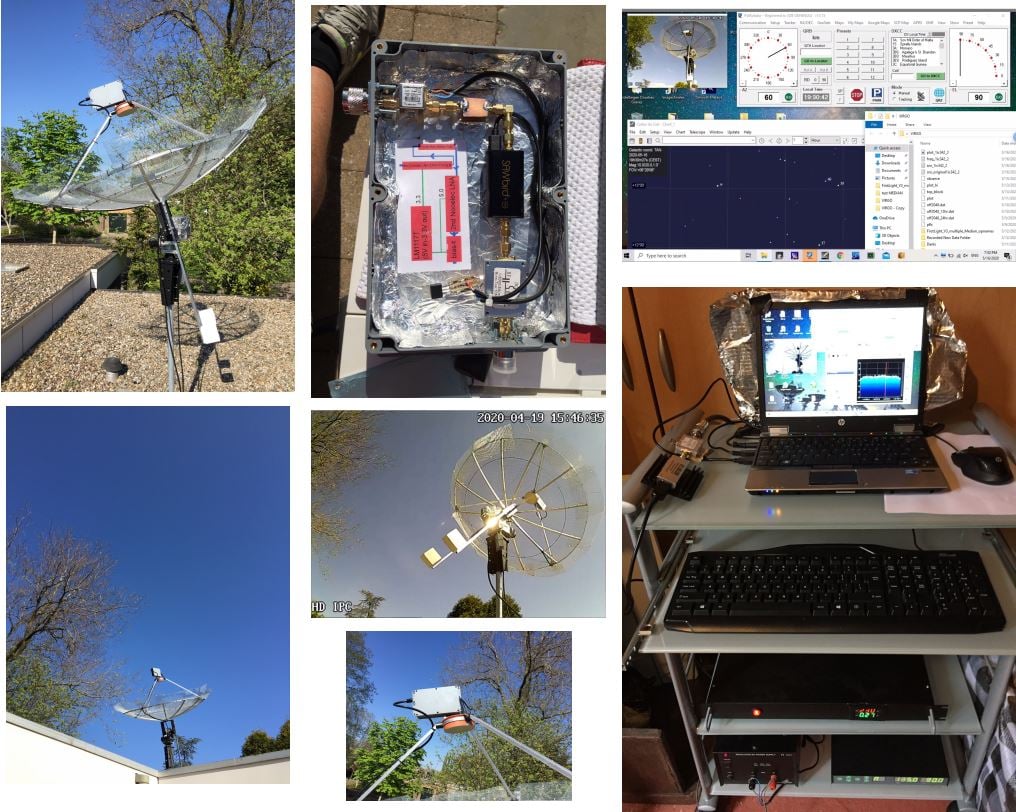
His setup consists of a 1.5m dish, extended to 1.9m with some mesh. A 1420 MHz tuned feed, Mini Circuits ZX6-P33ULN LNA, Bandpass Filter, NooElec SAWBird LNA, Bias-T, RTL-SDR V3, PST Rotator Dish Software, VIRGO software, SDR#, Cartes due Ciel sky chart and a home made netfilter.
He uses a modified version of the VIRGO software to read sky coordinates from a text file, and this points the telescope at each predefined coordinate. He then uses VIRGO to record data for 180 seconds before moving on to the next coordinate. The data is then plotted in Excel, and the highest peak is taken at each coordinate and put back into an 8x21 matrix in excel. Conditional formatting is then used to generate a color gradient resulting in a rough map. Then a Gaussian blur is applied, and it is projected over the Galaxy, resulting in the images above.
The Hydrogen Line is an observable increase in RF power at 1420.4058 MHz created by Hydrogen atoms. It is most easily detected by pointing a directional antenna towards the Milky Way as there are many more hydrogen atoms in our own galaxy. This effect can be used to measure the shape and other properties of our own galaxy.
TempestSDR is an open source tool made by Martin Marinov which allows you to use any SDR that has a supporting ExtIO (such as RTL-SDR, Airspy, SDRplay, HackRF) to receive the unintentional signals radiated from a screen, and turn that signal back into a live image. This can let you view what is on a screen through a wall without using any physical cables.
We first posted a demonstration of TempestSDR back in 2017 when we were finally able to get it to compile. Compiling the software took a fair amount of work for those without experience, and even running it was a chore. However, getting it to work is worth it as you can do some really interesting demonstrations.
However these problems are over and recently Erwin Ried @eried has made a self-executable version of TempestSDR. This means that no compilation, java installs, mingw or extra dlls are required to get the program to work as now it's just an exe that you can run. You will still need the appropriate ExtIO dlls for your SDR. The video in his twitter post shows it working with a HackRF.
Thank you to @Derek33197785 for writing in and highlighting @aang254's work on gr-hrpt, a GNU Radio 3.8 port of HRPT blocks from gr-noaa and other projects. These blocks are for decoding the HRPT signal from weather satellites like NOAA, METEOR, MetOP, and soon FengYun-3. @Derek33197785 writes to us:
[@aang254] made a custom HRPT decoder and ported HRPT blocks for NOAA, METEOR and MetOp to work with gnuradio 3.8 on Linux. Right now it is the only free and open source decoder for MetOp (that works), and he also thinks about implementing FengYun support. I tested the decoder and it works great.
He's also working on extracting the full data from HRPT, not just the AVHRR/MSU-GS imagery but also all the telemetry and other instrument data.
HRPT is a high resolution weather satellite image signal that is broadcast from the same NOAA satellites that provide the more commonly received low resolution APT images at 137 MHz. HRPT is also broadcast by the FengYun-3, Metop and Meteor satellites. However, HRPT transmits at 1.7 GHz, so a high gain dish antenna with motorized tracking mount (or hand guided tracking), LNA and a high bandwidth SDR like an Airspy is required to receive it.
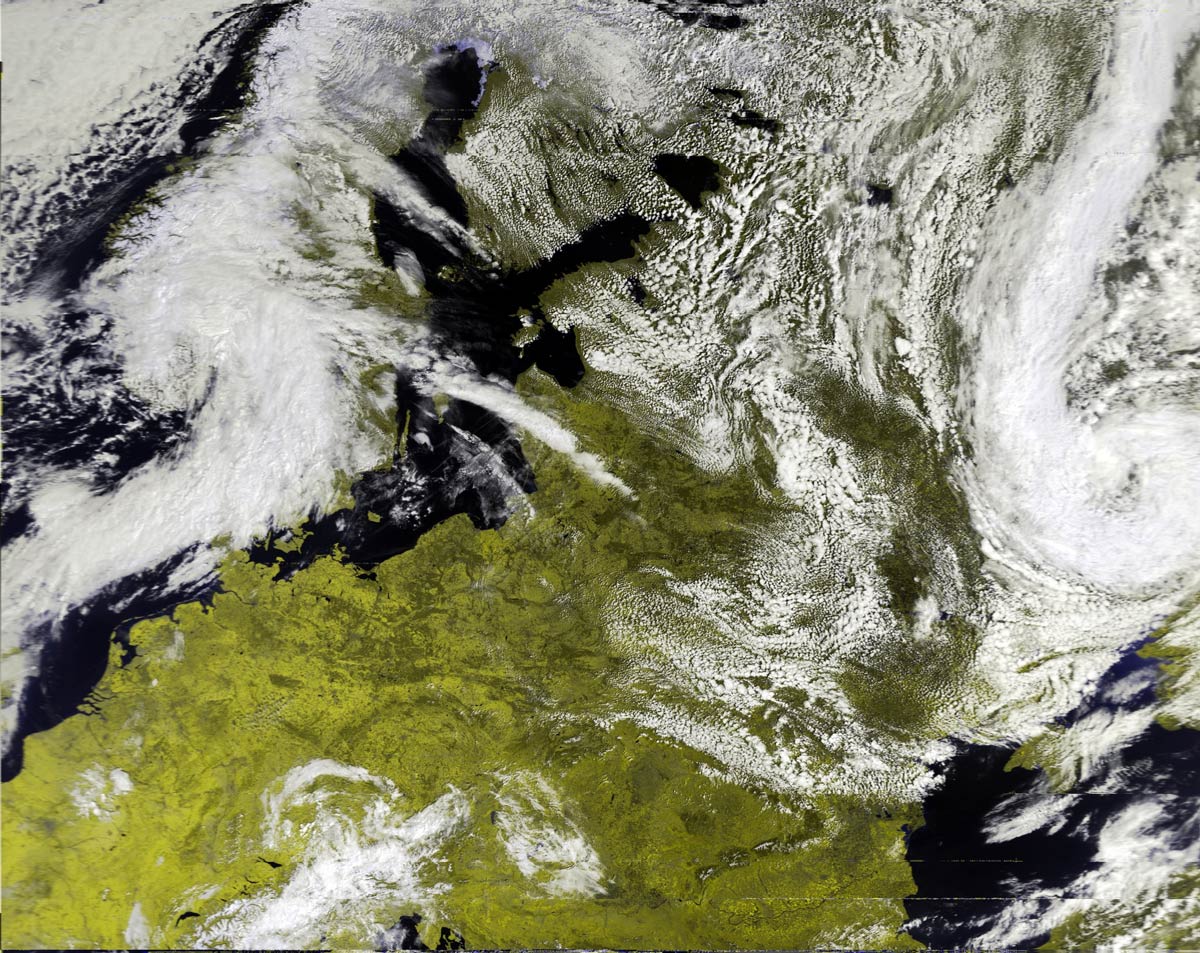
A Metop HRPT Weather Satellite Image (resolution reduced). See @Derek33197785's twitter post for the full resolution image.