Tagged: HF

Video Comparing the Airspy HF+ and KiwiSDR

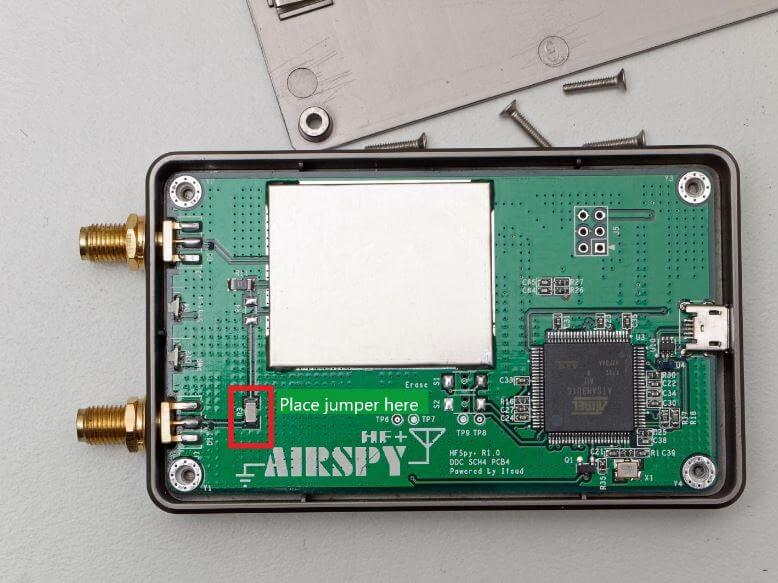
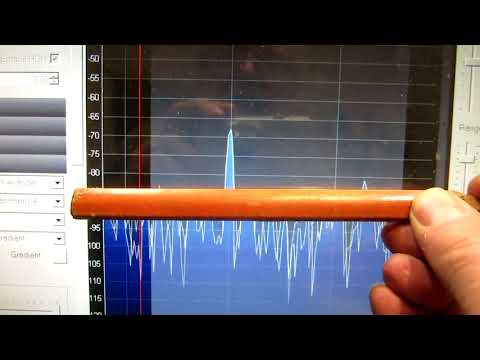
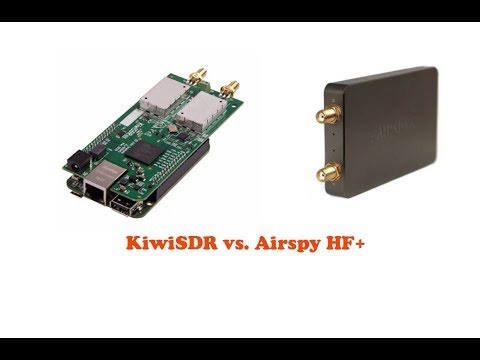
Over on YouTube user icholakov has uploaded a video comparing the Airspy HF+ with the KiwiSDR. The Airspy HF+ and KiwiSDR are both high performance yet low cost SDR platforms. The differences are that the Airspy HF+ is normally connected directly to a PC (but can be run remotely too) whereas the KiwiSDR is designed to be run remotely only, and so can only be accessed through a browser platform. In addition the HF+ only has maximum live bandwidth of 660 kHz whereas the KiwiSDR samples the entire 30 MHz of the HF band. Both are very sensitive and fairly resistant to overloading, but the HF+ should be better in both regards.

In his video icholakov does side by side comparisons with each radio. He writes

Comparing short wave and medium wave reception from Airspy HF+ SDR Console 3 and KiwiSDR with its built in web server. Using the same 80m dipole antenna. No special noise cancelling on the Airspy HF Plus.

Airspy HF+ vs. Kiwisdr SDR Radio comparison

Testing the Airspy HF+ Against the FDM-S2 on the Medium and Long Wave Bands

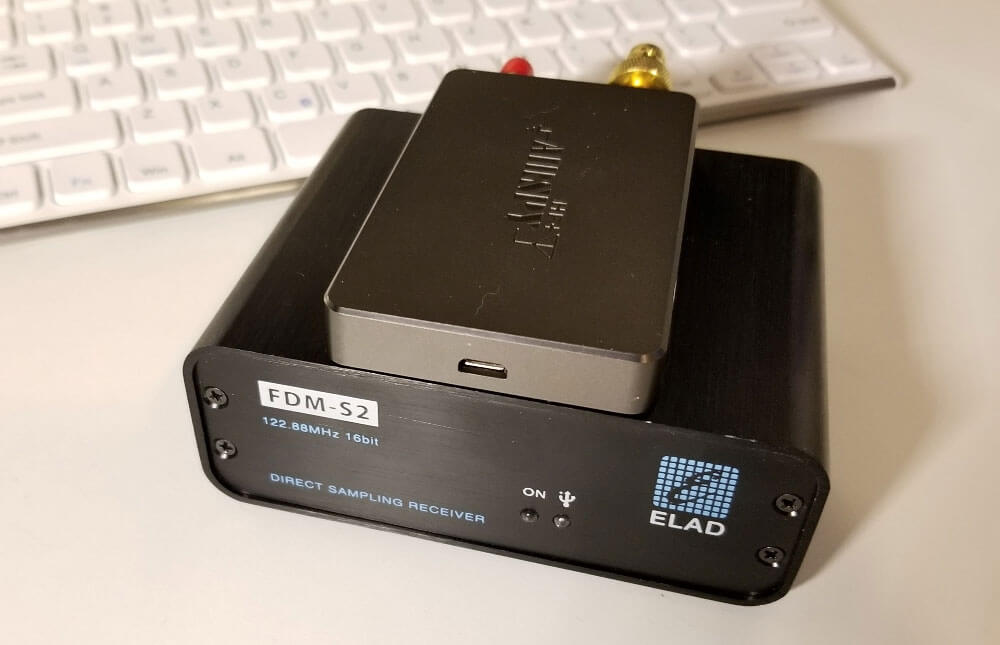
Over on the swling.com blog (short wave listening) contributor Guy Atkins has posted about his comparisons of the Airspy HF+ and the Elad FDM-S2 SDRs on the Medium Wave band. In the test he connected the two SDRs to the same ALA1530S+ Welbrook loop antenna via a splitter and recorded some audio comparisons.

It appears that the Airspy HF+ even outperforms the FDM-S2 on one particular test where he tries to listen to 1540 kHz which is just 10 kHz away from a strong signal at 1550 kHz. He also writes:

It became apparent quickly that the upstart HF+ provides strong competition to the Elad SDR. Clearly, the AirSpy’s trade-off is bandwidth for raw performance at lower cost–approx. 660 kHz alias-free coverage versus about 6 MHz maximum for the Elad.

Also in a later post on the swling.com blog Guy makes an addendum where he swaps out his ALA1530S+ Wellbrook loop antenna for the ALA1530LN Pro which overloads his receivers less. He notes that with the new antenna 6 dB of attenuation is required for the FSM-S2 in order to prevent overloading. With the HF+ very little overloading apart from a weak image could be found, and that was removed by adding 3 dB of attenuation.

He also tests longwave reception with the two receivers, and this time finds that the HF+ seems to have additional MW spurs in the LW band, compared with the FDM-S2.

The Airspy HF+ and Elad FDM-S2.

Securing the Bitcoin network against Censorship with WSPR

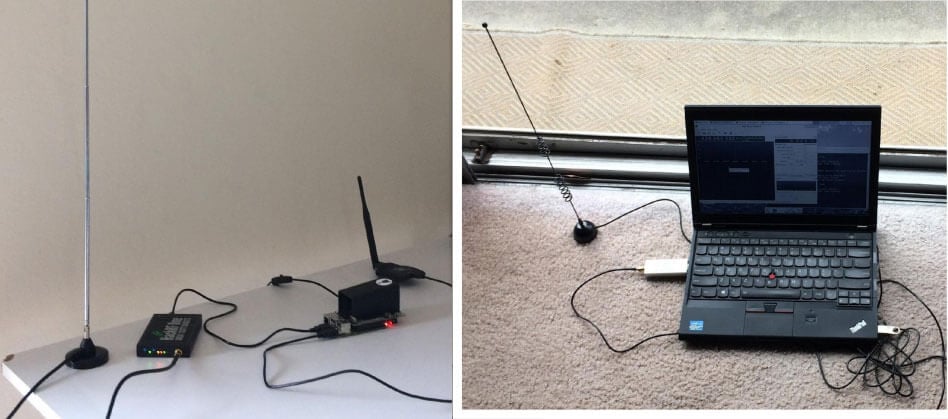
Bitcoin WSPR Test Setup

If you didn't know already Bitcoin is the top cryptocurrency which in 2017 has begun gaining traction with the general public and skyrocketing to a value of over $19,000 US per coin at one point. In addition to providing secure digital transactions, cryptocurrencies like Bitcoin are intended to help fight and avoid censorship. But despite this there is no real protection from the Bitcoin internet protocol being simply blocked and censored by governments with firewalls or by large ISP/telecoms companies.

One idea recently discussed by Nick Szabo and Elaine Ou at the "Scaling Bitcoin 2017" conference held at Stanford University is to use the something similar to WSPR (Weak Signal Propagation Reporting Network) to broadcast the Bitcoin network, thus helping to avoid internet censorship regimes. To test their ideas they set up a HackRF One as a transmitter and RTL-SDR and used GNU Radio to create a test system.

Other ideas to secure the Bitcoin network via censorship resistant radio signals include kryptoradio, which transmits the network over DVB-T, and the Blockstream satellite service which uses an RTL-SDR as the receiver.

If you're interested in the presentation the talk on WSPR starts at about 1:23 in the video below. The slides are available here.

Scaling Bitcoin 2017 Stanford University - Day 2 Afternoon

Airspy HF+ Can Receive L-Band 1.2 GHz to 1.67 GHz

The Airspy HF+ is a much anticipated and recently released software defined radio that specializes in HF and VHF reception. However, one little known and not often advertised feature is that it can actually be used for L-band reception between 1.2 and 1.67 GHz as well. This means that it could be used for signals such as AERO, STD-C, Iridium, the 23cm amateur radio band and more.

Over on YouTube Adam 9A4QV has uploaded a video that tests the HF+ with Alphasat AERO signals at about 1.545 GHz. He notes that the sensitivity is quite good as it is able to receive the satellite signals directly with only the antenna connected and no external LNA used. Of course adding in an external low noise figure LNA and filter would improve the signal even further. Adam notes that reception on the 23cm amateur band (1240 MHz to 1300 MHz) is also quite good with sensitivity reaching about -130 dBm.

Airspy HF+ L-band satcom test

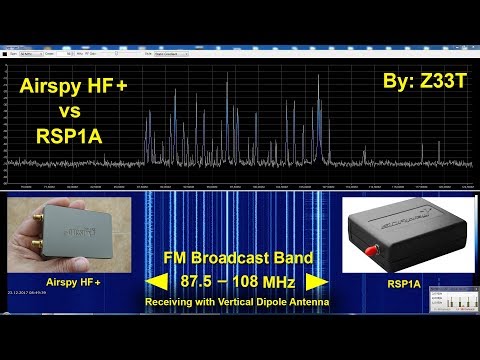
Video Comparison of the Airspy HF+ and SDRplay RSP1A on the FM Broadcast Band

Frequent reviewer of SDR products Mile Kokotov has just uploaded on his YouTube channel a new video where he compares the Airspy HF+ against the SDRplay RSP1A on FM broadcast reception.

At first Mile compares the two against strong broadcast stations, and then later compares them on weak DX stations surrounded in amongst other strong stations. With the strong stations a difference between the two radios is impossible to detect. But with the weaker stations that are surrounded by strong signals the Airspy HF+ has the edge with it's higher dynamic range and sensitivity.

Mile writes:

In this video I am comparing two popular SDR-Receivers (Airspy HF+ and SDRplay RSP1A) on FM Broadcast Band.

I have made few recordings with every receiver with the same antenna trying to set the best SNR = signal-to-noise ratio.

My intention was to ensure the same conditions for both SDR`s in order to make as fair as possible comparison.

No DSP enhancing on the SDR`s was used.

Antenna was Vertical Dipole.

When receiving signals are strong enough, You should not expect the difference between most receivers to be very obvious!

If you compare one average transceiver (which cost about $ 1000 USD) and top class transceiver which cost ten times more, the difference in receiving average signals will be very small too. Almost negligible! But when you have difficult conditions, the very weak signal between many strong signals, than the better receiver will receive the weak signal readable enough, but cheaper receiver will not. Today it is not a problem to design and produce the sensitive receiver, but it is far more difficult to design and produce high dynamic receiver for reasonable price! The Airspy HF+ and RSP1A are very very good SDR-receivers. They have different customers target and have strong and weak sides. For examle Airspy HF+ has better dynamics in frequency range where it is designed for, but RSP1A, on the other hand, has broadband coverage...

Airspy HF+ vs SDRplay RSP1A Comparison on FM Broadcast Band

Using a Slinky as a Cheap Antenna for the 80m Band

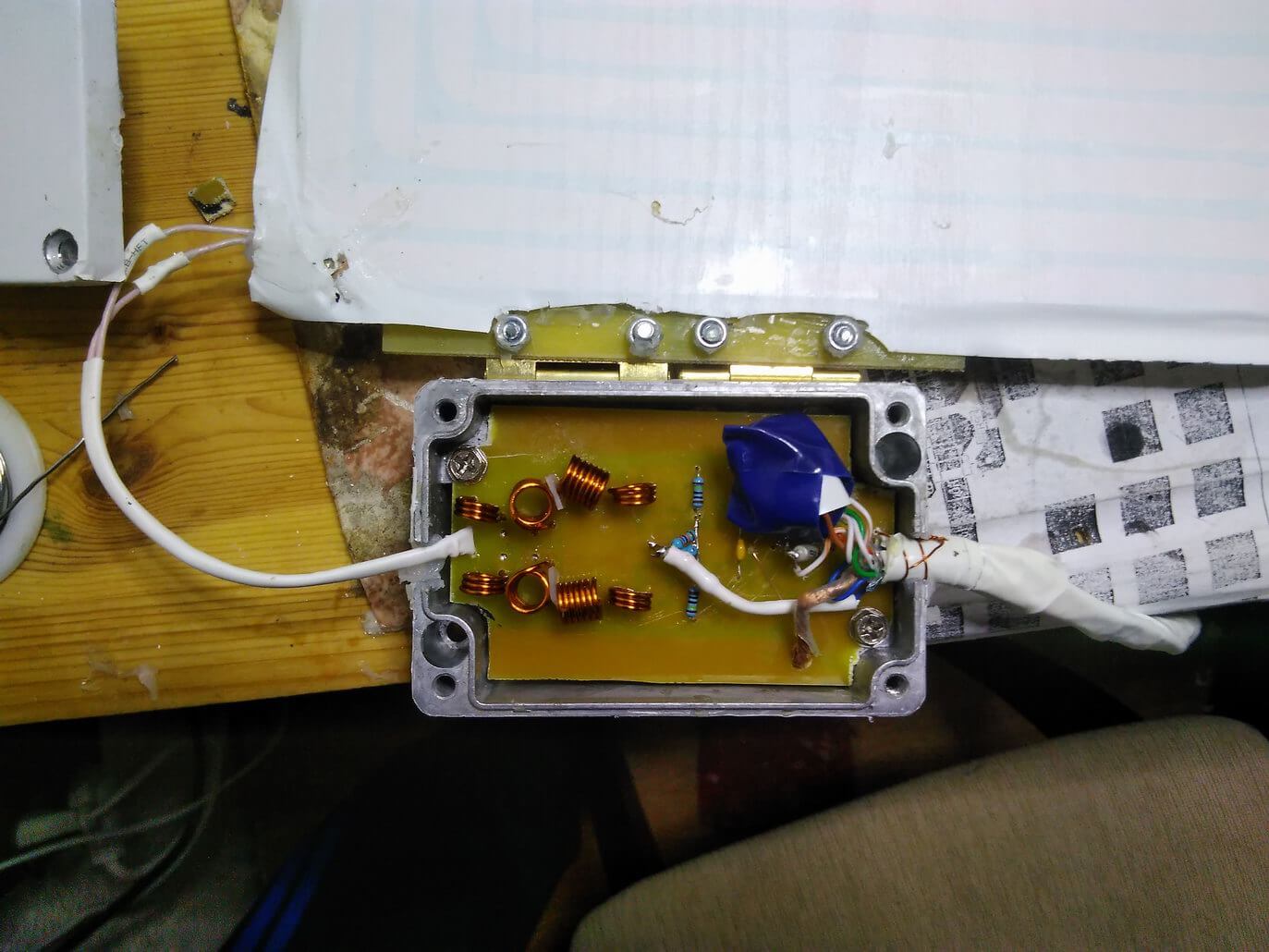
A slinky is a fun little toy that is essentially a long and loose spring. You can perform tricks with them, but the most iconic use is making them walk down stairs all by themselves. Over on Hackaday we've seen a tutorial that shows how to use a slinky as a good antenna for the 80m (3.5 MHz) band. Using a slinky as an antenna is nothing new to hams, but the original post on imgur shows some pretty clear photos and instructions on how to construct one.

The text written by the original poster on imgur notes that he uses this antenna very successfully with his RTL-SDR in direct sampling mode and this even outperforms his regular shortwave radio. He notes that slinkies aren't weather proof, so some sort of weather proofing spray coating or oil might be useful for a permanent set up.

If you are interested apart from the discussion on Hackaday there is also a comments thread on Reddit where the original poster discusses what he purchased.

Slink Antenna for 80m
Slinky Antenna for 80m

Testing Public Airspy HF+ SpyServers over the Internet

SpyServer is a streaming server for SDR# which allows you to use Airspy and RTL-SDR radios remotely over a network connection. There is now a list of publicly available SpyServers that you can connect to over on the airspy.com website.

The servers that are currently online include some streaming from Airspy HF+ devices, which is the hotly anticipated but as of yet unreleased HF receiver from Airspy. Over the last few months and weeks a number of prototype devices went out to testers and programmers and some have now put them online with a SpyServer. There are also some Airspy One/Mini and RTL-SDR devices available for streaming too.

To connect to one of the servers simply download the latest version of SDR# from airspy.com, and then in SDR# select SpyServer from the Source menu. Enter the URL from the list into the box and press the play button up the top. Note that you must ensure that there are no spaces after entering the URL in SDR#.

Most servers are locked to a particular frequency band, but some allow for free tuning. But if more than one person is connected to the server free tuning will be locked until there is only one person connected again. Currently streaming from most servers seems smooth, but it's possible that some may struggle if many users are connected at once.

If you want to set up your own SpyServer then we recently put up a tutorial which is available here.

The current list of SpyServers

Alternative streaming SDR lists for other non-Airspy SDR hardware include sdr.hu and websdr.org, but those stream compressed audio instead of IQ data.

Adam Tests his UP-64 Upconverter with an RTL-SDR

Over on YouTube Adam 9A4QV has uploaded a video of him testing out his 'UP-64' upconverter together with an RTL-SDR. An upconverter moves low frequencies 'up' into a higher frequency. This is useful for HF reception, as normal reception on an RTL-SDR starts at about 24 MHz (without using direct sampling mode).

Adam previously manufactured and sold his UP-100 upconverter, which was an upconverter of his own design that utilized a 100 MHz oscillator. These days it has been accepted that using an upconversion frequency that avoids the broadcast FM band is generally better as it avoids the interference that can come from very strong FM signals. The 64 MHz oscillator on the UP-64 avoids the broadcast FM band for the most part unlike the older UP-100.

RTL-SDR + UP-64 test on 14MHz