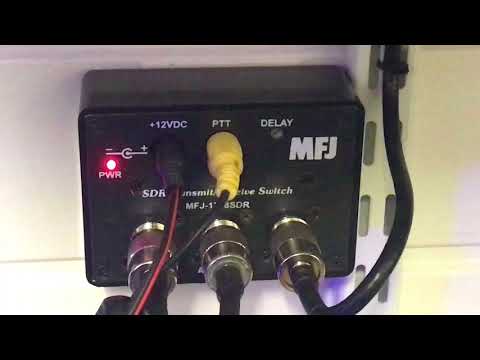
A few weeks ago we posted about the MFJ1708SDR automatic relay switch and how it can be used to combine an RX only SDR with a transmit capable radio. An automatic antenna relay switch is used to automatically ground the SDR's antenna input whenever the TX capable radio transmits in order to protect the SDR's front end from blowing up due to high TX power.
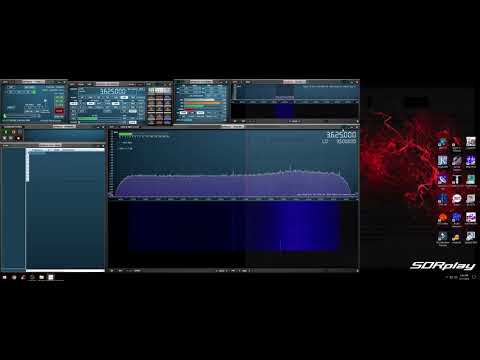
In this YouTube video Pete Sobye shows us the MFJ1708SDR working together with an Icom IC7300 HF radio and an SDRplay which is being used as a panadapter. For software Pete uses HDSDR and Omnirig which allows the PC to control the IC7300.
Icom IC7300 panadapter MFJ-1708SDR, SDRPlay, HDSDR and OmniRig
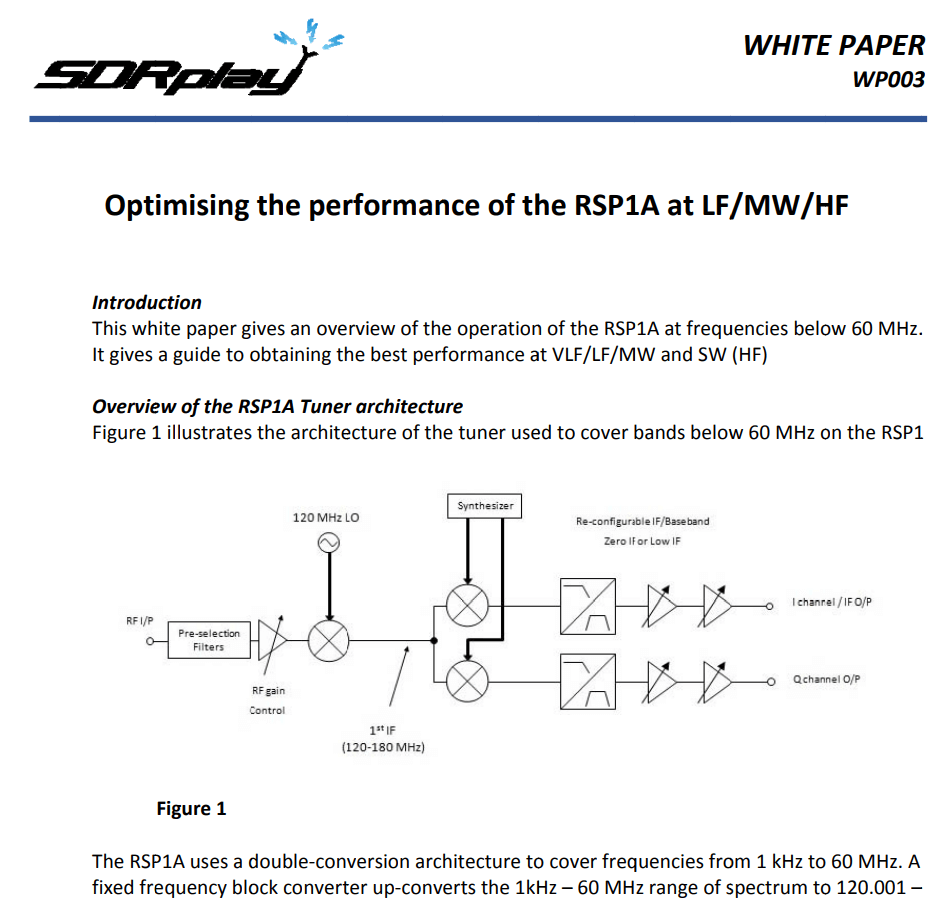
SDRplay have recently published an informative white paper that explains what intermodulation and higher order mixing effects are, and how they can affect reception on an SDR such as the SDRplay. This paper could be a useful introduction to understanding how to optimize reception of weak signals when they are in the presence of strong signals. While written for the SDRplay, the same knowledge and tips could be applied to any similar SDR.
Later in the paper they also show how to eliminate intermodulation effects by enabling the MW/AM notch filters on the SDRplay RSP1A unit, and by carefully choosing the LO frequency.
The RSP1A covers the spectrum from 1kHz to 2GHz, and phantom signals can be a menace for all wideband SDR receivers. More and more is being published about the most obvious culprit which is inter-modulation caused by very strong interferers such as MW/FM broadcast transmitters – indeed, all the current SDRplay RSPs have built in filters to help reduce the problems caused by that.
But the reality is, particularly at HF and below, that a phantom signal may occur for other reasons such as higher order mixing effects. Sometimes, it can be difficult to know what is the cause of the phantom signal. If you can understand the cause, there are additional steps you can take to overcome it.
We’ve just published this white paper to explain the difference between intermodulation and higher-order mixing effects, and what practical steps you can take to reduce the latter in particular. Our example uses an RSP1A operating at frequencies below 60MHz.
First pager of the SDRplay whitepaper on intermodulation effects.
Over on YouTube radio content creator Techminds has recently started a series that shows how to decode various signals using an SDR such as the SDRplay RSP1A. The first video explains what FT-8 is and shows how to decode it using the WSJT-X software. FT-8 is a modern digital HF ham mode that is designed to be receivable even in weak signal reception. However, the amount of information sent in a FT-8 message is small, so it is not possible to have a full conversation, and you can only make contacts.
In his second video Tech Minds explains RTTY and also shows how to decode it. RTTY is another much older mode that is used by the military as well as hams. To decode it he uses Digital Master 780 which is a program included in the Ham Radio Deluxe software.
Decoding FT-8 With WSJT-X And A SDRplay RSP1A SDR Receiver
Decoding RTTY With Digital Master And A SDRplay RSP1A SDR Receiver
Jon Hudson, head of marketing at SDRplay has recently released a helpful tutorial that shows how to access remote servers in SDR-Console V3, and also how to set up your own server too. As you may already know, SDR-Console V3 provides a remote server platform which allows you to access all sorts of SDR hardware remotely over a network connection or over the internet. Some SDR hardware owners even opt to share their radio hardware publicly over the internet for anyone to access. The video description reads:
This video is a screen-by-screen guide to both accessing, and setting up your own, remote SDR radio using the new (Feb 2018) SDR Console V3 software from SDR-Radio. Although the guide uses an RSP2 from SDRplay, this will work with all the popular SDRs
Please note - you need to have a good internet connection since (unlike in V2), the entire I/Q data is being sent over the internet. This also limits how much visual bandwidth you are can see at any one time.
SOME IMPORTANT WARNINGS IF YOU ARE ADDING YOUR OWN SDR! Be careful not to plug multiple SDRs into a single USB2 socket - for multiple SDRs, you may need a powered hub ( like this: https://www.amazon.co.uk/UGREEN-Adapt... )
Once you are up and running - please go to http://www.sdr-radio.com/Software/Ver... and view your listing - if there is a yellow triangle, then you are not accessible outside your own firewall - attention is needed! Just because you can access it on your own LAN doesn't mean it's accessible via the internet!!!
The RSP family of SDRs from SDRplay cover 1kHz to 2 GHz with no gaps and give up to 10MHz spectrum visibility.
Jon's video first shows how to use SDR-Console V3 to access those publicly shared SDR radios over the internet. The second part of the video demonstrates how to set up your own server that you can use remotely for personal use, or to share over the internet.
The SDR-Console V3 server accepts various kinds of SDR hardware including RTL-SDR, Airspy, SDRplay, HackRF, Elad, LimeSDR and many more SDR units so this is a good way to explore various types of hardware, or simply to explore signals from different areas around the world.
The official software package of the SDRplay range of products is SDRuno and it has recently been updated to version 1.22. SDRuno is also compatible with the RTL-SDR.
In addition to some UI improvements for new users, the main changes are pasted below. What's also very interesting is their road map which states that future versions of SDRuno will have frequency scanning capabilities, a remote network streaming server/client implementation and an API for the support of third party plugins. This would improve it's capabilities similar to that of SDR#.
Added • Support for 1366×768 default layout • ADC overload detection in AGC off mode • ADC overload acknowledgment system to avoid lockout condition • Custom step size for each mode • Band Button Groups (Ham Lower, Ham Upper, Broadcast) • Two additional SP1 width presets (2560 and 3840) • Additional menu option in memory panel to reset column widths (helps when upgrading) • Scheduled Recording • Auto update
Changed • Registry reset now only clears 1.2+ entries • SP1 Window max size supports 4K displays (3840×2160) • Small improvements to the memory panel (panel width and field width changes) • Improvements to the IF output mode • UTC time fixed to 24 hour format • Play!/Stop button colour coordinated • Move MUTE button to make way for VOLUME label • Moved Squelch value display to the right
Fixed • Log10 SING error • Aero support detection to try to prevent rendering issues • Freezing when switching to HiZ port in gain mode • Gain “pumping” issue when in gain mode • Settings panels not displaying properly when “un-minimised” • Zoomed in frequency scale drag out of bounds bug • Noise floor measurement bug • Improved RSP error handling • Sample rate change causing spectrum display issues • Device selection bug
Known Issues • SP2 CWAFC drift issue (Zoom/window size/freq display) – will be addressed in 1.23, workaround for now is to zoom out fully in the SP2 window and then the CWAFC feature will work. • IF output mode disabled SP1 spectrum mouse clicks – temporary issue until LO is separated from the VFO (see plans below)
Following on from the 1.21 release where we outlined the features for coming releases, we have updated our plans, as shown below. The purpose of publishing this information is to give people an insight to the development plans but it is NOT a guarantee of the exact feature line-up and we cannot give release dates.
1.23 Intermediate update • Recording of selected signal only (either I/Q or audio) to WAV file format • Selected signal piped to VAC in I/Q format
1.3 Major update • Separation of VFO and LO frequency control • Frequency scanning
1.31 Intermediate update • Remote client for network based streaming I/Q server applications
1.4 Major update • Addition of new API for third party plugins
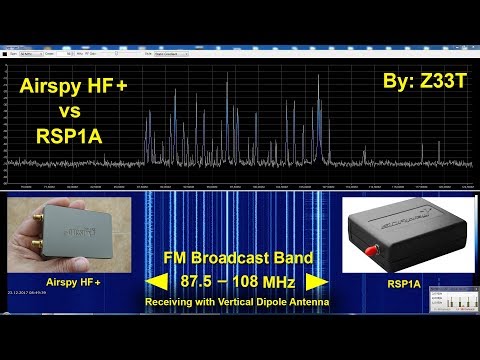
Frequent reviewer of SDR products Mile Kokotov has just uploaded on his YouTube channel a new video where he compares the Airspy HF+ against the SDRplay RSP1A on FM broadcast reception.
At first Mile compares the two against strong broadcast stations, and then later compares them on weak DX stations surrounded in amongst other strong stations. With the strong stations a difference between the two radios is impossible to detect. But with the weaker stations that are surrounded by strong signals the Airspy HF+ has the edge with it's higher dynamic range and sensitivity.
Mile writes:
In this video I am comparing two popular SDR-Receivers (Airspy HF+ and SDRplay RSP1A) on FM Broadcast Band.
I have made few recordings with every receiver with the same antenna trying to set the best SNR = signal-to-noise ratio.
My intention was to ensure the same conditions for both SDR`s in order to make as fair as possible comparison.
No DSP enhancing on the SDR`s was used.
Antenna was Vertical Dipole.
When receiving signals are strong enough, You should not expect the difference between most receivers to be very obvious!
If you compare one average transceiver (which cost about $ 1000 USD) and top class transceiver which cost ten times more, the difference in receiving average signals will be very small too. Almost negligible! But when you have difficult conditions, the very weak signal between many strong signals, than the better receiver will receive the weak signal readable enough, but cheaper receiver will not. Today it is not a problem to design and produce the sensitive receiver, but it is far more difficult to design and produce high dynamic receiver for reasonable price! The Airspy HF+ and RSP1A are very very good SDR-receivers. They have different customers target and have strong and weak sides. For examle Airspy HF+ has better dynamics in frequency range where it is designed for, but RSP1A, on the other hand, has broadband coverage...
Airspy HF+ vs SDRplay RSP1A Comparison on FM Broadcast Band
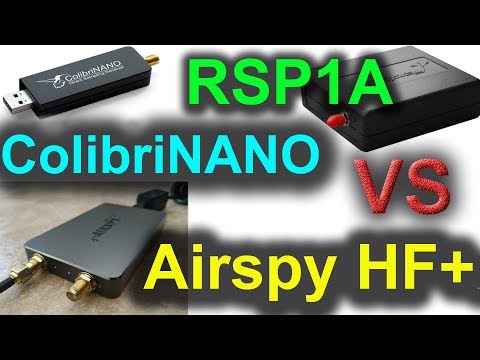
Over on his YouTube Channel Mile Kokotov has uploaded a video that compares three mid priced SDRs: the Airspy HF+, the SDRplay RSP1A and the ColibriNANO. Each SDR is compared on several ALPHA and NBD morse code stations which exist in his tests from between 14 kHz to 474 kHz. He writes:
In this video I am comparing three SDR-Receivers. I have made few recordings with every receiver with the same antenna and choose the best one (one with the best SNR = signal-to-noise ratio). My intention was to ensure the same conditions for all three SDR`s in order to make as fair as possible comparison. For example, I was set the frequency span displayed on the window to be as same as possible for all three receivers. The vertical axis for the signal stregth, was set to be equal (in decibels) too.Airspy HF+ and ColibriNANO was set to their minimum sample rate (48 kHz). RSP1A was set to minimum sample rate (2 MHz and 8 decimation).
No DSP enhancing on the SDR`s was used except APF (Audio peak filter) on ColibriNANO (I forgot to swith off).
The differences between each receiver as very difficult to detect as only really challenging signal conditions will really set them apart. Mile also added in a comment:
You should not expect the difference to be very obvious! If you compare one average transceiver (which cost about $ 1000 USD) and top class transceiver which cost ten times more, the difference in the receiving the average signals will be very small too. Almost negligible! But when you have difficult conditions, the very weak signal between many strong signals, than the better receiver will receive the weak signal readable enough, but cheaper receiver will not. Today it is not a problem to design and produce the sensitive receiver, but it is very difficult to design and produce high dynamic receiver for reasonable price! The Airspy HF+ and RSP1A are very very good SDR-receivers. They have different customers target and have strong and weak sides. For example Airspy HF+ has better dynamics in frequency range where it is designed for, but RSP1A, on the other hand, has broadband coverage...
Over on the SDRplay forums there has been a post by a NOAA engineer showing how they are using SDRplay RSP2 units in the field for tracking their radiosonde weather balloons. A radiosonde is a small sensor package and transmitter that is carried high into the atmosphere by a weather balloon. It gathers weather data whilst transmitting the data live back down to a base stations. You can get data such as temperature, pressure, humidity, altitude and GPS location.
Bobasaurus' coworker launching a weather balloon.
The NOAA engineer on the forum (handle 'bobasaurus') wrote SkySonde, which is the software used by NOAA to decode and plot data from the radiosondes. SkySonde is freely available for public download on the NOAA website. A PDF file showing how to use the SkySonde software with an RSP2 or RTL-SDR can be found here, and the full SkySonde manual is available here. The software consists of a client and server, with the server connecting to the RSP2 or RTL-SDR, and then sending data to the client. Both server and client can run on the same PC.
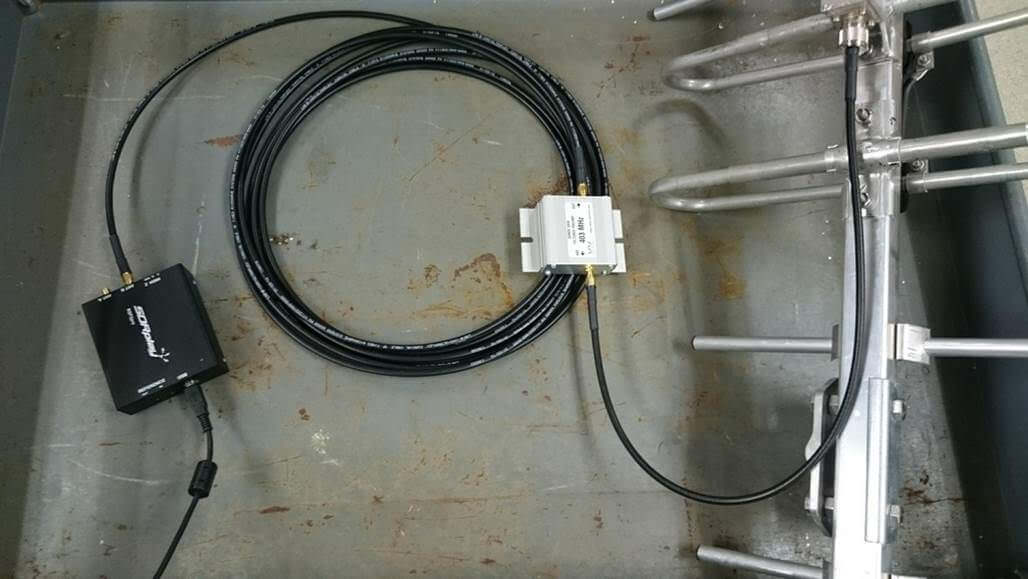
The hardware setup consists of an RSP2 (can be interchanged with an RTL-SDR), an Uputronics Radiosonde Filtered preamp and a Yagi antenna. Presumably a Yagi and LNA is not completely required, although the receivable range will be less. The RSP2 bias tee is used to power the preamp, and on a V3 RTL-SDR the bias tee should also work.
NOAA appears to use the iMet brand of radiosondes which transmit a Bell 202 signal. Bobasaurus writes that they transmit in the 401-405 MHz range. This video shows an example of such a signal. If you are in the US near an area that launches these iMet weather balloons you should be able to receive them. An alternative piece of software that supports iMet radiosondes is RS. For other radiosondes we have a tutorial that uses SondeMonitor available here.