Recently the Outernet project transitioned from using RTL-SDR dongles and C.H.I.P single board computers to using their Dreamcatcher board, which is an RTL-SDR and computing board all in one. In between the transition they also produced a number of ‘SDRx’ dongles. These were custom RTL-SDR dongles with a built in L-band LNA and filter. As they no longer need the SDRx they have them on clearance at their store.
The clearance price is $15 USD which is an excellent deal. Remember though, that the SDRx is limited in frequency range – it is designed for receiving L-band satellites between 1525 – 1559 MHz and the filter will cut off all other frequencies.
The Outernet SDRx on Clearance
Just add a simple L-band tuned antenna to the port and you should be able to receive Inmarsat and a signal like STD-C, AERO or the Outernet signal. A suitable antenna might be a homebrew patch, helix, cooking pot antenna or even a small tuned V-dipole antenna can work for the stronger AERO signals.
We also see that the price of their L-band Outernet active ceramic patch antenna has been dropped down slightly to $25 USD. This antenna is bias tee powered and can be used with a V3 dongle or their Dreamcatcher hardware. The Dreamcatcher itself is also now reduced in price to $59 USD.
We have a review of the Dreamcatcher and active ceramic patch antenna available here.
Outernet Dreamcatcher and L-Band Active Ceramic Patch
We also now list Outernet products in our store. These are commission sales so we receive a little bit per purchase which supports the blog, and the items are shipped by Outernet within the USA.
If you were unaware, Outernet is a free L-band based satellite service that provides content such as news, weather data, APRS repeats and more. Currently you can get about 20MB of data a day. Outernet receivers are also all based around the RTL-SDR, allowing for very cheap receivers to be built
Voice inversion scrambling is a simple and old security method used on analog radios to try and obscure conversations from being listened in on by people with scanners. It works simply by by moving the low frequencies higher and the high frequencies lower, or in other words inverting the audio. A descrambler is then required to recover the true audio, otherwise you will only hear garbled audio. Voice inversion provides little real security, as it is very simply to descramble, and many scanner radios already have descrambling features built in. These days most secure communications are digital and encrypted, but voice inversion scrambling is still available on many analog radios, and could still be in use by some users looking for protection against casual eavesdroppers.
Oona Räisänen (aka windytan) has recently released a simple program called ‘deinvert’ over on GitHub. This program is a descrambler that reads in a scrambled wav file and outputs a descrambled audio file. The audio file could be easily recorded with an RTL-SDR and rtl_fm, or a similar SDR.
Over on his YouTube channel GusGorman402 has uploaded a video that shows how he was able to capture and decode data from a USGS (United States Geological Service) streamgage.
A streamgage is a sensor for streams and rivers that is used for measuring the amount of water flowing. In particular the ALERT (Automated Local Evaluation in Real-Time) streamgages are designed for the warning of flooding. The ALERT streamgages are wireless with some transmitting data upwards to the GOES-15 geosynchronous satellite with a cross Yagi and some transmitting locally via a standard Yagi. Gus shows if you’re close to a streamgage antenna then you can still receive the signal on the ground with an RTL-SDR. Gus also mentions that all streamgages in his area are slowly being converted to satellite uplink.
His first video simply shows the RTL-SDR receiving a Streamgage satellite uplink signal at 400 MHz. In his second video he moves to a streamgage with terrestrial link at 170 MHz and shows that the data can actually be decoded into a binary string using minimodem. Another program called udfc-node can then be used to turn the data into a human readable format. The binary packets consist of an address that identifies the particular streamgage, and some data that describes the current level of the stream and how much precipitation it has counted.
Over on YouTube channel Bootstrap Workbench has been running a series on using an RTL-SDR and noise source to create a poor man’s spectrum analyzer. So far he has three videos available. The first shows how to install and setup Spektrum, his preferred Windows based wideband scanner for the RTL-SDR.
The second video shows how the RTL-SDR, noise source and Spektrum can be used to tune a cavity duplexer. A cavity duplexer is an adjustable set of filters that allows you to use a single antenna for TX and RX at different frequencies. It can be tuned by adjusting screws on the unit body.
In the third video he shows how to examine the response of a dual ferrite isolator/circulator which is a device that can be used to ensure RF only travels in one direction. This could be use for example to prevent damage to a TX power amplifier from reflected signals due to high VSWR or other nearby powerful signals.
Poor Man's Spectrum Analyzer - Installing Spektrum and Testing an RTL-SDR com 88-108 Bandstop Filter
Salamandra is a tool to detect and locate spy microphones in closed environments. It find microphones based on the strength of the signal sent by the microphone and the amount of noise and overlapped frequencies. Based on the generated noise it can estimate how close or far away you are from the mic.
Salamandra can either be used in live mode, or can use data recorded from rtl_power. It seems that the software simply attempts to detect peaks in the spectrum that look like analog audio, and print out their frequencies.
We’ve also seen this somewhat related piece of software called rtlsdr-wwb-scanner which can be used with an RTL-SDR to scan for microphones as well. However, this software is mostly intended to be used with the Shure Wireless Workbench which is a professional program for managing multiple microphones used in conferences, theatre performance, concerts etc.
Bitcoin is the worlds first and most popular digital currency. It is steadily gaining in value and popularity and is already accepted in many online stores as a payment method. In order to use Bitcoin you first need to download a large database file called a ‘blockchain’, which is currently at about 152 GB in size (size data obtained here). The blockchain is essentially a public ledger of every single Bitcoin transaction that has ever been made. The Bitcoin software that you install initially downloads the entire blockchain and then constantly downloads updates to the blockchain, allowing you to see and receive new payments.
Blockstream is a digital currency technology innovator who have recently announced their “Blockstream satellite” service. The purpose of the satellite is to broadcast the Bitcoin blockchain to everyone in the world via satellite RF signals, so that even in areas without an internet connection the blockchain can be received. Also, one problem with Bitcoin is that in the course of a month the software can download over 8.7 GB of new blockchain data, and there is also the initial 152 GB download (although apparently at the moment only new blocks are transmitted). The satellite download service appears to be free, so people with heavily metered or slow connections (e.g. 3G mobile which is the most common internet connection in the third world/rural) can benefit from this service as well.
The service appears to be somewhat similar to the first iteration of the Outernet project in that data is broadcast down to earth from satellites and an R820T RTL-SDR is used to receive it. The blockstream satellite uses signals in the Ku band which is between 11.7 to 12.7 GHz. An LNB is required to bring those frequencies back down into a range receivable by the RTL-SDR, and a dish antenna is required as well. They recommend a dish size of at least 45 cm in diameter. The signal is broadcast from already existing satellites (like Outernet they are renting bandwidth on existing satellites) and already 2/3 of the earth is covered. The software is based on a GNU Radio program, and can be modified to support any SDR that is compatible with GNU Radio. They write that the whole setup should cost less that $100 USD to purchase and set up.
To set it up you just need to mount your satellite antenna and point it towards the satellite broadcasting the signal in your area, connect up your LNB and RTL-SDR and then run the software on your PC that has GNU Radio installed.
More details can be found on the Blockstream Satellite website, and technical details about the software and hardware required can be found on their GitHub page.
How the Blockchain satellite works (From blockstream.com/satellite/howitworks/)
Some may wonder what’s the point if you can’t transmit to the service to make payments with it. Over on this Bitcoin Reddit thread user “ideit” explains why it’s still useful in this nice quote.
You sell goats in a small village. A customer wants to buy a goat, but you have no banks so people have put their money into bitcoin. Your customer goes to the village center which has a few computers hooked up to the internet. He sends you payment then comes to get his goat. You don’t have internet near your goat farm, but you’re connected to the satellite so you can see he sent you payment and you give him his goat.
Or, you live in an area that caps your bandwidth. You want to run a full node, but downloading blocks eats away at your cap. Connecting to a satellite reduces your bandwidth usage.
Or, you’re using an air gapped laptop to sign transactions from your wallet for security reasons. You can now connect that laptop to the satellites so your laptop can generate its own transactions without connecting to the internet.
Or, your internet connection is terrible. You can usually broadcast transactions since they’re small, but downloading blocks and staying in sync with the blockchain is literally impossible. Connect to a satellite and now it’s simple.
Manuel a.k.a ‘Tysonpower’ has been using his RTL-SDR (and his Baofeng) to listen in on ARISS contacts from the International Space Station (ISS). ARISS stands for Amateur Radio on the ISS, and is a program often used by schools to allow students to contact and ask questions to astronauts on the ISS with a ham radio. It is possible for anyone to listen in on the downlink (astronaut speech) if the ISS is over your location while transmitting. The uplink however may not be able to be heard as the signal is directed upwards towards the station.
For his first try he used a Baofeng (cheap Chinese handheld) and a DIY Carbon Yagi. For the second contact he used his RTL-SDR V3, an FM Trap and an LNA4ALL on a V-Dipole antenna placed on the roof of his car. With this set up he was able to receive the downlink transmissions from 1.6 degrees to 1.3 degrees elevation.
Paolo Nespoli ARISS Kontakt mit VCP-Bundeszeltplatz - 1. August 2017
Paolo Nespoli ARISS Kontakt mit FOFM / Moon Day - 5. August 2017
Lightning produces fairly wideband bursts of RF energy, especially down in the VLF to HF frequencies. Detecting these bursts with custom radio hardware is how lightning detection websites such as blitzortung.org work.
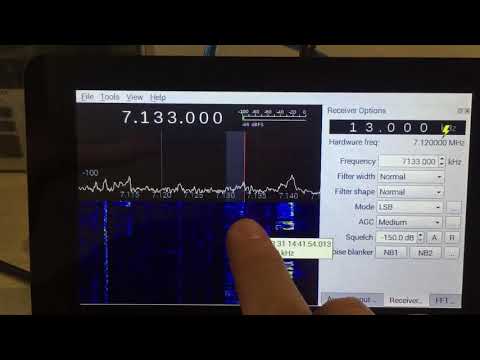
It is also possible to detect lightning using an RTL-SDR that can tune to to HF and lower, such as the RTL-SDR V3, or an RTL-SDR with an upconverter. Over on his blog Kenn Ranous (KA0SBL) has uploaded a short post showing what lightning bursts look like on an RTL-SDR waterfall. He uses an RTL-SDR V3 to tune down to the LF – MW frequency bands and looks for wideband pulses of noise which indicate lightning.
It would be interesting to see if this type of detection could be automated with DSP so that a similar service to Blitzortung.org could be created.