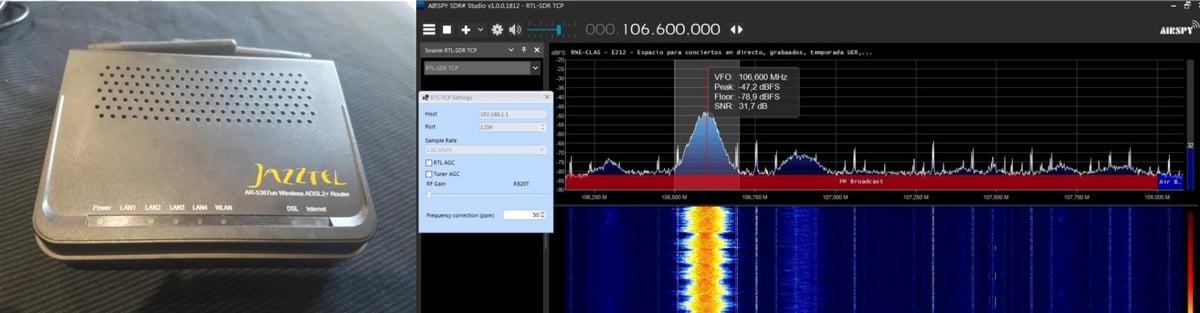
Thank you to Viol Tailor for submitting news about the release of his general purpose multimode software defined radio receiver program for Windows called "uSDR" or "microSDR". Viol writes that uSDR is designed as a lightweight binary with a simple and compact user interface and highly optimized DSP to minimize CPU, hence the "micro" part of the name.
The software is compatible with RTL-SDR, Airspy, BladeRF, HackRF and LimeSDR radios. It has features including demodulation, base band and pass band recording, playback, and spectrum and waterfall visualizations.
uSDR aka microSDR. A lightweight SDR receiver program from Windows.
Thank you to Jasper for writing in and letting us know about the release of his new open source software called "AIS-Catcher". AIS-Catcher is a MIT licensed dual band AIS receiver for Linux, Windows and Raspberry Pi. It is compatible with RTL-SDR dongles and the Airspy HF+.
AIS stands for Automatic Identification System and is used by marine vessels to broadcast their GPS locations in order to help avoid collisions and aide with rescues. An RTL-SDR with the right software can be used to receive and decode these signals, and plot ship positions on a map.
Jasper notes that his software was intended to be a platform for him to experiment with different receiving model algorithms. On the GitHub readme he explains how he's experimented with a coherent demodulation model that estimates the phase offset, a non-coherent model which is similar to what most existing decoders use, a modified non-coherent model with aggressive PLL, and an FM discriminator model which assumes the input is the output of an FM discriminator.
The readme goes on to show some comparison results indicating that the coherent model is the best although it uses 20% more computation time. He also compares AIS-Catcher against some other AIS decoders like AISRec and rtl-ais, showing that AIS-Catcher appears to be comparable or better than AISRec, which is one of the most sensitive decoders available for SDR dongles.
A Windows binary is provided on the releases page and compilation instructions for Linux are provided on the Github Readme.
Some results from AIS-Catcher. Different algorithms and different software compared.
We recently came across the LibreCellular project which is aiming to make it easy to implement 4G cellular networks with open source software and low cost SDRs. The project appears to be in the early stages, and seems to be focusing on deploying and modifying existing open source 4G basestation software known as srsRAN which will be used with a particular combination of hardware in order to create a reliable and easy to set up 4G basestation solution.
The reference hardware that they are recommending consists of an Intel NUC single board computer ($699), LimeSDR ($315), LimeRFE front end filtered power amplifier ($699), and Leo Bodnar Mini Precision GPS Reference Clock ($140). All together you can create a 4G basestation for around $1850.
LibreCellular Components for a 4G Basestation: LimeRFE, Leo Bodnar GPS Clock, LimeSDR, Intel NUC.
Over on Reddit we've seen that SDR4Space, a provider of a satellite ground station receiver hardware and software has released a free feature limited lite version of their embedded software over on their GitHub page. In the Reddit comments the software is explained as follows:
It's a command-line tool using scripts, for SDR users. You can write your own scripts to: record IQ samples, predict satellite passes, start a record for a specific satellite and correct doppler at the same time.
It's also useful to record narrow subband IQ streams ( example: 48kHz wide instead of 2.048 MHz on rtlsdr, a single signal on HF is only few kHz wide).
You can work on IQ files: cut, resample, merge, convert formats and so on.
Having said that you can recognize features from predict, rx_sdr/rtl_sdr ,rtl_power/rx_power.
Regarding installation, a Debian package is provided, installing application and some examples in /opt/vmbase directory. Most of dependencies are installed by the package. But you should install SoapySDR and Soapy drivers for your SDR device first by yourself if not yet done !
To understand how it works, the best is perhaps starting download TLE and print a passes list, using scripts in ./sat/ directory.
For the next SSTV event I'd try to run unattended reception of ISS (from ./sat/sat_receiver directory).
From the examples, it appears that you can script a fully automated doppler corrected satellite signal receiver with the SDR interface connecting through Soapy, and all the DSP handled by the SDR4lite library.
In the latest episode of his YouTube series on Aviation monitoring Rob explores how to decode L-band satellite ACARS (Aircraft Communication Addressing and Reporting System) and CPDLC (Controller Pilot Data Link Communications) messages using JAERO, an SDR like an RTL-SDR, and a appropriate L-band antenna such as our RTL-SDR Blog Active L-Band Patch (currently out of stock).
In the video Rob shows examples of what you might receive such as CPDLC ATC instructions, digital ATIS information, arrival information and suggested landing data configuration instructions. He goes on to show satellite coverage maps, what hardware is required to receive these signals, and finally how to setup the receiving and decoding software.
How To Decode L band Satellite ACARS and CPDLC messages with JAERO and your SDR
If you weren't already aware KerberosSDR is our 4-channel phase coherent capable RTL-SDR unit that we previously crowdfunded back in 2018. With a 4-channel phase coherent RTL-SDR interesting applications like radio direction finding (RDF), passive radar and beam forming become possible. It can also be used as four separate RTL-SDRs for multichannel monitoring.
KerberosSDR is soon to be replaced with the upgraded KrakenSDR, which will begin crowd funding on Crowd Supply later this year. Please note that we have had some pandemic related delays finalizing the design, but progress is being made.
Recently we came across a brief demonstration video on YouTube where it appears that students have embedded a KerberosSDR into an RC boat. The boat carries four direction finding antennas connected to the KerberosSDR and autonomously navigates towards a signal source.
Over on Reddit Ian Grody (u/DutchOfBurdock) has posted about his success in using a modded Android smartphone to run an RTL-SDR Blog V3 and NOAA decoder software all within the phone itself.
In the past we posted about Ian's work in getting rtl_power scans to work in conjunction with the Tasker app, in order to generate automated frequency scans on his phone on the go. His more recent work from the past year includes showing us how it's possible to install Debian chroot on an Android phone, and run Linux software like GQRX, GNU Radio, DSD, rtl_433, multimon-ng and dump1090 directly on the phone with an RTL-SDR.
His latest Reddit post shows that the NOAA-APT decoder also runs well on the Debian chroot, leading to a truly portable NOAA decoding setup. He notes that he is now working on the possibility of Meteor M2 decoding on the phone.
Below is his video from last year demonstrating SDR GQRX and GNU Radio running on the Debain chrooted phone.
Back in April we posted about "Hash's" RECESSIM YouTube series on hacking electricity smart meters using a software defined radio. Recently his series continues with a video on decoding and logging the GPS coordinates sent by the smart meters used in his area. Using a car, SDR and laptop he was able to drive down the freeway collecting smart meter data as he travelled, decode the data, and plot it on a map. In his video Hash explains why there is GPS data in the signal, and how he was able to reverse engineer and determine the GPS data.