Category: Digital Signals

OpenWebRX Updated to V1.1.0

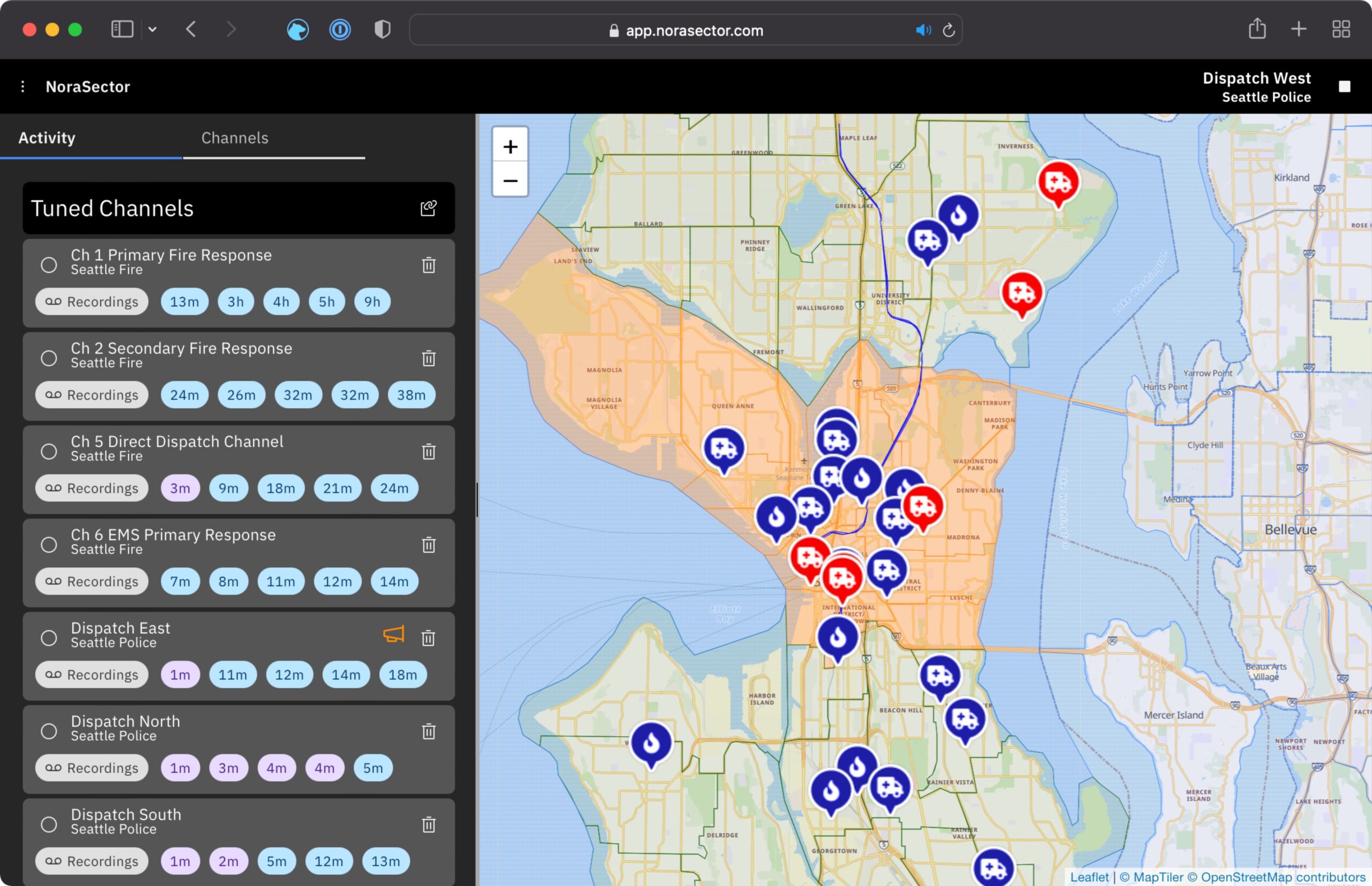
Thank you to Jason for writing in and letting us know that OpenWebRX Version 1.1.0 has been released on August 03. OpenWebRX is an open source program that allows users to make RTL-SDRs, KiwiSDRs and other SDRs accessible over the internet via a web browser. It is is currently available as a Raspberry Pi SD card image, in the Debian + Ubuntu repositories, as a docker image, or for manual installation. 

The latest version adds an AMBE voice data decoder, new decoders and metadata displays for NXDN and D-Star, and crisper SVG graphics.

Since we last posted about OpenWebRX updates in early 2020, there has also been support added for the Perseus-SDR, RadioBerry 2, Hermes HPSDR, Funcube Dongle Pro+ software defined radios. New decoders and support for external decoders such as JS8Call, FreeDV, Wideband FM, DREAM DRM,  FST4, FST4W, Q65 and M17 digital voice have been added.

There is also now a site called Receiverbook.de that aggregates a list of publicly available OpenWebRX receivers.

OpenWebRX Interface

Decoding HFDL ACARS with a WebSDR and PC-HFDL

In the previous episode Rob from the Frugal Radio YouTube channel showed us how to decode HF ACARS using PC-HFDL and an HF capable SDR such as the Airspy HF+. In that episode he mentioned that it is possible to decode HF ACARS using a WebSDR as well.

In this weeks episode, Rob shows us how to do just that, making use of WebSDR receivers and the PC-HFDL software. Like the previous episode we see how to plot the aircraft HF ACARS position data on Google Earth and how to read and interpret some example messages received.

Decoding HFDL ACARS with a WebSDR and PC-HFDL

Using an RTL-SDR Dongle to Receive Pictures from the ISS

Over on YouTube we've seen a good video from channel Ham Radio DX where presenter Hayden shows how to use an RTL-SDR to receive slow scan television (SSTV) images from the International Space Station (ISS). Often the ISS will transmit SSTV images down to earth on the VHF 2 meter bands as part of an event. With an RTL-SDR and simple antenna it's possible to receive those images.

In the video Hayden discusses the SSTV transmission, and demonstrates some SSTV decoding happening in real time as the ISS passes over his location. If you're looking to get started in ISS SSTV reception, this is a good video to get an idea of what's involved. He finishes the video with some useful tips for reception.

Using a RTL SDR Dongle to receive pictures from the ISS! | Software Defined Radio

AIS-Catcher: A Dual Band Multiplatform AIS Receiver for RTL-SDR and Airspy HF+ with Multiple Decoding Models

Thank you to Jasper for writing in and letting us know about the release of his new open source software called "AIS-Catcher". AIS-Catcher is a MIT licensed dual band AIS receiver for Linux, Windows and Raspberry Pi. It is compatible with RTL-SDR dongles and the Airspy HF+.

AIS stands for Automatic Identification System and is used by marine vessels to broadcast their GPS locations in order to help avoid collisions and aide with rescues. An RTL-SDR with the right software can be used to receive and decode these signals, and plot ship positions on a map.

Jasper notes that his software was intended to be a platform for him to experiment with different receiving model algorithms. On the GitHub readme he explains how he's experimented with a coherent demodulation model that estimates the phase offset, a non-coherent model which is similar to what most existing decoders use, a modified non-coherent model with aggressive PLL, and an FM discriminator model which assumes the input is the output of an FM discriminator.

The readme goes on to show some comparison results indicating that the coherent model is the best although it uses 20% more computation time. He also compares AIS-Catcher against some other AIS decoders like AISRec and rtl-ais, showing that AIS-Catcher appears to be comparable or better than AISRec, which is one of the most sensitive decoders available for SDR dongles.

A Windows binary is provided on the releases page and compilation instructions for Linux are provided on the Github Readme.

Some results from AIS-Catcher. Different algorithms and different software compared.

LibreCellular: Easy 4G Cellular Network with LimeSDR and Intel NUC

We recently came across the LibreCellular project which is aiming to make it easy to implement 4G cellular networks with open source software and low cost SDRs. The project appears to be in the early stages, and seems to be focusing on deploying and modifying existing open source 4G basestation software known as srsRAN which will be used with a particular combination of hardware in order to create a reliable and easy to set up 4G basestation solution.

The reference hardware that they are recommending consists of an Intel NUC single board computer ($699), LimeSDR ($315), LimeRFE front end filtered power amplifier ($699), and Leo Bodnar Mini Precision GPS Reference Clock ($140). All together you can create a 4G basestation for around $1850.

LibreCellular Components for a 4G Basestation: LimeRFE, Leo Bodnar GPS Clock, LimeSDR, Intel NUC.

Decoding and Logging GPS Coordinates From Wireless Smart Meters

Back in April we posted about "Hash's" RECESSIM YouTube series on hacking electricity smart meters using a software defined radio. Recently his series continues with a video on decoding and logging the GPS coordinates sent by the smart meters used in his area. Using a car, SDR and laptop he was able to drive down the freeway collecting smart meter data as he travelled, decode the data, and plot it on a map. In his video Hash explains why there is GPS data in the signal, and how he was able to reverse engineer and determine the GPS data.

Smart Meter Hacking - Decoding GPS Coordinates

European GNU Radio Days: Presentation on gr-rpitx

J.-M Friedt has created a block for GNU Radio called gr-rpitx which allows a Raspberry Pi to be used directly as an output RF sink in GNU Radio. If you were unaware, RPiTX is software that allows you to turn your Raspberry Pi into a transmit capable SDR without any additional hardware apart from a wire antenna connected to a GPIO pin. It works by modulating a GPIO pin in a way to generate any arbitrary signal modulation. gr-rpitx allows this software to be used directly within GNU Radio.

In his presentation uploaded early for the upcoming online European GNU Radio Days conference, J.-M Friedt explains how gr-rpitx works, and shows how you can easily connect any flowgraph to the gr-rpitx output sink. His examples demonstrate retransmitting broadcast FM using an RTL-SDR, broadcasting digital signals like DRM, and how gr-rpitx and RTL-SDR could be used as part of a basic scalar network analyzer.

gr-rpitx uses the GPIO4 output of the Raspberry Pi to generate a radiofrequency stream fed by a GNU Radio signal processing flowchart with sample rates up to 400 kS/s.

European GNU Radio Days/SDRA presentation about gr-rpitx (J.-M Friedt)

Exploring 433 MHz Devices in the Neighborhood with RTL-SDR and rtl_433

Over on his YouTube channel CWNE88 has posted how he has been using and RTL-SDR with the rtl_433 software to explore the data coming in from various 433 MHz ISM band devices in his neighborhood. In the video he explains how he has set up rtl_433 on his Raspberry Pi, and what sort of data he is receiving. Some examples of devices he's received include various weather stations, doorbells, remotes and car tyre pressure monitors.

He also mentions how these signals are unencrypted, noting that in a future video he will show on GNU Radio how a false signal could be synthesized.

Decoding 433 MHz Devices With SDR