Hacking a PlayStation 3 using an RTL-SDR
There is a war going on between game console designers and the console modding community. Modders hack the console system so that they can jailbreak it and then install their own custom firmware while console designers are constantly finding new ways to prevent unauthorized modding. Custom firmware allows a console to run homebrew applications like media players and emulators that use the console in ways that is was not intended to be used in. One PlayStation 3 modder has recently been using an RTL-SDR to help jailbreak a PlayStation 3 Super Slim (4K) console, whose current official firmware appears to not yet have been jailbroken. It’s important to note that so far no actual jailbreaking has been done with this method, but the modder is currently working on it. His idea is to receive leaked RF signals from the PS3 and then use methods similar to Acoustic Cryptoanalysis to decode the data and find out what opcode operations the processors are performing. The modder writes about his method in the following.
My idea was to hook up a rtl-sdr device to the PS3 4k between chassis and real ground (yes, I actually have a two meter copper rod buried in my lawn) using the antenna leads. First I had to make sure the PS3 4k chassis wasn’t grounded in the outlet, and that no video out or USB connector was hooked up to ground indirectly via other hardware. If you want to try this, make sure that the rtl-sdr antenna leads are the only lead between the PS3 mobo/chassis and real ground. Before connecting the rtl-sdr antenna leads I measured the voltage on the PS3 chassis which peaked at around 1.8V which was safe enough, didn’t want to blow it up on the first try.
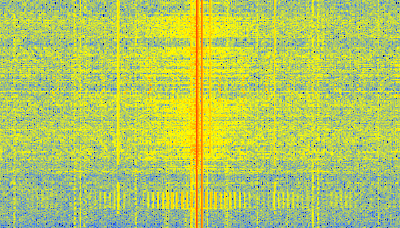
This method will effectively turn your console into an “active antenna” leaking all kind of interesting data on the rtl-sdr frequency spectrum (between 24 – 1766 MHz). After hooking it up, I started using gqrx on my laptop to look for signal peaks while the PS3 4k was turned on, after finding a peak I just powered off the PS3 completely and turned it back on, using the waterfall plot you’ve seen in my first post I can see if there is something interesting happening during boot and verify that the signal is indeed coming from the PS3. In a similar way I learned to distinguish between the PS3 BD drive, GPU and CPU which pops up at different frequencies. Then I dumped the data (I/Q recording) that looked interesting and made a note of the frequency. It’s hard to describe the incredible feeling when you tune into a good signal and start watching the waterfall plot revealing opcodes, register bits and what might be stack contents. The Acoustic Cryptoanalysis paper (PDF) has a lot of good info how to interpret the output from various window functions in the plot. What I’m coding right now is a gnuradio-companion block which will filter and test the dumped data for decryption keys against encrypted PS3 data.