Over on YouTube user kpappa has uploaded a video showing his reception of the J43VHF radio amateur stratosphere balloon with an RTL-SDR dongle and discone antenna. On the 10th of May radio amateurs in Greece launched a high altitude balloon. The balloon carried a transceiver payload which allowed amateurs to talk to each other via the balloon at a frequency of 144.200 MHz. The video shows good reception of the balloon and also shows it’s tracking via APRS.fi.
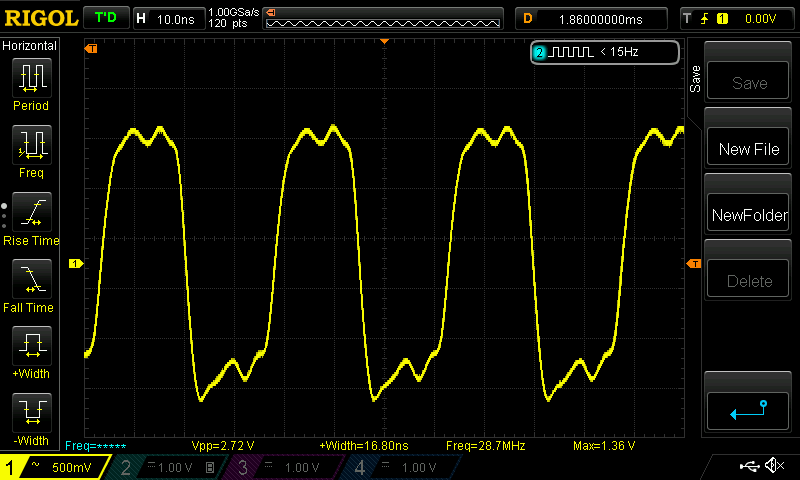
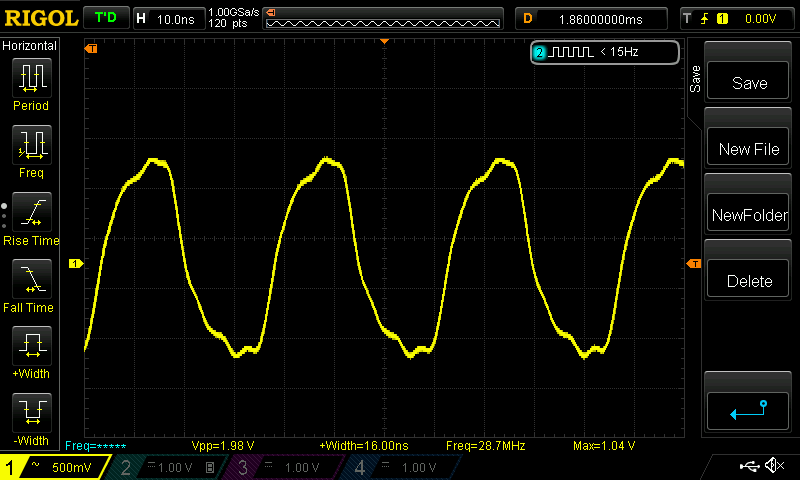
Now in order to reduce the number of spurious signals produced at multiples of 28.8 MHz by the external local oscillator, Milan has added a simple low pass filter to the oscillator output. He used a 3-pole Butterworth filter with a 30 MHz cut off point. This filter acts to the convert the Si535A’s square wave output into a sine wave, which should help reduce the number of spurious signals produced.
Square wave before filtering.Closer to a sine wave after filtering.
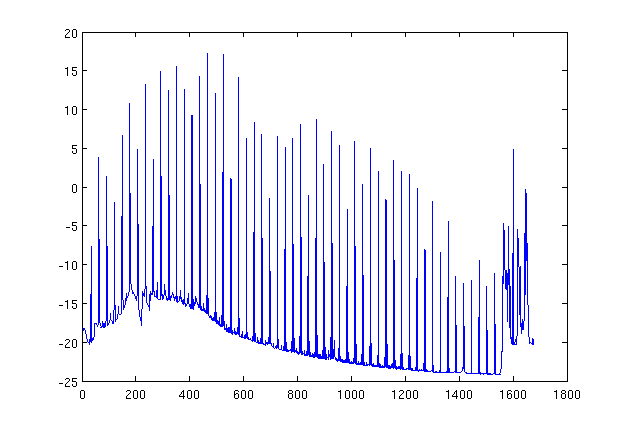
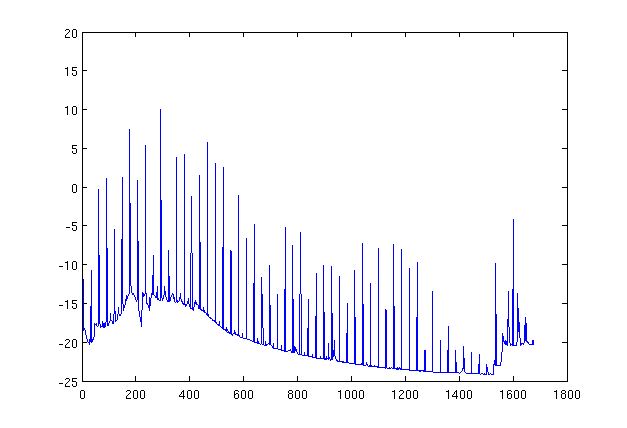
Milan tested his filtering by creating a wideband comparison sweep with rtl_power. With the low pass oscillator inserted, the spurious signals were clearly reduced a significant amount. Then by reducing the drive level from 8mA to 2mA, the spurious signals were reduced even more. By using a filter with more poles it’s possible that the spurious signals could be reduced even further.
Spurious signals with no low pass filter added.Spurious signals are reduced after adding the low pass filter.
With the recent release of ADSBSpy, an ADS-B decoder for the Airspy software defined radio, many people have been wondering how much better the Airspy is compared to the low cost RTL-SDR dongle at ADS-B reception. Over on his blog, Anthony Stirk has performed a test comparing an E4000 RTL-SDR with the Airspy.
In his test Anthony uses an A3 ADS-B antenna from Jetvision.de, and a HABAMP which is an LNA plus 1090 MHZ SAW filter. To create a fair test he used an antenna splitter and measured the reception of both dongles at the same time. He ran one instance of ADSB# for the E4000 RTL-SDR, and one instance of ADSBSpy for the Airspy over 24 hours and recorded the results.
Airspy vs E4000 RTL-SDR
The results showed that the Airspy had approximately 50 km more range compared to the E4000 in some areas. More interestingly the stats showed that the Airspy received approximately 7 million more ADS-B messages compared to the RTL-SDR.
While there is no doubt the Airspy will perform better, one thing to note about this test is that it used an E4000 RTL-SDR which is widely considered to have inferior performance at the 1090 MHz ADS-B frequency when compared to the R820T/2 dongles.
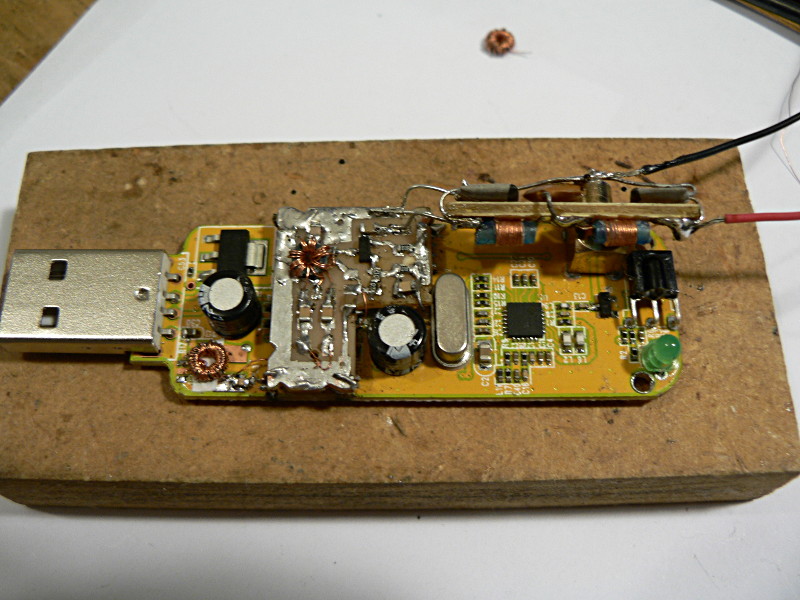
Over on the Reddit RTL-SDR discussion board user pksato has posted an image of his direct sampling modified RTL-SDR dongle. His mod includes a simple common base amplifier with 9dB gain, an impedance transformer with calculated output impedance of 50 Ohms and a 5V power filter.
The direct sampling mod allows you to modify your RTL-SDR to receive HF frequencies, without the need for an upconverter. It requires a hardware mod that can be as simple as soldering a wire to one of the RTL2832U pins, but for improved results you will need filters, impedance transformers and amplifiers. There is more information about direct sampling here.
More information and images about pskato’s mod can be found on the Reddit thread.
We also note that amateur radio hobbyist KN0CK (aka Marty Wittrock) sells direct sampling modified dongles that are modified in a similar way to pskato’s mod (circuit placed on top of the RTL-SDR PCB). His products can be found at http://www.kn0ck.com/HF_SDR/.
Direct Sampling Modified RTL-SDR.Direct sampling mod with amplifier circuit schematic by pskato.
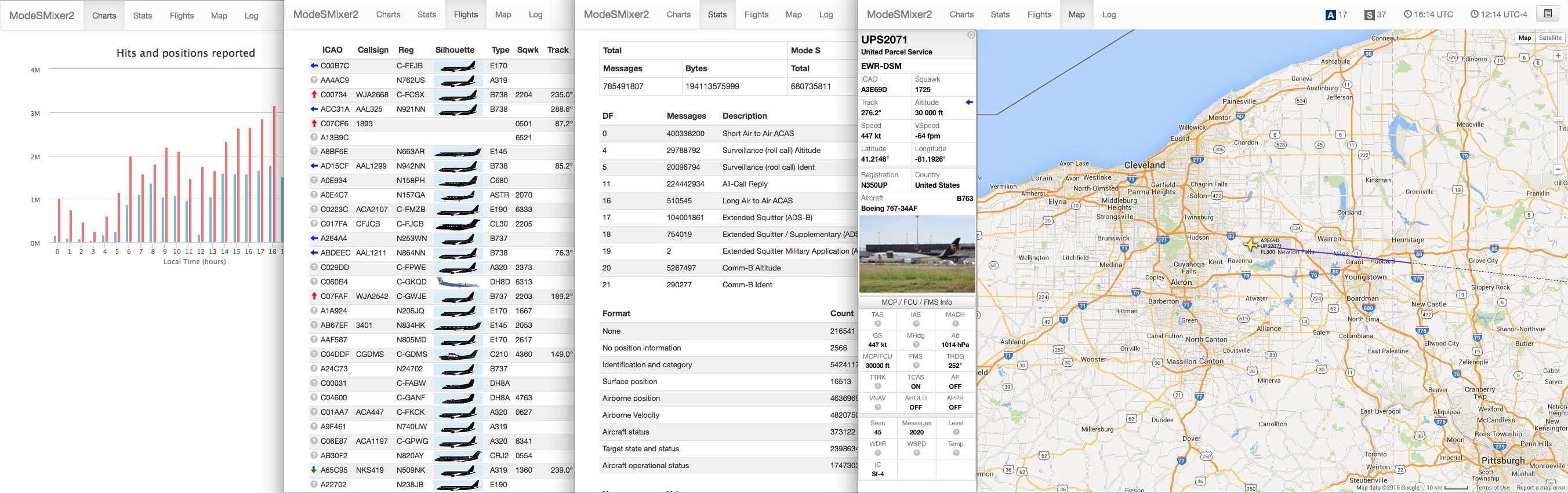
The author’s tutorial goes over setting up ModeSDeco2 to broadcast data over the network, setting up ModeSMixer2 to receive data, and also setting up the basestation.sqb file to add airline logos and silhouettes to the web based GUI of ModeSMixer2.
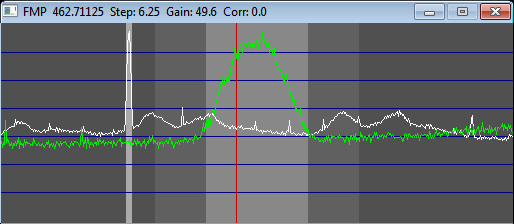
The latest version of Digital Speech Decoder+ (DSD+) has just been released, bringing it up to version 1.071. There appears to be no changelog, so we are unsure as to what is new, but one obvious change is that they now include a new program called FMP which is a simple NFM demodulator, similar to rtl_fm, although it does have a GUI with point and click tuning. FMP can be used as a replacement for SDR# or similar software, and is especially useful to use on low end devices such as netbooks.
An active discussion on the latest release of this software can be found in this thread on the RadioReference.com forums.
The FMP NFM demodulator tuned to a MotoTRBO signal.
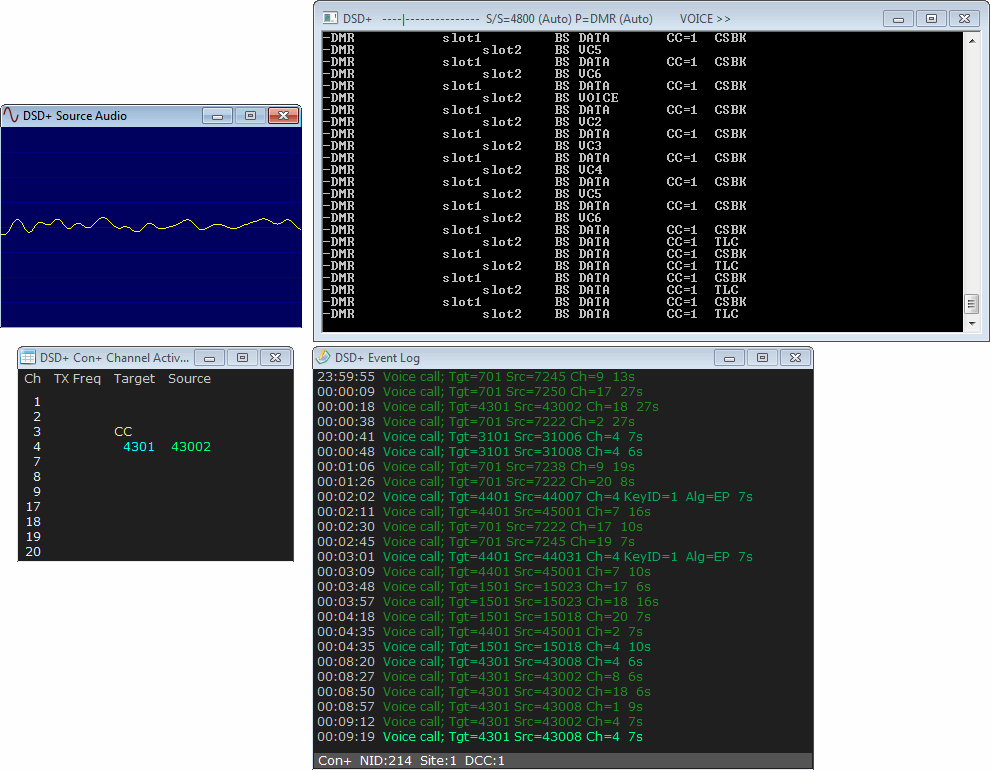
DSD+ is a Windows program which can be used to decode and listen to digital voice protocols such as D-STAR, NXDN4800, NXDN9600, DMR/MotoTRBO, P25 Phase 1, X2-TDMA and ProVoice with an RTL-SDR or other radio. On some DMR systems you may also be able to use the included LRRP software, which allows you to view the GPS locations of broadcasting radios. The last major release was version 1.05.
DSD+ GUI
The DSD+ team are now also offering a “fast lane” early access program, which for a small donation will allow you to have early access to new and upcoming DSD+ features. They aim to release a new update to donators every 7 to 30 days, while stable public releases will continue to be released every 4 to 6 months. The donation costs $10 for one year of early access, and $25 for lifetime updates. Some features they are currently working on include:
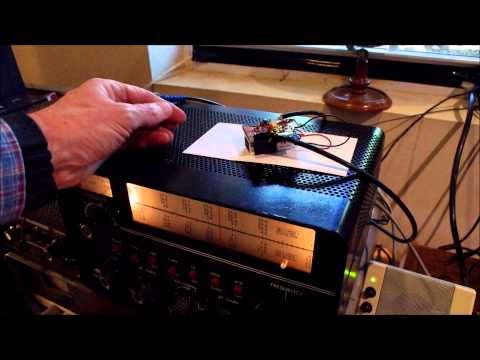
The Drake 2B is an old analogue tube based radio from 1961. Although it is so old it is still considered a decent shortwave receiver. Over on YouTube user M0HBR decided to bring his Drake into the modern age by coupling it with a panadapter made from an RTL-SDR dongle. A panadapter is a device that allows you to view the RF spectrum and waterfall of a normal radio.
To do this he tapped into the 455 kHz IF output of the Drake and amplified it with a homebrew FET source-follower, before connecting it to the RTL-SDR. He then uses the HDSDR software to listen to and display the received signals on the waterfall.
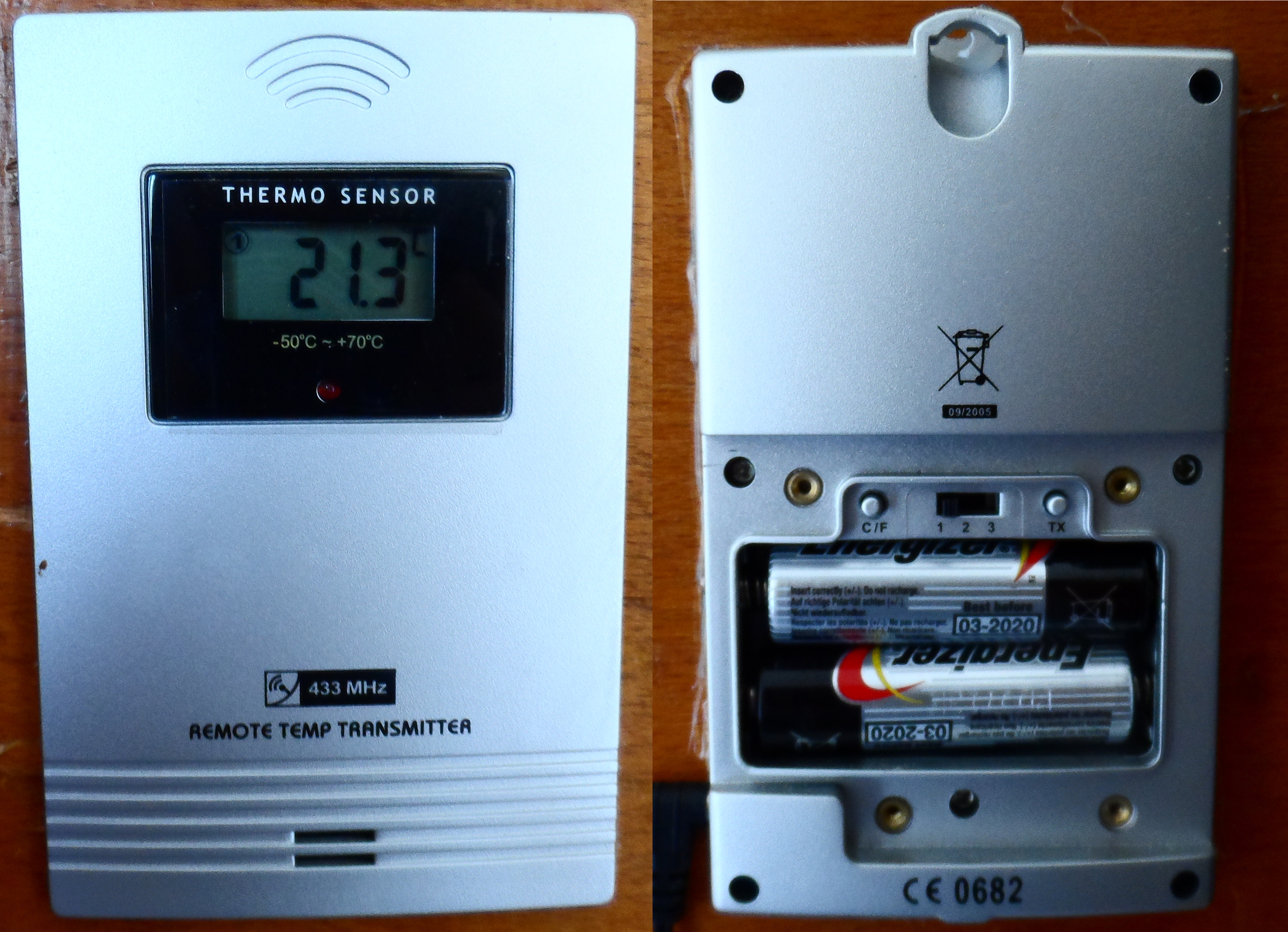
On his blog Josef Gajdysek has posted about his experience with using an RTL-SDR to reverse engineer the radio protocol used by his home weather station. Josef’s weather station is an ISM band device and transmits at 433 MHz. First he opened up GQRX and tuned to his weather station’s transmit frequency of 433.6 MHz and recorded some audio in AM mode. Josef initially assumed that the device would use on-off-keying (OOK) to encode the data. However, when he opened the sound file in Audacity and looked at it’s waveform he found that the weather station instead used Differential Pulse Position Modulation. In this modulation scheme the distance between pulses determines whether or not the binary bit is high or low.
Differential Pulse Position Modulation in Audacity
To decode this Josef then wrote a python script to measure the distance between pulses and thus convert the pulses into a binary string. Then by decoding and analyzing the captured packets he was able to isolate the checksum, temperature, channel, and status flags. Knowing all this information finally allowed him to create a real time decoder that uses rtl_fm. The python script can be downloaded from his post.