Artificial Intelligence Radio – Transceiver Now Released for Crowdfunding

Last week we posted about the Artificial Intelligence Radio - Transceiver (AIR-T), which was awaiting release for crowdfunding. Today the Crowd Supply campaign for it has gone live

As expected, the AIR-T is not a cheap with it coming in at US$5,699, and this is with a 10% discount off the MSRP. However, the AIR-T is likely to be more of interest to high end industry and university researchers who have research money to spend. Also, compared to Ettus E310/N310 and LimeNET Mini SDRs which have built in non-GPU based computing platforms and similar SDR performance, the AIR-T could be seen as reasonably priced assuming that the software and drivers for it are decent. In the future we expect to see the price of similar SDR-AI development boards eventually reduce down to hobbyist level prices. 

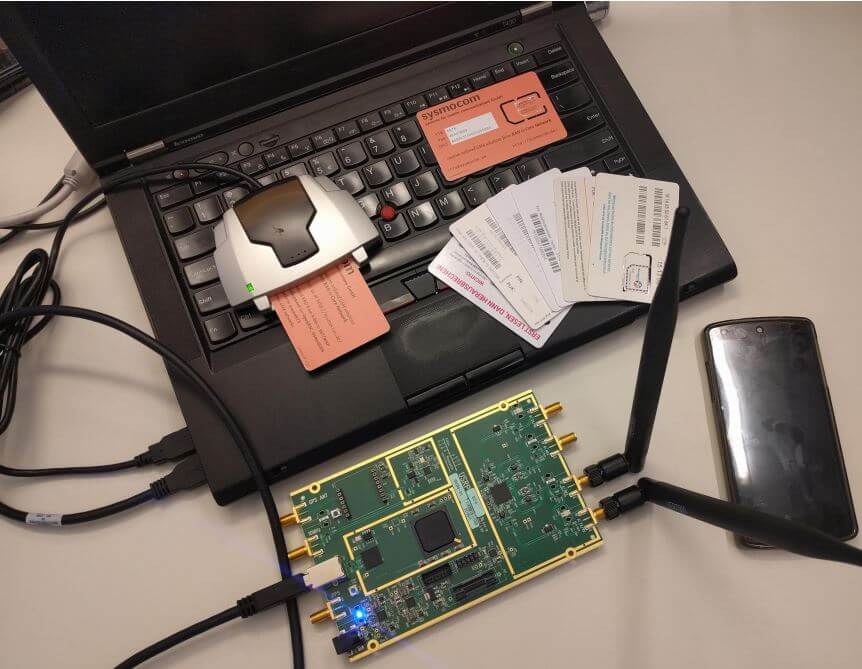
The basic idea behind the AIR-T is to combine a 2x2 MIMO SDR transceiver with a NVIDIA Jetson TX2 GPU that can be used to run artificial intelligence (AI) software fast. They will include software that will allow GNU Radio and Python code to be easily ported to the GPU architecture. 

Why build tomorrow’s tech with yesterday’s signal processing tools? The Artificial Intelligence Radio - Transceiver (AIR-T) is a fully integrated, single-board, artificial intelligence equipped, software defined radio platform with continuous frequency coverage from 300 MHz to 6 GHz. Designed for new engineers with little wireless experience to advanced engineers and researchers who develop low-cost AI, deep learning, and high-performance wireless systems, AIR-T combines the AD9371 RFIC transceiver providing up to 2 x 2 MIMO of 100 MHz of receiving bandwidth, 100 MHz of transmitting bandwidth in an open and reprogrammable Xilinx 7 FPGA, with fast USB 3.0 connectivity.

The AIR-T has custom and open Ubuntu software and custom FPGA blocks interfacing with GNU Radio, allowing you to immediately begin developing without having to make changes to existing code. With 256 NVIDIA cores, you can develop and deploy your AI application on hardware without having to code CUDA or VHDL. Freed from the limited compute power of a single CPU, with AIR-T, you can get right to work pushing your telecom, defense, or wireless systems to the limit of what’s possible.

The Artificial Intelligence Receiver - Transceiver (AIR-T) SDR

Building A Giant $200 3D Corner Reflector Antenna for GOES, Moon Bounce and Pulsar Detection

A corner reflector antenna is basically a monopole antenna with a metallic 'corner' reflector placed behind it. The reflector helps the monopole collect signals over a wider aperture resulting in signals coming in stronger from the direction that the corner is pointing at. In past posts we've seen a homemade tinfoil corner reflector used to improve reception of the generic stock RTL-SDR monopole antenna, and a larger one was used in a radio astronomy experiment to detect a pulsar with an RTL-SDR.

Recently The Thought Emporium YouTube channel has uploaded a video showing how to build a large 2 meter 3D corner reflector out of readily available metal conduit pipes and chicken wire. While the antenna has not been tested yet, they hope to be able to use it to receive weather satellite images from GOES-16, to receive moon bounce signals, to map the Hydrogen line and to detect pulsars. 

Tracking Police and Military Aircraft at the G7 Summit with an RTL-SDR

Back in early 2016 we posted about a journalist who used an RTL-SDR to gather ADS-B data about the type of aircraft used at the world economic forum in Davos. The idea was to help highlight the vast wealth and power of the attendees by showing off their heavy use of private aircraft.

Now more recently Laurent Bastien Corbeil has published a similar article in Motherboard (a Vice News tech magazine) explaining how he tracked police and military planes at this years G7 summit which was held in Canada in early June. Laurent used an RTL-SDR Blog V3 with the small dipole antenna attached to a window to gather ADS-B data from all the aircraft activity during the summit.

ADS-B is a radio system used on modern aircraft which broadcasts the aircraft's current GPS location and other data such as aircraft identifiers. It is now used extensively by air traffic controllers as it is significantly more reliable than traditional radar. With a simple RTL-SDR it is possible for anyone to track and plot ADS-B data on a map, and this is how tracking sites like flightradar24.com and flightaware.com work.

From his collected data he was able to spot several interesting aircraft such as Canadian Air Force Chinooks, C130 Hercules', RCMP Pilatus', a military Bombardier jet, and a coast guard Bell 427. He also notes that while he was able to spot Donald Trumps Marine One helicopter with his own eyes, the ADS-B data was not present, indicating that more important military aircraft do not broadcast ADS-B for security reasons.

In the article Laurent makes estimates of the costs of operating these aircraft, and makes some guesses on the type of mission flown by some of the aircraft.

G7 Aircraft Flight Costs (Data by Laurent Bastien Corbeil, Graphics by Marvin Lau)

Video Explaining the Basics of RF Bias Tees

Over on YouTube w2aew who has many excellent videos explaining various radio topics has uploaded a new video that talks about the basics of bias tees, and shows some applications and examples. In the video he demonstrates using a bias tee to add DC voltage to a serial signal, measure the RF performance of a BJT transistor, and to tune a remotely tunable 'screwdriver' antenna.

On receiver radios bias tees are commonly used to power remote LNA's (low noise amplifiers) or active antennas by putting DC power onto the coax cable. Ideally an LNA should be placed closer to the antenna as this will help reduce the loss caused by coax cable. Often the antenna is far away from the receiver on a roof or attic where there is no power supply. A bias tee solves that by allowing the coax cable to be used for DC power.

We note that our RTL-SDR Blog V3 dongle has a built in bias tee that can be activated in software. 

#284: Basics of RF Bias Tees including applications and examples

Notice: WXtoImg Website Down

Just a note that the website for the popular NOAA APT weather satellite decoding software WxtoImg is currently down, and may possibly never be revived. This software is commonly used with RTL-SDR dongles to download weather satellite images from the NOAA 15, 18 and 19 polar orbiting satellites.

It seems that the author of the software has not been maintaining the site and software for a while, although there was a brief update on the site back in 2017 when the professional version keys were released for free. But the keys reportedly no longer work. WXtoImg is closed source, so the code is not available either.

Some of the downloads are still available via archive.org, however it only seems to be the Windows and some of the Linux versions that were archived. Over on two Reddit threads [1] [2], some users are also collecting the last free versions and making them available for download again. If anyone has access to the last beta versions for ARM devices please upload them somewhere too.

Also if anyone happens to have the contact details of the author, or someone who knows the author please let us know as we'd like to ask for permission to mirror the files.

GQRX and gr-osmosdr now with support for SpyServer

Thanks to the work of Lucas Teske, GQRX is now able to connect to SpyServer servers. SpyServer is the IQ streaming server software solution developed by the Airspy SDR developers. It can support Airspy and RTL-SDR devices, and can be used to access these SDRs remotely over a network connection. It is similar to rtl_tcp, but a lot more efficient in terms of network usage, meaning that it performs well over an internet connection. On a previous post we have a tutorial about setting up a SpyServer with an RTL-SDR.

The code modified by Lucas is the gr-osmosdr module, and Lucas' code can be downloaded from his GitHub at github.com/racerxdl/gr-osmosdr. It doesn't yet appear to have been merged into the official osmocom branch. The gr-osmosdr module is a generic block used to access various SDR hardware, so any software that utilizes it (such as GNU Radio) should be able to connect to a SpyServer connection too.

Building an RF Direction Finding Robot with an RTL-SDR

Over on Hackaday.io, project logger Humpelstilzchen has been writing about his attempts to create an autonomous RF direction finding robot RC car with an RTL-SDR. The goal is to set up an ISM band transmitter as a beacon, and use the RTL-SDR on the robot as the receiver. It will then use direction finding techniques to drive towards the beacon. The robot is a 4WD RC toy car with some autonomous navigational features like GPS, ultrasonic, IMU and vision sensors.

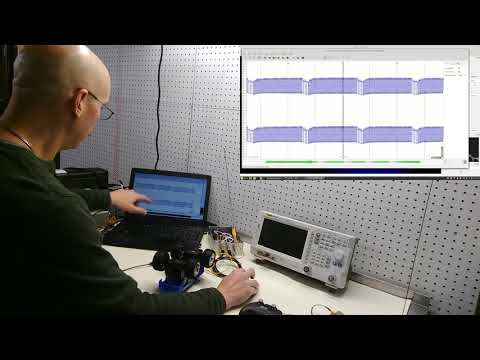
In his latest project log Humpelstilzchen describes his first semi-successful attempt at getting RF direction finding working. In the experiment he uses a 433 MHz module to send out an FSK beacon. On the robot two antennas are used for the time difference of arrival/pseudo-doppler direction finding technique, and PIN diodes are used to rapidly switch between the antennas. A GNU Radio script running on a HummingBoard single board computer computes the TDOA/pseudo-doppler algorithm.

Psuedo-doppler direction finding works by rapidly switching between several antennas. The difference in the time that the signal arrives at each antenna can be used to calculate the transmitter's direction.

With the current set up he's been able to get the robot to distinguish if the beacon is closer to the left, or closer to the right, or equidistant. However, he notes that there are still problems with reflections of the beacon signal which can cause the robot to drive in the wrong direction.

This is still a work in progress and we look forward to his future results.

Humpelstilzchen's RF direction finding robot

Generating a WiFi Radio Heatmap with a Helical Antenna, Antenna Rotator and a HackRF

Over on YouTube The Thought Emporium channel has been working on creating a "WiFi Camera" over the past few weeks. The idea is to essentially create a small radio telescope that can "see" WiFi signals, by generating a heatmap of WiFi signal strength. This is done with a directional helical 2.4 GHz antenna and motorized rotator that incrementally steps the antenna through various angles. After each movement step a HackRF and Python script is used to measure WiFi signal strength for a brief moment, and then the rotator moves onto the next angle. The helical antenna and rotator that they created are made out of PVC pipe plastic and wood, and are designed to be built by anyone with basic workshop tools like a bandsaw.

The final results show that they've been able to successfully generate heatmaps that can be overlaid on top of a photo. The areas that show higher signal strength correlate with areas on the photo where WiFi routers are placed, so the results appear to be accurate. In the future they hope to expand this idea and create a skyward pointing radio telescope for generating images of the galactic hydrogen line, and of satellites.

WiFi Heatmap Building Scan Results
The Thought Emporiums' WiFi Heatmap Building Scan Results

The videos are split into three parts. The first two videos show the build process of the antennas and rotator, whilst the third video shows the final results.

DIY Radio Telescope Version 2: Wifi vision - Part 1

The Angriest Radio Telescope - Wifi Camera Part 2

Building a Camera That Can See Wifi | Part 3 SUCCESS!