Talks from the AMSAT-UK RSGB 2017 Convention

The Radio Society of Great Britain (RSGB) and AMSAT-UK recently presented a number of talks at their latest convention held in October of this year. Some of the talks are SDR related and are interesting for those interested in satellite reception. A couple of interesting SDR related talks are presented below, and the rest of the talks can be accessed on their YouTube page.

Software defined radio for the satellite geek - Alex Csete OZ9AEC

In this talk Alex Csete (Oz9AEC) who is the programmer behind the popular GQRX software that is often used with RTL-SDRs discusses his latest work and some of his experiences with writing software for SDRs.

2017: Software defined radio for the satellite geek - Alex Csete OZ9AEC

Going to space the libre way - Pierros Papadeas, Libre Space Foundation

In this talk Pierros Papadeas who is the founder of the Libre Space Foundation discusses their SatNOGS project. SatNOGS is a project that uses RTL-SDRs in custom 3D printed home made satellite tracking ground stations. It aims to enable easy access to live satellite data online by significantly increasing ground station coverage.

2017: Going to space the libre way - Pierros Papadeas, Libre Space Foundation

XTRX: Soon to be crowdfunding Mini PCIe based TX/RX SDR

Over on the crowd funding site crowdsupply.com there have recently been several updates on the Fairwaves XTRX SDR. The XTRX is an upcoming TX/RX capable SDR in a tiny Mini PCIe form factor. Mini PCIe is the expansion slot system used on some laptops. The SDR itself will be 2 x 2 MIMO, with a tuning range of 10 MHz - 3.7 GHz (down to 100 kHz with some degradation), and have a sample rate of up to 120 MSPS. It uses the LimeSDR RF chipset which provides most of the hardware required.

The XTRX is not yet for sale, and is planned for a crowdfunding run on Crowdsupply 'soon'. You can subscribe to future updates on their page. No word yet on pricing, but according to one of the developers comments on Reddit the price will be somewhere between the LimeSDR ($299 USD) and LimeSDR Mini ($139 USD). Eventually in the future if they can tap into a mass market they hope to get the price down to $50 USD.

Features & Specifications

  • RF Chipset: Lime Microsystems LMS7002M FPRF
  • FPGA Chipset: Xilinx Artix 7 35T
  • Channels: 2 × 2 MIMO
  • Tuning Range: 30 MHz - 3.8 GHz
  • Rx/Tx Range:
    • 10 MHz - 3.7 GHz
    • 100 kHz - 3.8 GHz with signal level degradation
  • PCIe Bandwidth:
    • PCIe x2 Gen 2.0: 8 Gbit/s
    • PCIe x1 Gen 2.0: 4 Gbit/s
    • PCIe x1 Gen 1.0: 2 Gbit/s
  • Sample Rate: ~0.2 MSPS to 120 MSPS
  • Reference clock:
    • Frequency: 26 MHz
    • Stability: <10 ppb stability after GPS/GNSS lock, 500 ppb at start up
  • Form Factor: full-size miniPCIe (30 × 51 mm)
  • Bus Latency: <10 µs, stable over time
  • Synchronization: synchronize multiple XTRX boards for massive MIMO
  • GPIO: 4 lines @ miniPCIe connector, 3 lines @ FPC edge connector
  • Accessories: miniPCIe-USB3 converter, miniPCIe-PCIe converter, etc
XTRX Prototype
XTRX Prototype

A Tutorial on Receiving HRPT Weather Satellite Images with an SDRplay RSP2

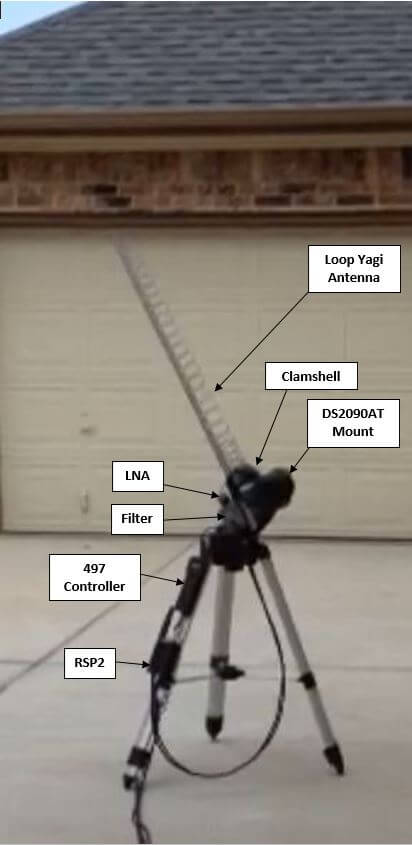
RSP2user's HRPT equipment

Over on the SDRplay forums user 'RSP2user' has put up a quality post describing how he receives HRPT weather satellite images with his SDRplay RSP2. HRPT stands for 'High Resolution Picture Transmission' and provides a much higher resolution image compared to the APT weather satellite images typically downloaded from NOAA satellites. Somewhat confusingly the picture quality of HRPT is similar to LRPT (low rate picture transmission) which is used on the Russian Meteor M series weather satellite. HRPT provides 1.1 km resolution, whilst LRPT provides 1 km resolution.

Currently there are multiple satellites broadcasting HRPT signals including NOAA 19, NOAA 18, NOAA 15, Meteor M2, Fengyun 3B, Fengyun 3C, Metop A and Metop B.

The difference in difficulty of receiving APT and LRPT versus HRPT transmissions typically occur in the L-band at about 1.7 GHz, and requires a directive high gain antenna with tracking motor to track the satellite as it passes over. This makes these images many times more difficult to receive compared to APT and LRPT which only require a fixed position antenna for reception at the more forgiving 137 MHz.

Over on his post RSP2user shows how he uses a repurposed Meade Instruments telescope tracking mount and controller to drive the tracking of a 26 element loop Yagi antenna. A 0.36dB noise figure LNA modified with bias tee input is used to boost the signal and reduce the noise figure. The signal is received by a SDRplay RSP2 and processed on a PC with USA-satcoms HRPT decoder software, which is available for purchase by directly contacting him. The HRPT signal bandwidth appears to be about 2.4 MHz so possibly an RTL-SDR could also be used, but it might be pushing it to the limit.

If you are interested, RSP2user also uploaded an APT weather satellite image reception tutorial on another post. This tutorial shows how to build a quality quadrifilar helix antenna as well.

Receiving the HRPT signal on USA-Satcoms' HRPT decoder.

Building a 3D Printed LHCP Helical L-Band Feed for Inmarsat, AERO and HRPT

Thanks to Manuel a.k.a. Tysonpower for submitting his latest YouTube video tutorial about building an 1550 MHz L-band LHCP helical antenna for receiving satellite signals such as Inmarsat, AERO and HRPT.

Manuel's design is based on a 3D printed part which is used to accurately form the helical winding. The winding then mounts onto an aluminum plate and a satellite dish arm using a custom 3D printed adapter for the dish arm. In the video he uses the helical feed with an 80cm satellite dish and a standard 40mm LNB mount on the dish arm. Attached to the feed are two LNAs in series which help to lower the noise figure and reduce losses in the coax cable.

With this setup he writes that he was able to get very good AERO and Outernet reception from Alphasat (25E geostationary). He also writes that he's had good results using it for HRPT reception as well.

The 3D printing STL files and list of parts required are available on Thingiverse, and the companion video is shown below. Note that the video is narrated in German, but English subtitles are available.

[EN subs] LHCP Helix L-Band Feed - 3D Druck für eine genaue Helix

Manuel's L-Band Helical Feed

Defcon 25 SDR and Radio Related Talks

Defcon is a huge yearly conference based on the topics of information security and hacking. Some of the talks relate to wireless and SDR concepts. Recently videos from the last Defcon 25 conference held in July 2017 have been uploaded to YouTube. Below is a selection of some interesting SDR and radio related talks that we have found. If you're interested in exploring the rest of the talks then you can find them on their YouTube page. Most of the radio related talks are in the 'WiFi Village' category.

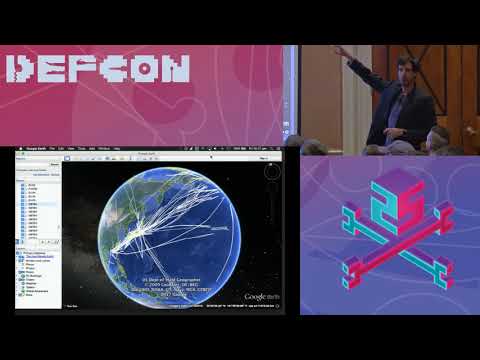
DEF CON 25 Wifi Village - Balint Seeber - Hacking Some More of the Wireless World

The hacking continues on from last year! Three interesting applications will be demonstrated, and their underlying theory and design explained. The audience will be exposed to some novel GNU Radio tips and DSP tricks. INMARSAT Aero will be revisited to show (in Google Earth) spatial information, such as waypoints and flight plans, that are transmitted from airline ground operations to airborne flights. A good chunk of the VHF band is used for airline communications; plane spotters enjoy listening to tower and cockpit communications.

Modern SDRs can now sample the entire band, and as AM modulation is used, it's possible to use a counterintuitive, but simple, demodulator chain (first shown by Kevin Reid's wideband 'un-selective AM' receiver) to listen to the most powerful transmission. This will be demonstrated with a GNU Radio-based implementation. It is also possible to 'spatialise' the audio for the listener using stereo separation, which can convey a transmission's relative position on the spectrum. FMCW RADAR experiments are enhanced to include Doppler processing.

Plotting this new velocity information, due to the Doppler effect, shows whether a target is heading toward or away from you, and often reveals targets not normally seen in range-only information - this demonstrates the true power of full RADAR signal processing. This technique will be applied to the live audio demo, a new live SDR demo, CODAR ocean current tracking, and passive RADAR exploiting powerful ATSC digital television signals (this was used to track aircraft on approach across the Bay Area).

DEF CON 25 Wifi Village - Balint Seeber - Hacking Some More of the Wireless World

DEF CON 25 - Matt Knight - Radio Exploitation 101

What do the Dallas tornado siren attack, hacked electric skateboards, and insecure smart door locks have in common? Vulnerable wireless protocols. Exploitation of wireless devices is growing increasingly common, thanks to the proliferation of radio frequency protocols driven by mobile and IoT. While non-Wi-Fi and non-Bluetooth RF protocols remain a mystery to many security practitioners, exploiting them is easier than one might think.

Join us as we walk through the fundamentals of radio exploitation. After introducing essential RF concepts and characteristics, we will develop a wireless threat taxonomy by analyzing and classifying different methods of attack. As we introduce each new attack, we will draw parallels to similar wired network exploits, and highlight attack primitives that are unique to RF. To illustrate these concepts, we will show each attack in practice with a series of live demos built on software-defined and hardware radios.

Attendees will come away from this session with an understanding of the mechanics of wireless network exploitation, and an awareness of how they can bridge their IP network exploitation skills to the wireless domain.

DEF CON 25 - Matt Knight - Radio Exploitation 101

Continue reading

QrssPiG: Decoding QRSS on a Raspberry Pi with an RTL-SDR

QRSS is a ham communications mode that is essentially just very slow CW (morse code), with each dash/dot being broadcast for a number of seconds. With QRSS instead of audibly decoding the morse code signal, it is decoded visually via a spectrum display (or automatically by software). It is designed to be a QRP mode, which means that hams transmitting QRSS can be heard all over the world even though very low transmit power is used. 

QrssPiG is a QRSS grabber program that runs headless on a Raspberry Pi and can interface with an RTL-SDR. It automatically generates the waterfall graphs of received QRSS images, and supports uploading them via SCP or FTP. The software can also run with a HackRF, or via audio piping from another SDR or standard hardware radio.

Recently on Twitter @ON4CDJ has been trying QrssPiG with an RTL-SDR V3 and has been having good results.

xaVNA: Kickstarter for a $200 Open Hardware VNA

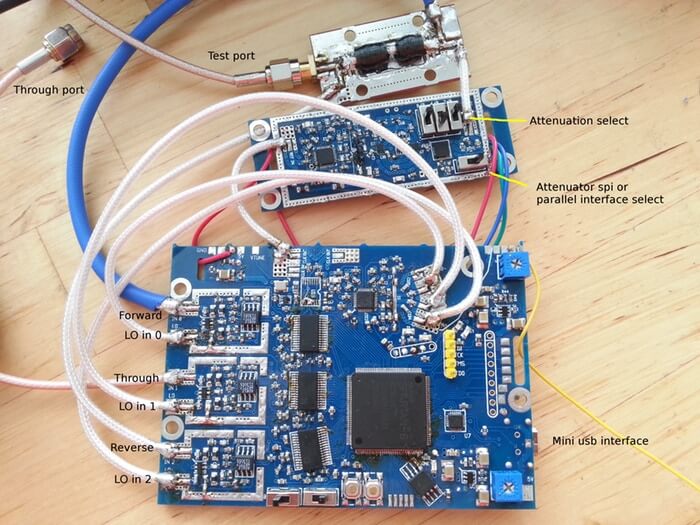
Thanks to Cary Wang for submitting news about his new Kickstarter for a $200 open hardware VNA called the xaVNA. The xaVNA is PC USB based, has a guaranteed frequency range of 140 MHz to 2.5 GHz (typical 137 MHz - 3.5 GHz), and is supposed to be a lower cost alternative to other low end PC based VNAs such as the PocketVNA and miniVNA Tiny. In addition to the lower cost, the xaVNA is advertised as being superior to its competitors as it has less trace noise and no warm up time is required, as well as the hardware and software being open source.

A VNA (Vector Network Analyzer) is a tool that can allow you to easily measure things like the SWR curve of an antenna, the characteristics of a filter, or the loss of a coax cable for example. So it is a very useful tool to have around if you are building home brew antennas or filters for your SDRs. Compared to a standard antenna analyzer, a VNA gives you complex impedance/phase information as well, making it possible to design better circuits and antennas.

Currently the closest competitors on the market are other PC based VNA's like the PocketVNA ($430) and the miniVNA Tiny ($580). The main advantage of the competitors so far is that they go down to the HF frequencies, but a stretch goal of the Kickstarter is to create an xaVNA that goes down to 10 MHz.

At the moment they only have a functional prototype with the second iteration soon to be ready. The delivery date of a completed unit is expected to be around April 2018. But as with any crowdfunded project remember to only back the project if you are willing to lose your money as there is no guarantee that a product will actually be delivered on time, or even delivered at all.

The xaVNA Prototype
The first xaVNA prototype

SDR Programming For Kids: LimeSDR Mini with Scratch on a Raspberry Pi 3

Scratch is a visual block based programming language aimed at getting kids into programming. Recently the LimeSDR team have been working at creating a Scratch interface for their LimeSDR Mini. It is basically working as a wrapper/interface to the processing backend which is handled by LuaRadio.

The idea is to keep the barrier of entry to SDR as low as possible, by making SDR programming accessible to kids as well. The software is currently a work in progress, but they write that they are attempting to develop the Scratch blocks necessary to enable the transmission and reception of text messages. Something like that would make a great learning tool for educators.

The video demo shows Scratch and the LimeSDR running on a Raspberry Pi 3. During the demo he creates a simple 433 MHz spectrum display by connecting up several blocks.

Scratch running with a LimeSDR Mini on a Raspberry Pi