SDR# Now with Noise Blanker

The latest version of SDR# has now been updated to include a noise blanker plugin. A noise blanker can reduce impulsive noises like those created by spark gaps and electric motors. Other SDR programs like Linrad and HDSDR have had noise blanker functions for a while so this is a welcome addition to SDR#. Below is a comparison of the noise blanker turned on and off on a noisy CW signal.

To update SDR# to the latest version simply run install.bat again. Take note that updating will remove any plugins you have added to the SDRSharp.exe.Config file so you may wish to save it first.

Noise Blanker Off

[audio https://www.rtl-sdr.com/wp-content/uploads/2014/03/nb_off.mp3]

Noise Blanker On

[audio https://www.rtl-sdr.com/wp-content/uploads/2014/03/nb_on.mp3]
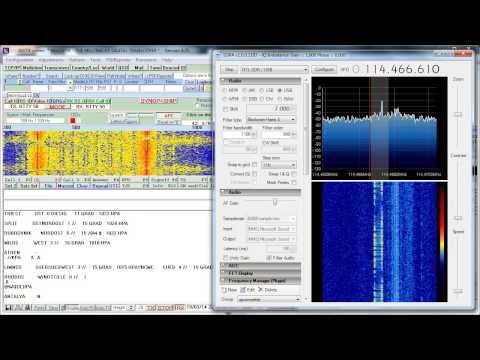
Receiving Weather RTTY and FAX with the RTL-SDR

YouTube user Tiago Sousa shows how he was able to receive weather Radioteletype (RTTY) data using the RTL-SDR, an upconverter and MultiPSK. Weather RTTY is broadcast by weather services such as the Deutscher Wetterdienst (DWD) which is broadcast from Hamburg, Germany. It is intended for people at sea.

Tiago used an RTL-SDR with upconverter and an 11 meter long wire antenna. For the software he used SDR# and piped the audio to MultiPSK.

Weather RTTY - DWD Hamburg heard in Portugal

Tiago has also uploaded a second video showing him receiving Weatherfax with the same setup. Weatherfax is a signal that transmits a fax image showing weather patterns.

Weather Fax - DWD Hamburg heard in Portugal

SDR# now with IF Stage Noise Reduction Algorithm

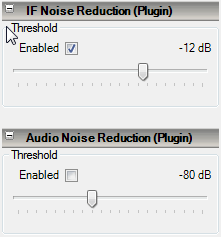
SDR# has recently been updated to include an IF stage digital noise reduction algorithm. Previously digital noise reduction could be done at the audio output stage, but now it can be done to the IF signal as well. Performing digital noise reduction on the IF stage appears to work much better than at the audio stage. Update SDR# by running the install.bat file again.

Here are some comparison audio files tested on a noisy NFM voice signal for listening.

Original Signal

[audio https://www.rtl-sdr.com/wp-content/uploads/2014/03/IF_NR_OFF.mp3]

IF Noise Reduction (set to -12 dB)

[audio https://www.rtl-sdr.com/wp-content/uploads/2014/03/IF_NR.mp3]

Audio Noise Reduction (set to -80 dB)

[audio https://www.rtl-sdr.com/wp-content/uploads/2014/03/AF_NR.mp3]
sdrsharp_if_nr
SDR# IF Digital Noise Reduction Plugin

Decoding HOT, EOT & DPU Train Data

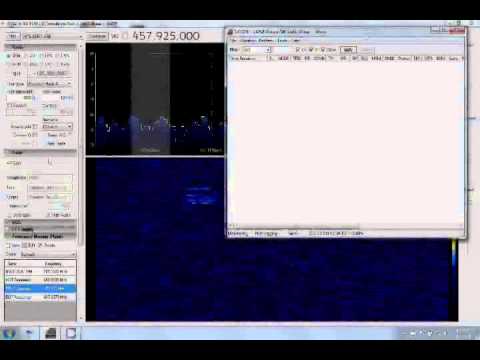
On YouTube user Curt Rowlett has uploaded a video showing how he was able to decode HOT, EOT & DPU signals from trains using an RTL-SDR. Head of Train (HOT) and End of Train (EOT) signals are used on trains to transmit telemetry data such as brake line pressure and monitor accidental separation of the train. Distributed Power Unit (DPU) signals are control signals that are used to control remote DPU’s on long trains. DPU’s are locomotives which are placed in the middle or rear of a train to help more evenly distribute pushing and pulling power over the entire train.

Curt used the SoftEOT and SoftDPU software programs to monitor and decode these signals. This software can be downloaded from the softEOT Yahoo! Group after requesting and being accepted into membership.

HOT signals can be found on 452.9375 MHz, EOT signals on 457.9375 MHz and DPU signals on 457.9250 MHz.

Decoding HOT, EOT & DPU Train Data

Ham it up Upconverter 3D Printed Case YouTube Giveaway

Over on YouTube Eric William has posted a video about his competition where he is giving away two 3D printed ham-it-up upconverter cases. The ham-it-up is an upconverter that can be used with the RTL-SDR to allow it to receive HF (0-30 MHz) frequencies. To enter the competition you simply need to go to Erics web forum and post about what you use SDR for in the competition thread. The competition is open only for North American viewers and ends on May 19 2014.

Transmitting DAB with the HackRF

A RTL-SDR.com reader has written in to let us know about his project involving transmitting Digital Audio Broadcasting (DAB) using GNU Radio and the HackRF. DAB is a digital radio technology that is used to broadcast radio stations. He uses the CRC-DABMUX and CRC-DABMOD software to modulate an audio file into DAB and then uses a GNU Radio python script to write the modulated signal to the HackRF for transmitting.

Decoding 2x AIS Channels with SDR Console, AISMon and OpenCPN

YouTube user k2nccvids has posted a video showing him decoding and plotting both AIS channels simultaneously on a Windows PC with free software. To do this he uses SDR Console and two AISMon instances. SDR Console is a general purpose SDR GUI that supports the RTL-SDR. One of it’s major advantages over other SDR software is that it can tune to multiple signals in the same swath of tuned bandwidth simultaneously and output their audio to different virtual audio cables.

k2nccvids used two AISMon instances, each one connected to a separate virtual audio cable outputting AIS audio from SDR Console. He set AISMon to output decoded UDP packets on two different ports. Then he created two UDP listeners in OpenCPN for plotting, one for each port.

RTL-SDR Wide Spectrum Analyzer

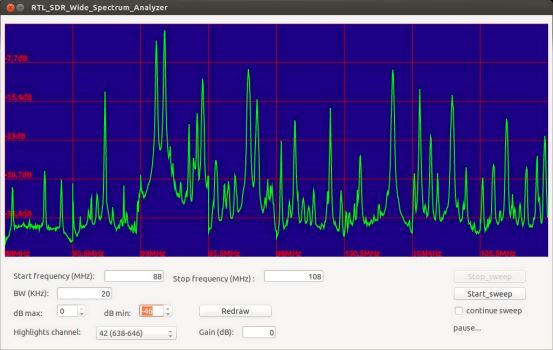
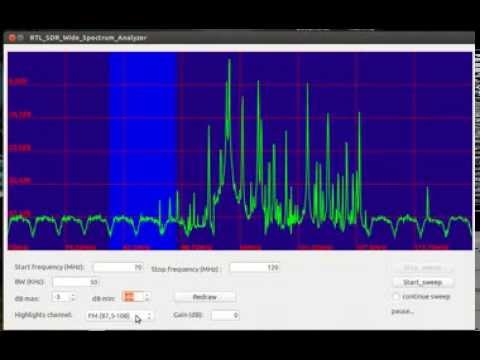
Over on YouTube claudio giuliani has posted a video of his RTL-SDR Wide Spectrum Analyzer software. The software is written in the basic for gambas language and uses an RTL-SDR software defined radio to plot a wide chunk of the frequency spectrum by sweeping over it. It looks to be similar to the RTL-SDR Scanner software. Currently it is only available for Linux.

RTL-SDR Wide Scanner
RTL_SDR Wide spectrum analyzer