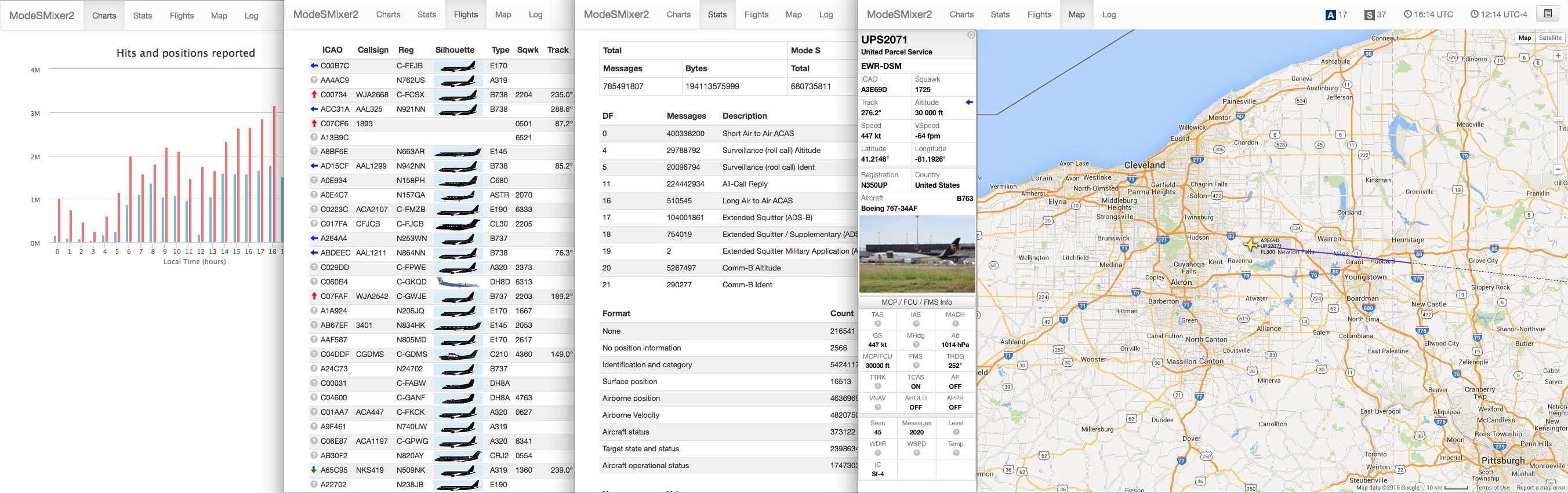
The author’s tutorial goes over setting up ModeSDeco2 to broadcast data over the network, setting up ModeSMixer2 to receive data, and also setting up the basestation.sqb file to add airline logos and silhouettes to the web based GUI of ModeSMixer2.
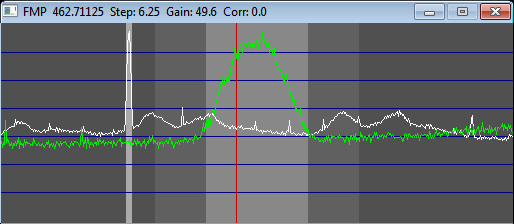
The latest version of Digital Speech Decoder+ (DSD+) has just been released, bringing it up to version 1.071. There appears to be no changelog, so we are unsure as to what is new, but one obvious change is that they now include a new program called FMP which is a simple NFM demodulator, similar to rtl_fm, although it does have a GUI with point and click tuning. FMP can be used as a replacement for SDR# or similar software, and is especially useful to use on low end devices such as netbooks.
An active discussion on the latest release of this software can be found in this thread on the RadioReference.com forums.
The FMP NFM demodulator tuned to a MotoTRBO signal.
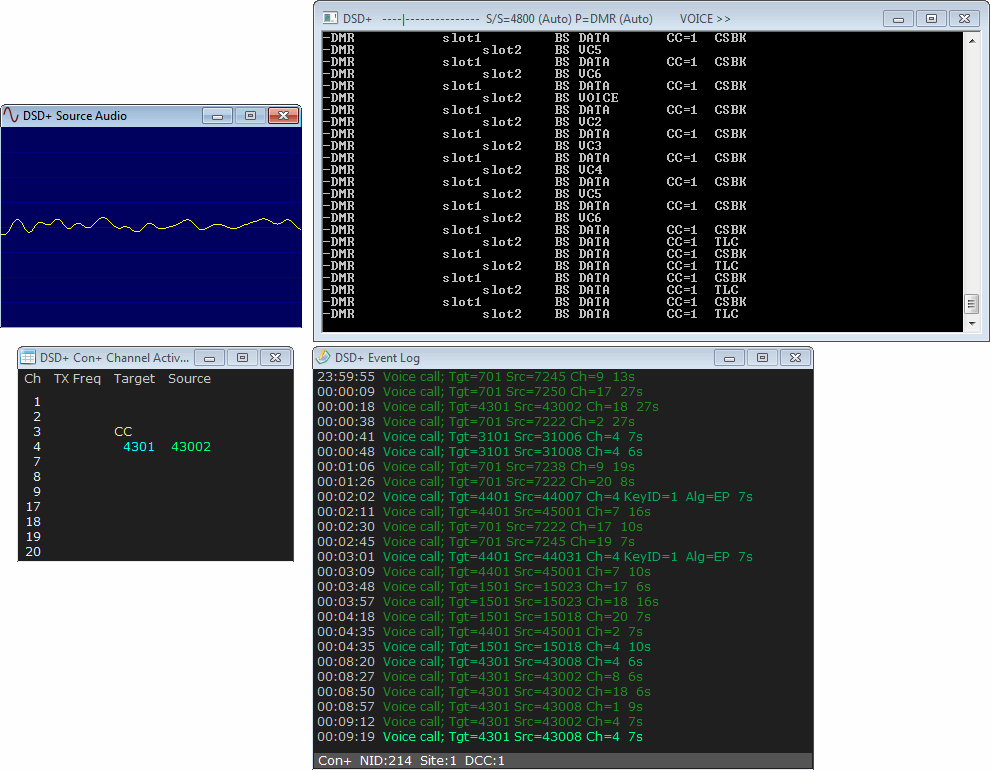
DSD+ is a Windows program which can be used to decode and listen to digital voice protocols such as D-STAR, NXDN4800, NXDN9600, DMR/MotoTRBO, P25 Phase 1, X2-TDMA and ProVoice with an RTL-SDR or other radio. On some DMR systems you may also be able to use the included LRRP software, which allows you to view the GPS locations of broadcasting radios. The last major release was version 1.05.
DSD+ GUI
The DSD+ team are now also offering a “fast lane” early access program, which for a small donation will allow you to have early access to new and upcoming DSD+ features. They aim to release a new update to donators every 7 to 30 days, while stable public releases will continue to be released every 4 to 6 months. The donation costs $10 for one year of early access, and $25 for lifetime updates. Some features they are currently working on include:
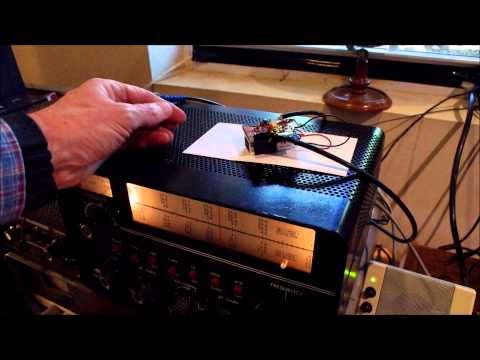
The Drake 2B is an old analogue tube based radio from 1961. Although it is so old it is still considered a decent shortwave receiver. Over on YouTube user M0HBR decided to bring his Drake into the modern age by coupling it with a panadapter made from an RTL-SDR dongle. A panadapter is a device that allows you to view the RF spectrum and waterfall of a normal radio.
To do this he tapped into the 455 kHz IF output of the Drake and amplified it with a homebrew FET source-follower, before connecting it to the RTL-SDR. He then uses the HDSDR software to listen to and display the received signals on the waterfall.
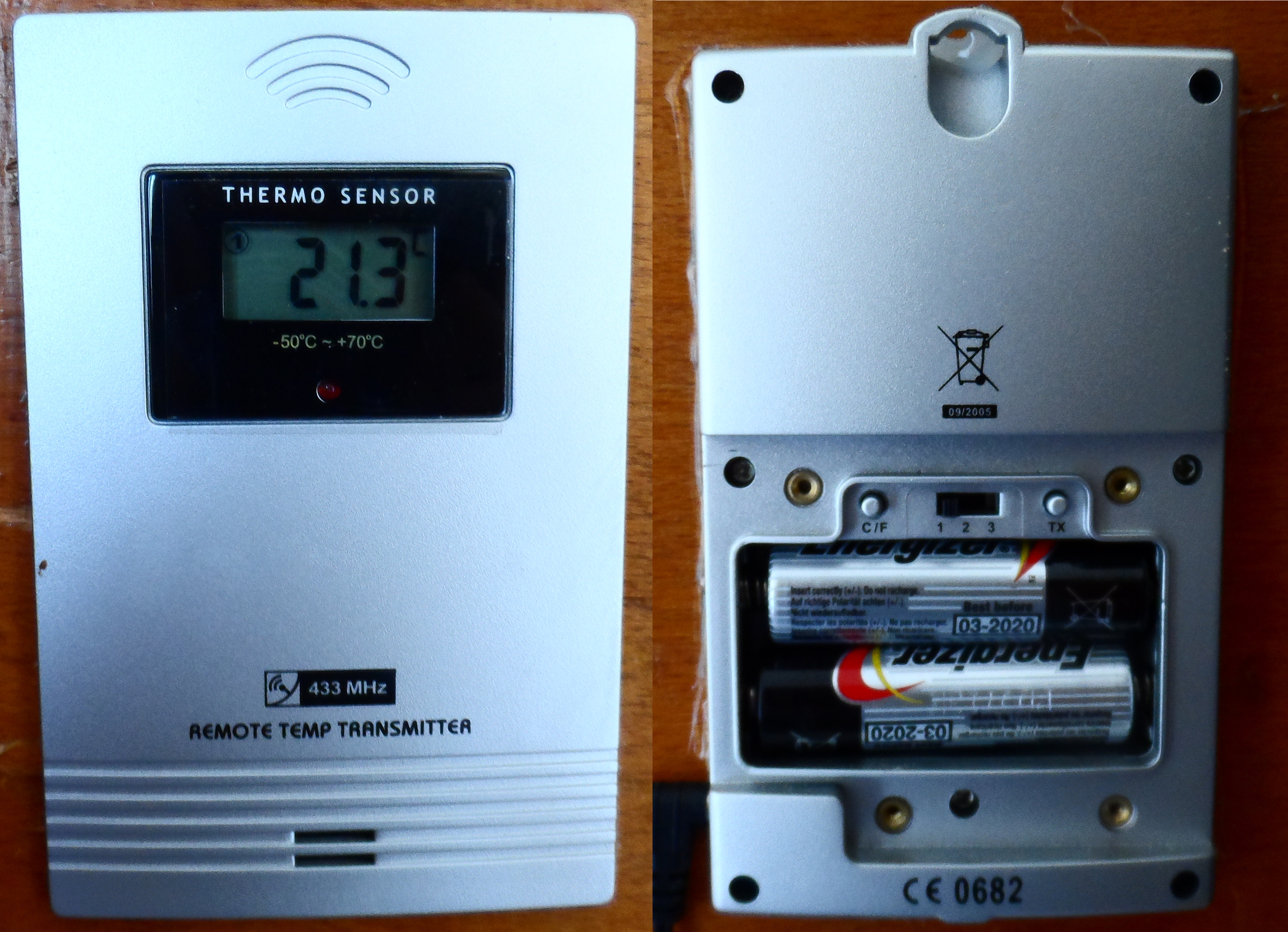
On his blog Josef Gajdysek has posted about his experience with using an RTL-SDR to reverse engineer the radio protocol used by his home weather station. Josef’s weather station is an ISM band device and transmits at 433 MHz. First he opened up GQRX and tuned to his weather station’s transmit frequency of 433.6 MHz and recorded some audio in AM mode. Josef initially assumed that the device would use on-off-keying (OOK) to encode the data. However, when he opened the sound file in Audacity and looked at it’s waveform he found that the weather station instead used Differential Pulse Position Modulation. In this modulation scheme the distance between pulses determines whether or not the binary bit is high or low.
Differential Pulse Position Modulation in Audacity
To decode this Josef then wrote a python script to measure the distance between pulses and thus convert the pulses into a binary string. Then by decoding and analyzing the captured packets he was able to isolate the checksum, temperature, channel, and status flags. Knowing all this information finally allowed him to create a real time decoder that uses rtl_fm. The python script can be downloaded from his post.
Previously we posted about BigWhoop which is a project entry into the NASA International Space Apps Challenge. The BigWhoop team aim to create a networked system where RTL-SDR’s are used around the world to continually monitor the global radio spectrum.
Now BigWhoop have won the Stuttgart chapter of Global NASA Space Apps Challenge and have been chosen as one of the 15 finalists in the competition. You can help the BigWhoop team by voting daily so that they can get into the top 5 finalists. Voting lasts until May 3.
Ultimately BigWhoop is intended to run on the Constellation computation grid with 60,000 computers. However, we started a pre-alpha test. So we asked for your help during the hackathon weekend to plug in your software defined radio devices and start a sensor node for us. Our BigWhoop software was already able to send this to our server at shackspace and we received data from nice people in Virginia, US and Bremen, Germany. With this help, we were able to show you a first live demo at the end of the hackathon. Since then, we received further data and are really overwhelmed by everyone’s support and want to say a big THANK YOU!
bigwhoop global spectrum monitoring spaceapps2015 stuttgart local winner airtraffic
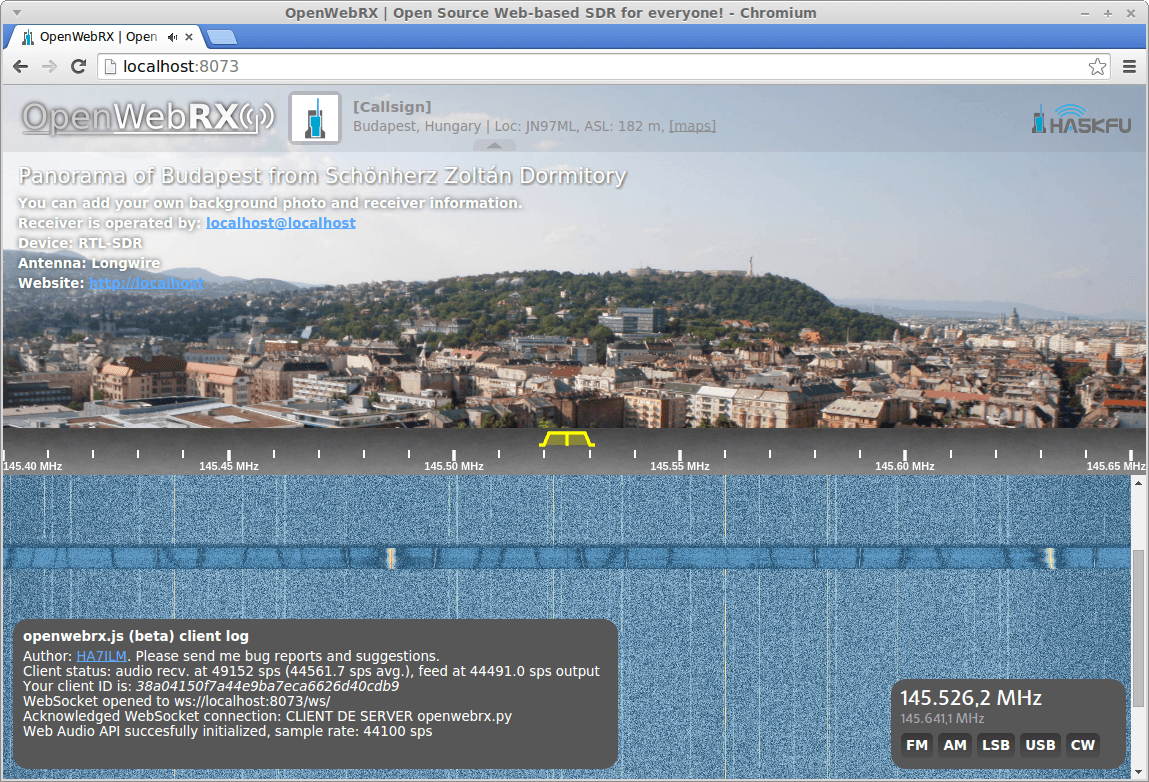
From Reddit we’ve learned of a new web based SDR receiver software for the RTL-SDR called OpenWebRX. This python based software allows you to run a web server that allows multiple users to connect to an RTL-SDR and listen to it through a web interface. The web interface also allows the RTL-SDR frequency and mode settings to be controlled. The software appears to still be in beta, so it may have some bugs.
The author has also written his BSc. thesis on this software and it is available for reading here. The thesis describes his software design and implementation as well as some SDR theory and may be useful to anyone wishing to implement similar SDR software.
Previously we posted about Android programmer Tosis Nikolaos’s last app which was called “Track your flight Europe”. The app allows you to view aircraft tracked via ADS-B received by an RTL-SDR on an offline map.
Now Nikos has written into us once again to let us know about his new app called “Track your flight North America“. It is the same as his previous app, but this one has high resolution offline maps for North America. He also writes that his Europe app has also been updated to support high resolution offline maps. The app costs 5.09 Euros + VAT. To run it you will need an Android device and an RTL-SDR with OTG cable.
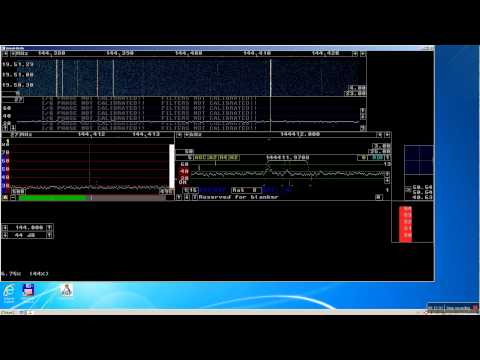
Leif, the programmer of Linrad has uploaded a video on YouTube showing how to set up it’s waterfall for very high sensitivity reception of extremely weak signals. Linrad is an SDR GUI receiver software with a tough learning curve, but very advanced features. In the tutorial Leif uses an RTL-SDR dongle to receive a weak beacon at 144.412 MHz. He shows how to adjust the Linrad settings to produce a waterfall and FFT spectrum that it optimized for visualizing and tuning to very weak signals such as distant beacons.