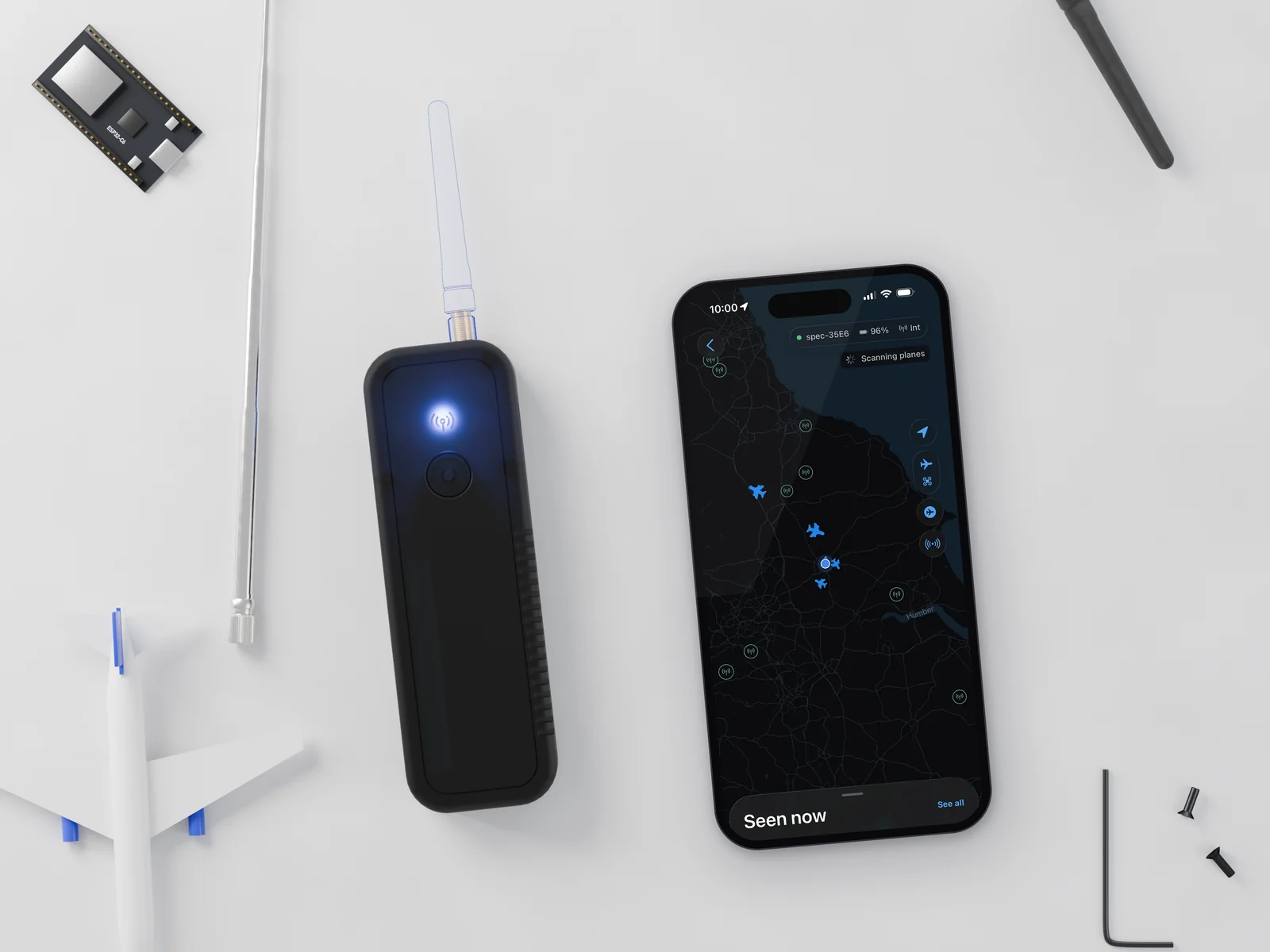
Thank you to Tom Emmerson from Carefully Coded for writing in and sharing LittleSpec, a pocket-sized, battery-powered receiver built around our RTL-SDR Blog V4/V4L. It sends data to an iOS or Android phone over Bluetooth LE, so there is no USB cable involved.
An ESP32-P4 drives the RTL-SDR and does all the processing on the device. An ESP32-C6 then sends the results to the phone app. Bluetooth doesn't have enough bandwidth for raw I/Q, so the app only gets spectrum, audio, and decoded data. That's still enough for an ADS-B aircraft map, an AIS ship map, FM and DAB radio, a spectrum and waterfall display, and mapped band sweeps. Drone Remote ID is received with the onboard 2.4 GHz Wi-Fi chip, and 433 MHz decoding is listed as coming soon. Other hardware includes a 3,350 mAh battery (about 8 hours estimated), USB-C charging, an SMA antenna port, and a resin-printed case.
UK pre-orders are open now, with the unit priced at £269. The first batch is expected to ship in January 2027. The website notes that the iPhone app is ready and free, and that the Android app will ship with the first units. US and EU orders are expected to open in a few weeks, and a build-it-yourself kit is planned for later.
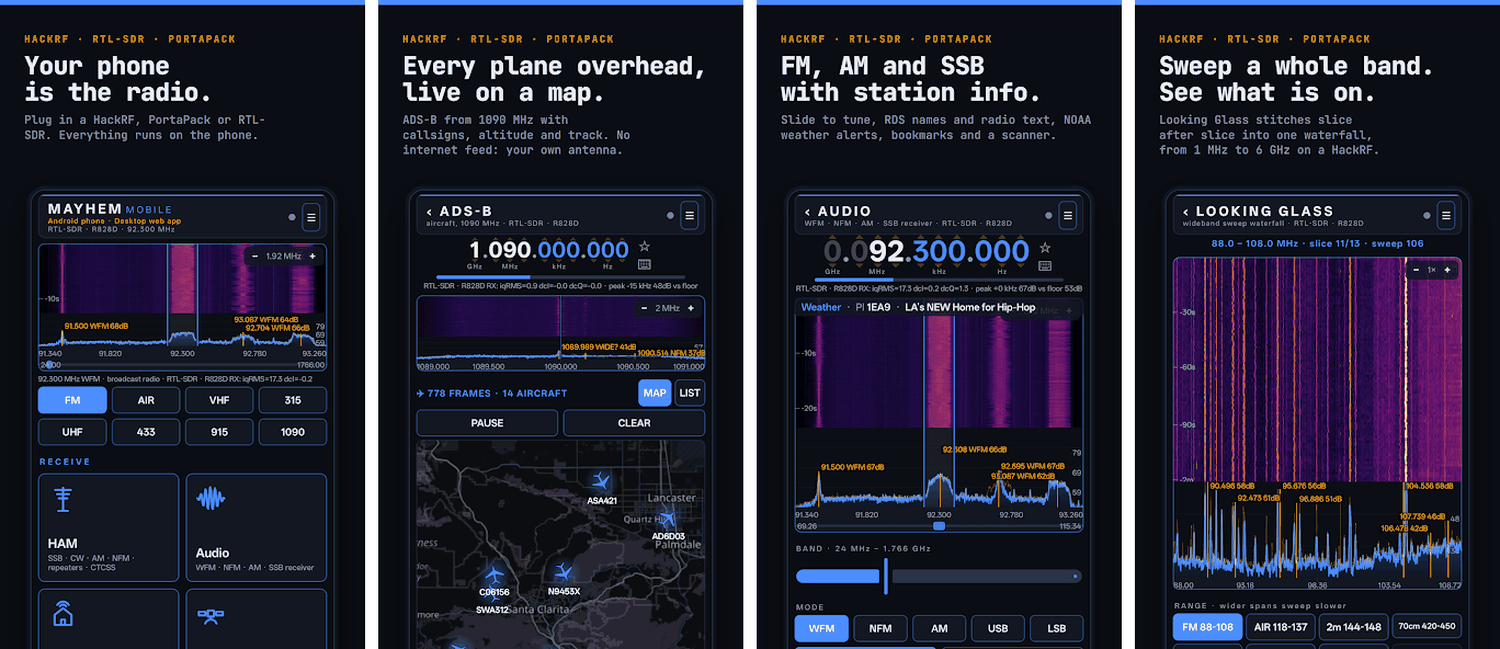
Back in October, we posted about Mayhem Mobile, a port of the HackRF PortaPack Mayhem apps that runs in a web browser or on Android with a HackRF, or an RTL-SDR. The developer, RocketGod, recently wrote in again to share a long list of new apps and upgrades.
The biggest addition is "Dispatch", a trunked radio feature that follows P25 Phase 1, P25 Phase 2 and DMR (including Capacity Plus) control channels and plays the voice calls. Encrypted calls are recognized and skipped. Other new apps include an NRSC-5 HD Radio decoder with album art and traffic and weather maps, 978 MHz UAT FIS-B weather, a combined ACARS and VDL2 decoder that receives every VDL2 channel at once, a radiosonde decoder with landing prediction, and a LoRa scanner for Meshtastic, MeshCore and LoRaWAN. There are also apps for JS8, ATSC TV, LTE emergency alerts, trains, utility meters, and car keys.
For RTL-SDR users, HF now works through direct sampling on the Blog V3, or the upconverter on our RTL-SDR Blog V4/V4L, and a bias tee switch has been added. The app is also now available on Google Play, and the web app can be accessed here. RocketGod notes that some of the apps may only be useful in the USA.
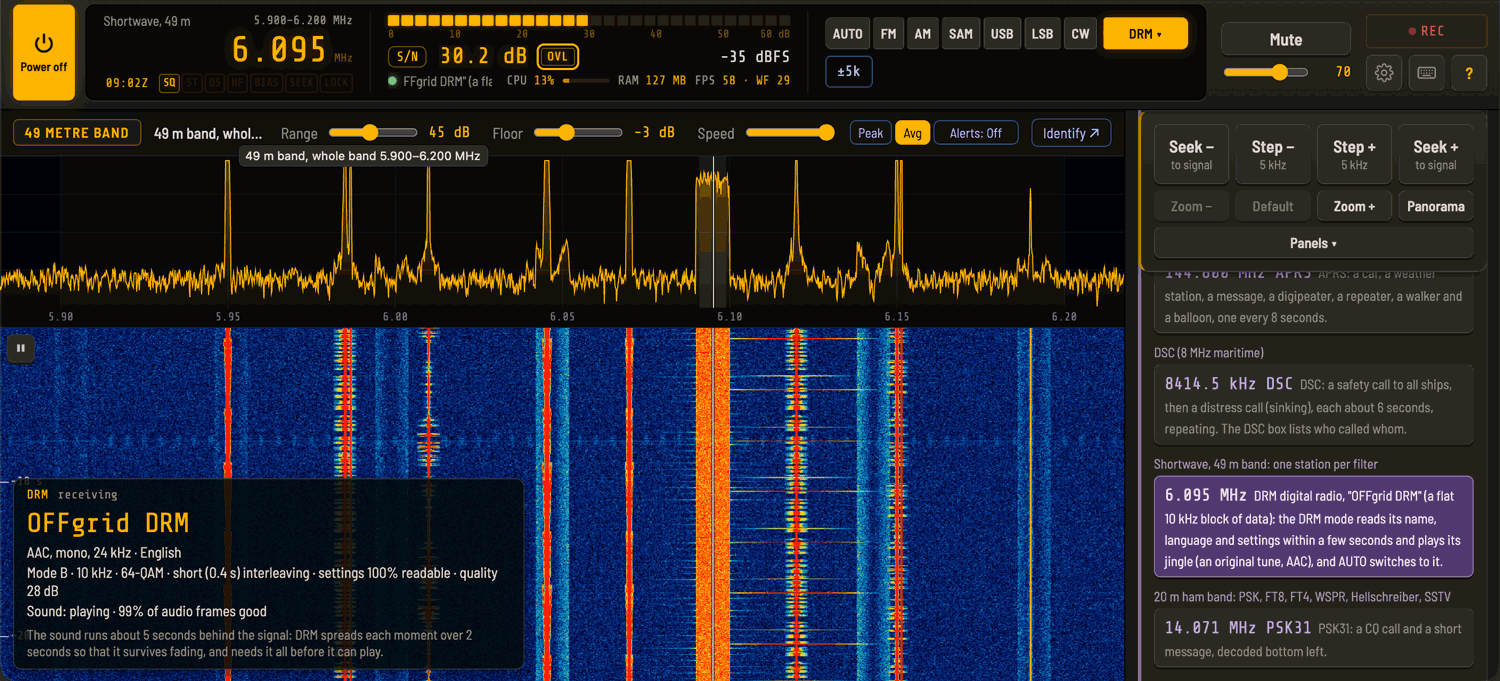
Back in October, we posted about OFFgrid-SDR, a fully offline RTL-SDR receiver program that runs in a web browser from a single index.html file, and we covered it again at the beginning of the month. OFFgrid-SDR creator Richard Didd wrote in again to share that the software is now at version 2.5 and has added several new features.
The biggest addition is support for SDRplay RSP devices. These connect through SDRplay's SDRconnect software, which can run on the same computer or on a headless machine elsewhere on the local network. A new Signal Monitor mode can watch up to eight signals at once while you listen to something else. It logs the level, S/N, occupancy, and drift of each signal, and it can follow drifting signals, estimate the modulation type, and record each transmission. DAB/DAB+ and DRM decoding have also been added, and station text and SlideShow images are shown where they are broadcast.
Over on the Airspy groups.io forum, Youssef (prog), the developer of SDR#, has announced the release of the SDR# VDK (Vibe Development Kit). The VDK is meant to let anyone create SDR# plugins with AI coding agents like Claude Code or ChatGPT Codex, without needing to be a programmer.
The kit includes a working plugin template, the SDR# API documentation, DSP primitives, and a set of instructions that teach the AI agent the coding practices Youssef uses in his own plugins. You unzip the VDK on a Windows PC, point the agent at the folder, and describe the plugin you want. The agent then writes the code, builds it and deploys the plugin into your local SDR# install.
To demonstrate it, Youssef had an AI agent produce a working DRM receiver plugin from a single prompt. In a second video, ChatGPT built a DAB/DAB+ plugin in about 20 minutes. Youssef notes that AI-written code still needs testing. The VDK is available as a zip file from the Airspy website, and plugins built with it require the latest SDR# build.
Other users have posted results but haven't released their plugins yet. Edward MacDonald built an MCP server and connector plugin that lets Claude control SDR# directly, view the spectrum and work with the I/Q and audio streams. As a test, Edward asked Claude to find all local FM broadcast stations and list their names, frequencies and SNR values. Craig_H created an L-band ACARS decoder for the 600, 1200 and 10500 bps channels with a single Claude prompt, and TheP111 reports getting a working RTTY decoder plugin out of Claude Code in 15 minutes. Roberto Cipriani has replaced the old 32-bit SimpleDMR plugin with a VDK-built version and plans to do TETRA next. Youssef himself is currently using the VDK to write a DVB-T/T2 decoder from scratch.
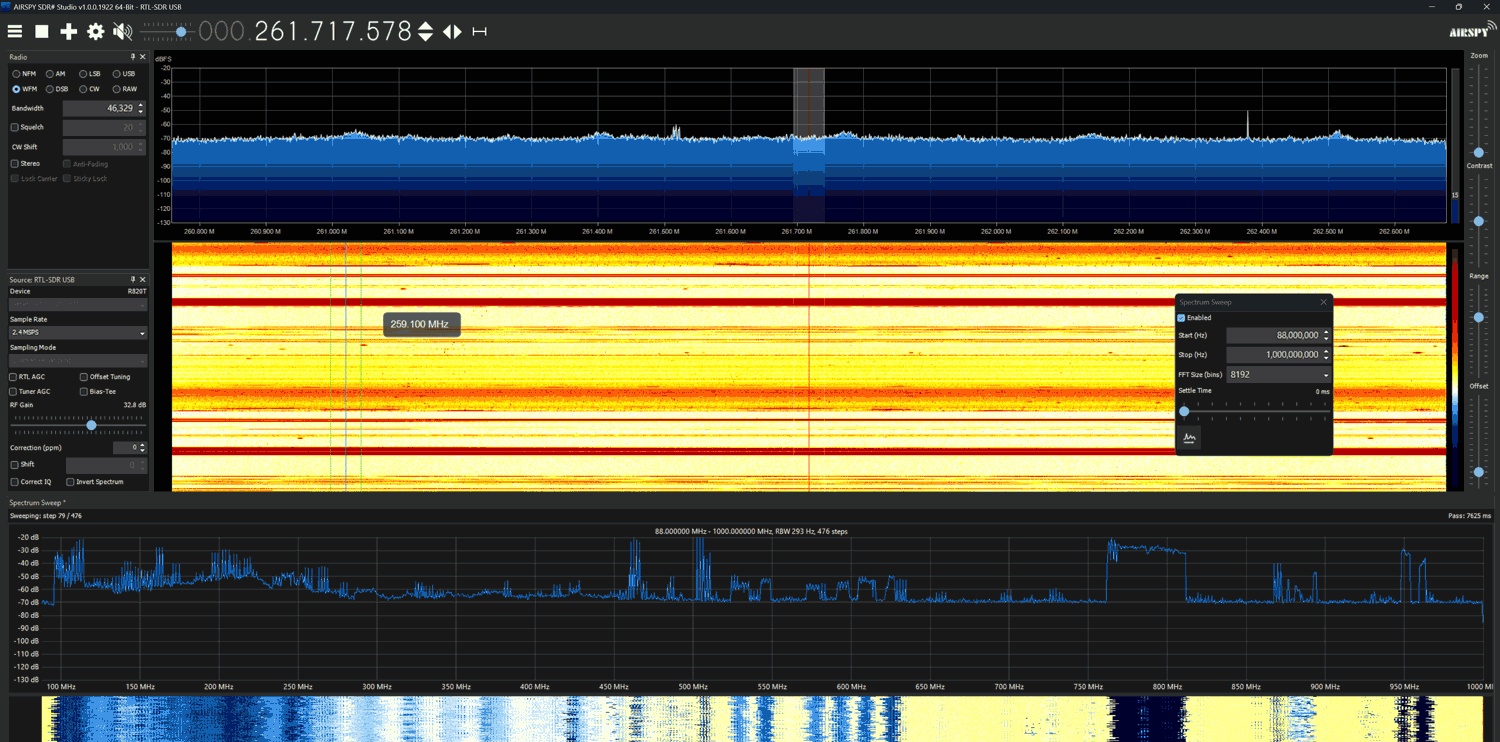
We gave the VDK a test ourselves and had it code up a wideband FFT sweeper by giving Claude Opus 5.5 a simple plain english prompt "Make a plugin that allows us to view a wider spectrum, by rapidly sweeping across the spectrum". Claude prompted us to install the .NET 10 SDK, and then it created, compiled, and installed the plugin all on its own, giving a working result after only 10 minutes.
SDR# VDK: Wideband FFT Sweep implemented by Claude Opus 5.5 in 10 minutes.
Airspy VDK Demo - DRM Plugin
SDR# VDK One Liner Demo
AI Disclaimer: The VDK is designed for building SDR# plugins with AI coding agents, and the plugins mentioned in this post were created with AI agents.
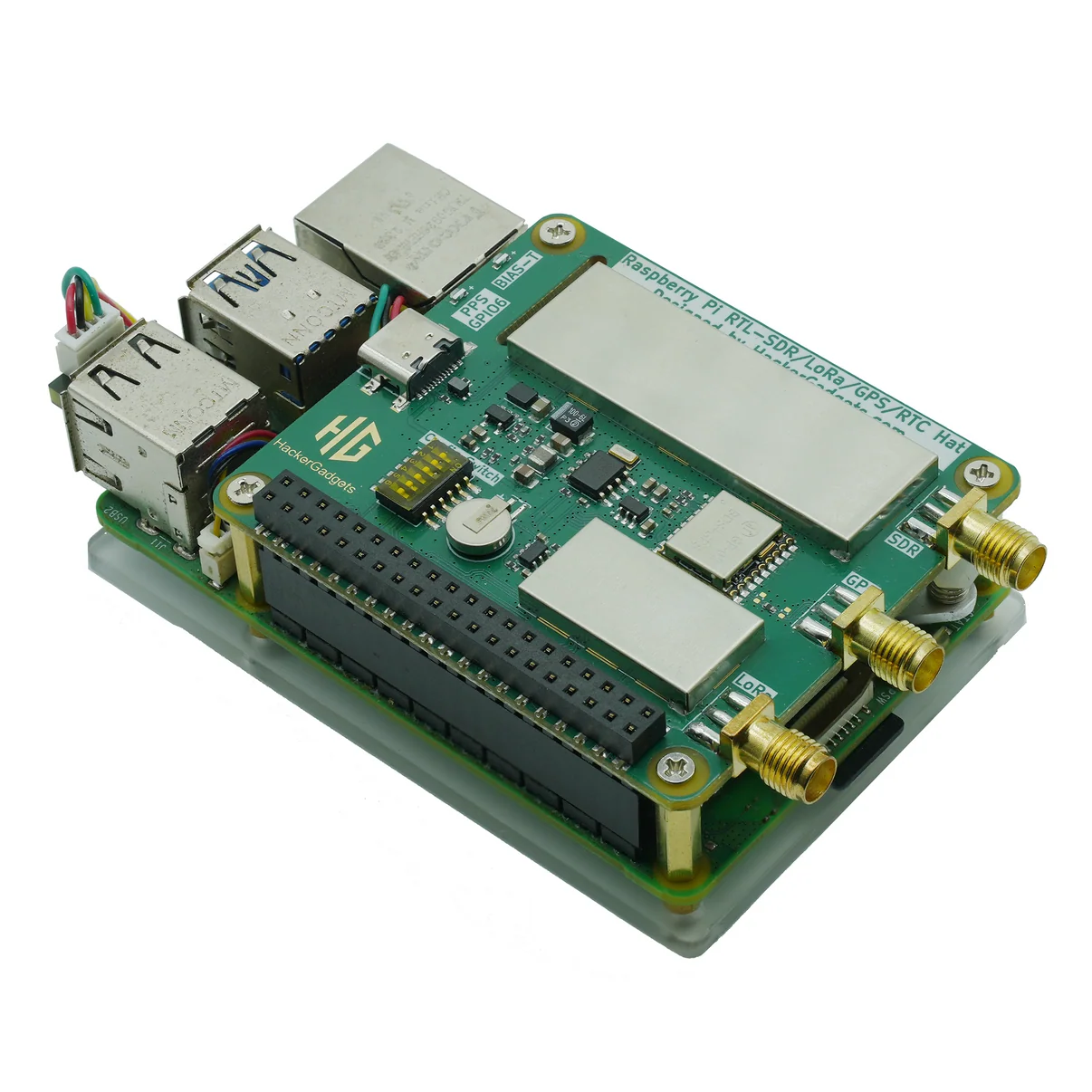
Thank you to Shelly from HackerGadgets for writing in and sharing their new Raspberry Pi 4-in-1 HAT, which puts an RTL-SDR, a LoRa radio, a GNSS receiver, and a real-time clock onto a single board that sits on top of a Raspberry Pi.
The RTL-SDR section uses an RTL2832U with an R860 tuner. It covers 100 kHz to 1.74 GHz, with HF direct sampling from 100 kHz to 28.8 MHz. It also has a TCXO and a software-controlled 5V bias tee. The LoRa side uses a Semtech SX1262 covering 860 - 960 MHz with up to 22 dBm output and Meshtastic support. The board also has a GPS/BDS GNSS receiver that works with active or passive antennas, and a PCF85063A RTC chip with a rechargeable 3V coin cell.
HackerGadgets suggests ADS-B tracking, NOAA weather satellite reception, Meshtastic off-grid messaging, and vehicle or drone positioning as potential uses. Having GPS and a battery-backed RTC on the same board should be useful for portable or off-grid Pi builds where there is no network time to sync to. So far we have not seen any reviews or demonstrations of the product in action, but we will update if we do.
HackerGadgets Raspberry Pi 4-in-1 RTL-SDR, LoRa, GPS and RTC HAT
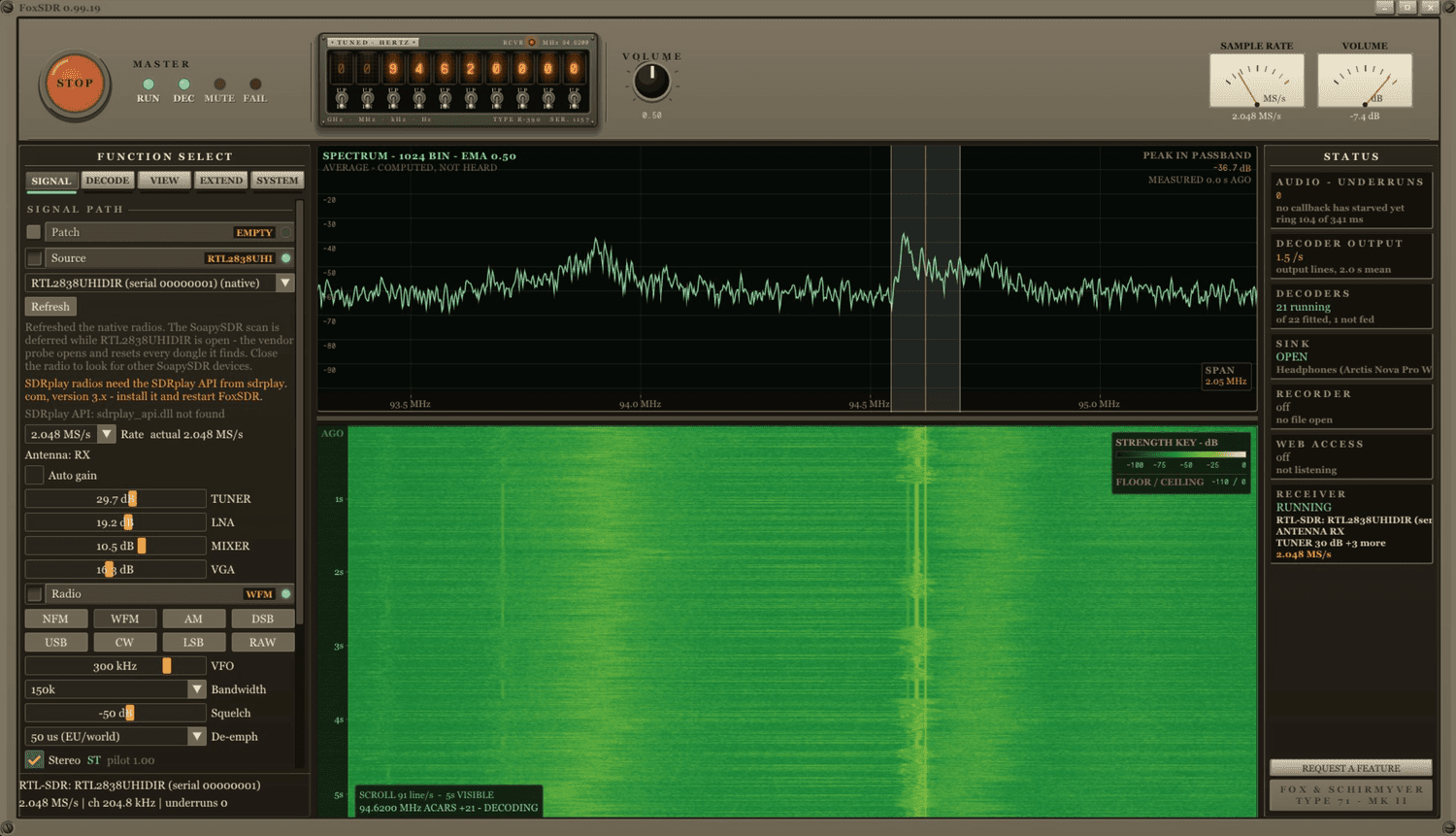
Back in September we posted about FoxSDR, a from-scratch SDR receiver for Windows with a built-in plugin store. In October, we covered its node canvas update and its Airports & Navaids plugin. The developers have now written in again to share version 0.99.109, which has a redesigned main window and is now up to 89 plugins.
FoxSDR supports the RTL-SDR Blog V3 and V4. On Windows, a single click installs the WinUSB driver, so you no longer need Zadig. There are new decoders for DAB/DAB+,
radiosondes, VDL2 and P25 trunking, plus some less common plugins. "Radar Sweep" finds nearby secondary surveillance radars from aircraft replies. The ILS Meter measures
a localizer or glide path from its 90 and 150 Hz tones. The Meteor Scatter Ping Counter counts meteor echoes per hour on a steady VHF carrier such as 143.050 MHz. There's
also a Loran-C receiver, a sudden ionospheric disturbance (SID) monitor that logs VLF carriers, a voice inversion detector, and a fox hunt homing aid that turns signal
level into a rising pitch.
The developers are open about the fact that only 28 of the plugins are tested. The other 61 are experimental and have only been tested on their own recordings. They're asking RTL-SDR owners to help beta test, especially the DMR/D-STAR monitor and the Inmarsat-C/Aero plugins. For the first seven days after release, they are running a bug fix sprint. FoxSDR is free for noncommercial use, and the application source is public under PolyForm Noncommercial 1.0.0.
FoxSDR 0.99.109 Screenshot
AI Disclaimer: wonderingStars describes their company as a human-gated AI company, and FoxSDR is coded with the help of AI.
Back in October, we posted about D325f-SDR, which turns the Qualcomm modem in an old LG phone into an SDR, and we posted an update last week. Now Piotr Krysik has written in to share HaxaWave, a similar project but for the MSM8916 modem in a Wileyfox Swift phone. Piotr notes that it has been in the works since before these phone SDRs started appearing this year.
HaxaWave is receive-only and needs no hardware modification. It tunes 735-995 MHz and 1195-2700 MHz at up to 14.8 MS/s, limited by the phone's USB 2.0 port.
Piotr notes that sensitivity varies strongly across the range because of the filters in the phone's receive path. The phone runs Nura (formerly postmarketOS) and shows up as a SoapySDR device, so programs like SDR++ work on a PC over USB networking, or on the phone itself.
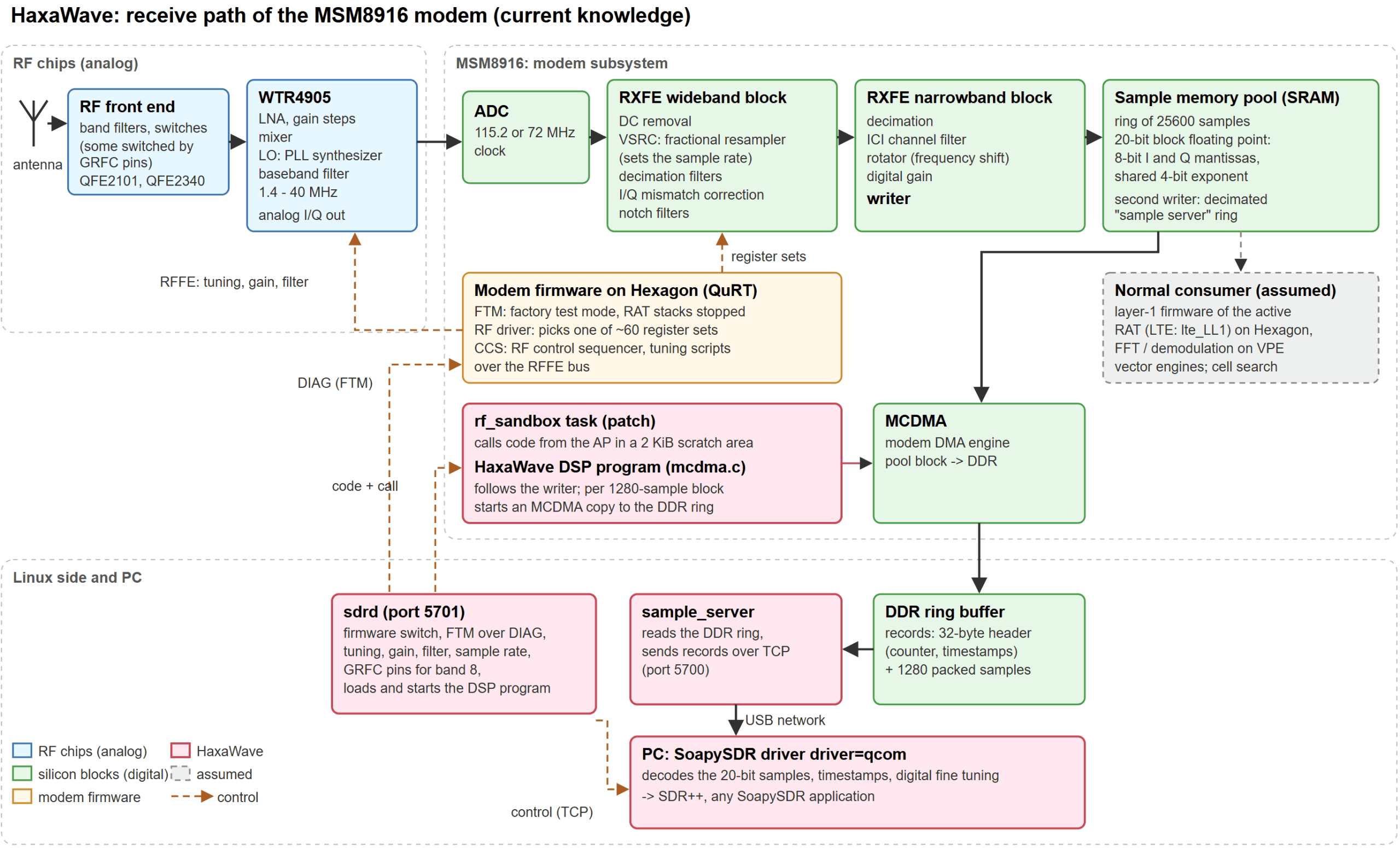
Rather than patching the stock modem image, the firmware is built from Qualcomm's public modem_proc source with a few small patches. The SDR itself is a Hexagon DSP program loaded at run time, and the stock firmware can be selected again at any time. The project is experimental and tested on one phone only. The code is open source under the GPL-3.0 licence and available on GitHub, along with a build and install guide and a description of how the receive path works.
Block Diagram of the MSM8916 Modem
HaxaWave: Comparing a USRP B210 with the modem of a phone used as an SDR
AI Disclaimer: Piotr notes that the project was developed with the help of LLM tools, and the README states that language models did a large part of the work.
Over on YouTube, Jdaie Lin from the PiSugar Studio channel has uploaded a video showing how they built a handheld ADS-B "air traffic control" console. A Raspberry Pi runs readsb with an RTL-SDR (RTL2832U / R820T) to receive 1090 MHz ADS-B signals, and the aircraft are shown on a live map on PiSugar's Whisplay HAT+ touchscreen. A PiSugar 3 Plus battery makes it portable, and an M5Stack joystick and scroll wheel on the Grove port handle panning and zooming. The RTL-SDR sits outside the 3D-printed enclosure for cooling and antenna access.
The more unusual feature is the AI "pilot". When you select an aircraft, its live telemetry goes to a language model with a pilot voice profile. You can then hold a button and ask questions like "What is your altitude?" through the console's microphone and speaker. The answers come from real ADS-B data, but nothing is transmitted and no real pilots are involved. We note that the project README says speech recognition and the Ollama model run on a separate Mac, not on the Pi itself.
The code is available on GitHub, but no license is listed. Note that PiSugar makes the Whisplay HAT+ and battery used in the build. The AI pilot section starts at timestamp 4:08 in the video below.