Live Mesh Map: A Self-Hosted Live Map for Meshtastic and MeshCore LoRa Mesh Networks

Thank you to Olivier Parriaux (F4GLD) for writing in and sharing "Live Mesh Map", a free, open-source and self-hosted live map and monitoring tool for Meshtastic and MeshCore LoRa mesh networks. We've posted about Meshtastic several times before, and Live Mesh Map can display both Meshtastic and MeshCore networks together.

Live Mesh Map takes data from a local node or an MQTT broker, decodes the mesh traffic, and plots nodes, direct RF links with SNR and RSSI, traceroutes and channel utilization live. It can also estimate terrain coverage from any point using the worldwide Copernicus 30 m DEM, rank the best hilltops for a new relay, and simulate what happens if a relay goes down. Olivier notes that the coverage model is calibrated against the links actually measured on the network. Optional layers can also show LoRaWAN devices from The Things Network and APRS stations.

The software runs in Docker on a Raspberry Pi, NAS or PC with no cloud dependency, and is available in English and French. The code is open source under the GPL-3.0 licence and available on GitHub. A live demo running on a real network in Haute-Loire, France, can be found at http://saint-appo.fr:8095/, and more screenshots are on the project's wiki.
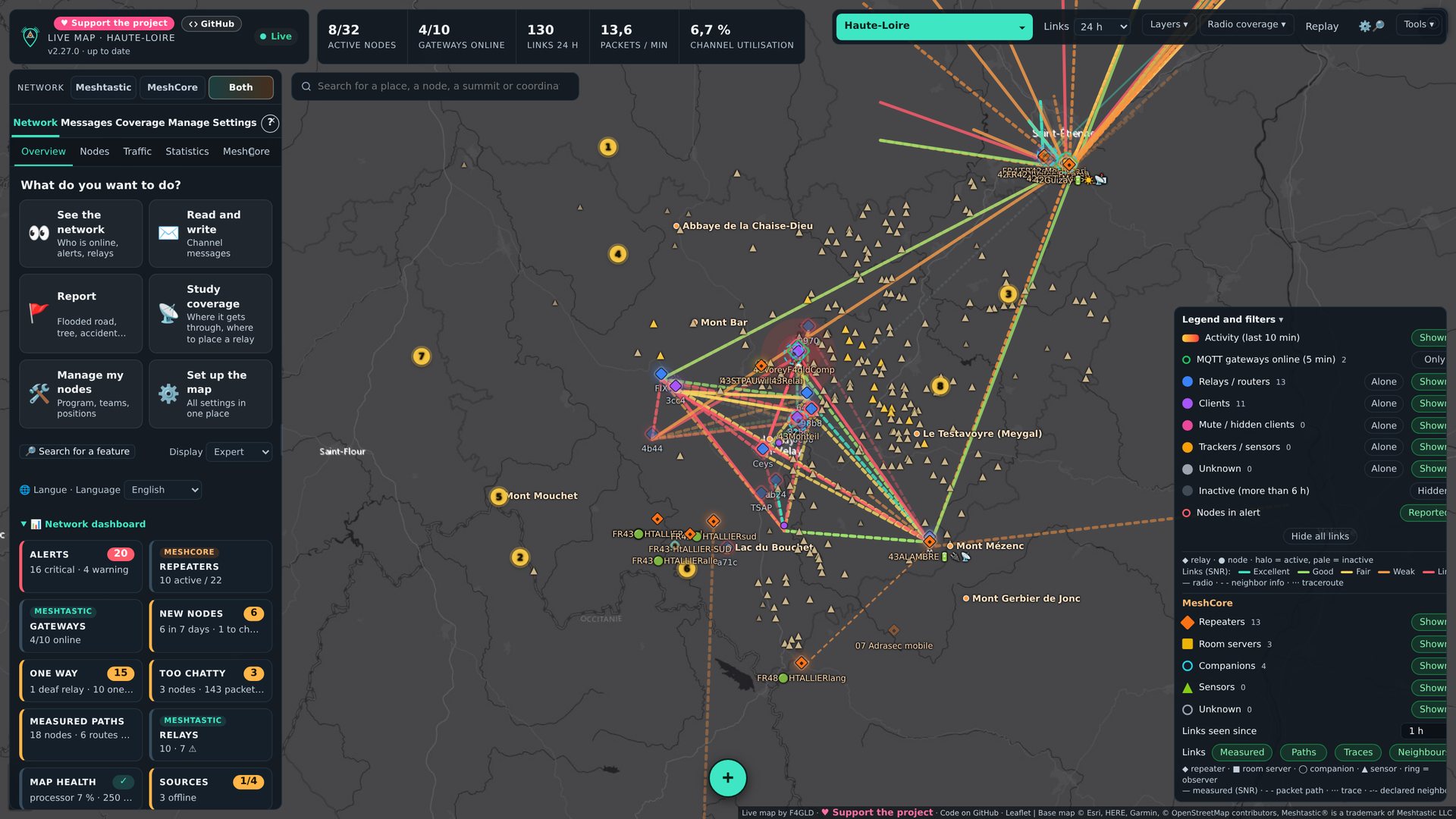
Live Mesh Map Showing a Meshtastic Network in Haute-Loire, France

AI Disclaimer: While the author does not disclose it, the GitHub repository contains Claude Code agent configuration files, so it is our opinion that this software may be coded with the help of AI.
VKVSkimmer: A Free CW and RTTY Skimmer for RTL-SDR, SDRplay and Icom IC-7610 / IC-7760

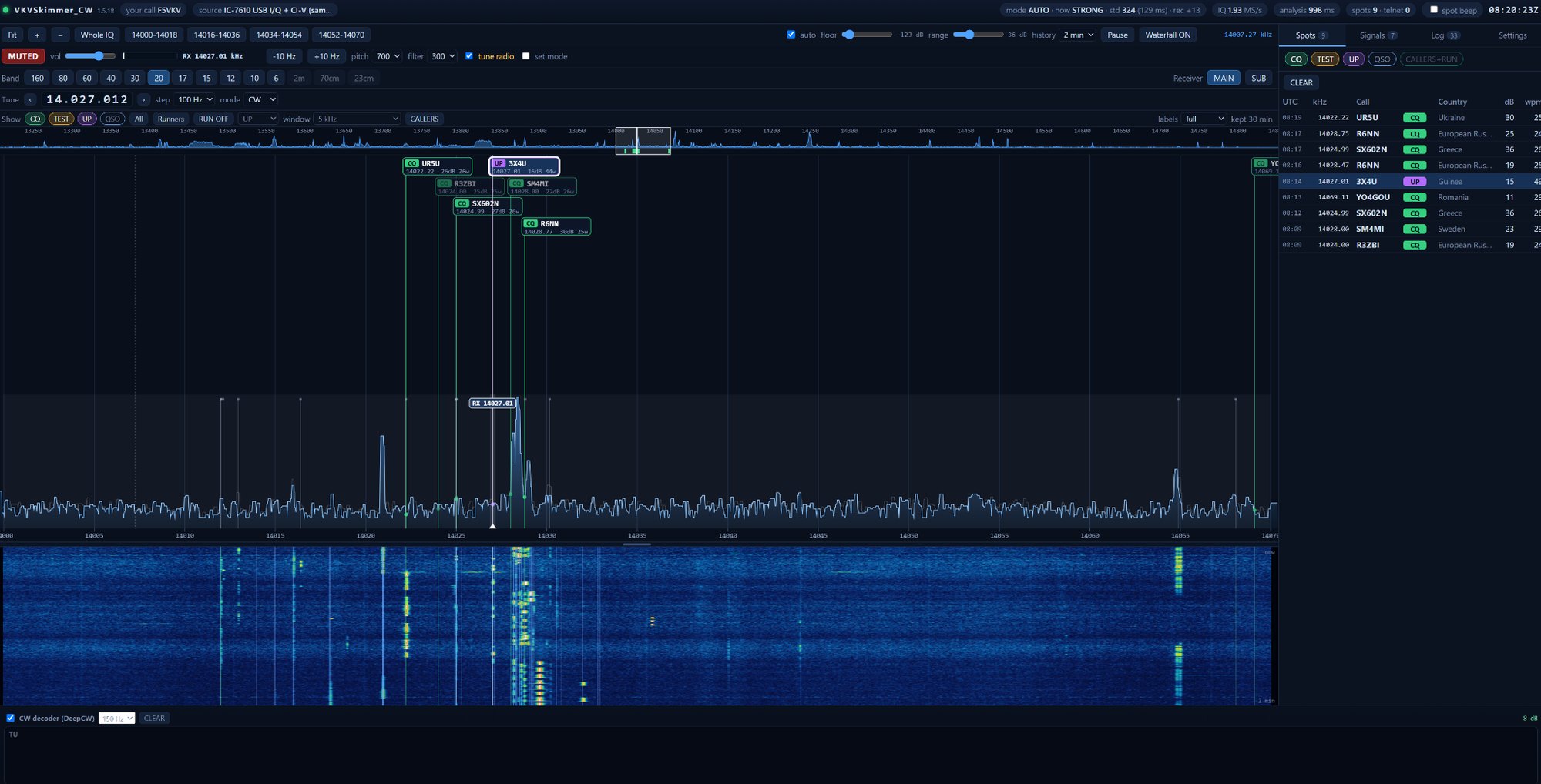
Fabio (F5VKV) has written in to share VKVSkimmer, a newly released free CW and RTTY skimmer for Windows. A skimmer decodes every CW or RTTY signal in the received bandwidth at once and publishes the callsigns it hears as spots, which contesters and DXers then use to find stations.

VKVSkimmer works with an RTL-SDR through rtl_tcp, an SDRplay RSP, or the I/Q output of the Icom IC-7610 and IC-7760. CW decoding uses the neural-network-based DeepCW decoder from VE3NEA, with a Viterbi decoder as a second opinion. To keep busted calls from being published, callsigns are checked against cty.dat, Super Check Partial and, optionally, live Reverse Beacon Network (RBN) spots. The software has a browser-based GUI with a spectrum, waterfall and spot list. It also includes a built-in telnet cluster for N1MM+, DXLog or any telnet client, spectrum output to N1MM+, and output to the RBN Aggregator.

VKVSkimmer is free, with no licence or registration required. Note that receiving HF with an RTL-SDR needs a dongle with HF support, such as our RTL-SDR Blog V4L, or the V3 in direct sampling mode. Screenshots and the download are available on the VKVSkimmer website.

VKVSkimmer GUI
VKVSkimmer GUI

Flipper One Launches on Kickstarter: A Linux Multi-Tool with an Optional SDR Module and MT7921 Wi-Fi

Back in May, we posted about the early development plans for Flipper One, a pocket Linux computer from the makers of the Flipper Zero. The Flipper One Kickstarter campaign has now launched and is already well past its goal, with over 23,000 backers and over $12 million raised. Pledges start at US$399, or US$539 with the SDR module, and shipping is expected to start in July 2027.

The SDR module is a USB device that mounts to the top of the Flipper Zero, and it screws to the frame to protect the USB connector. Flipper notes that its specifications are not finalized yet, as they are experimenting with "undocumented features of some unusual chips", but preliminary figures on the campaign page indicate 24 - 1700 MHz with 10 MHz of bandwidth. Interestingly, the built-in Wi-Fi 6E uses the MediaTek MT7921AUN, the same chip that the BirriaSDR and Mtk79ICAP projects use to capture raw I/Q, and Flipper says they are exploring this too. A LoRa module for Meshtastic, MeshCore, and Reticulum is also offered, along with a 5G module.

Otherwise, Flipper One is mainly a networking tool running mainline Linux, with a Rockchip RK3576 CPU, 8 GB of RAM, two Gigabit Ethernet ports, HDMI and an M.2 slot for 5G modems or SSDs. Note that it is not a Flipper Zero replacement, as it has no Sub-GHz radio, NFC or RFID.

Flipper One - Open Linux Multi-tool | Kickstarter Video

ramses-sdr: Decoding Honeywell Evohome Heating System Traffic with an RTL-SDR

Thank you to Hans de Vries for writing in and sharing ramses-sdr, an open-source receiver for Honeywell Evohome's RAMSES II traffic at 868.3 MHz. Evohome is a wireless multi-zone heating control system, and RAMSES II is the protocol its radiator valves, thermostats, and boiler bridges use to talk to the controller. Hans built ramses-sdr to see when the radiator valves were calling for heat and what the OpenTherm bridge was reporting.

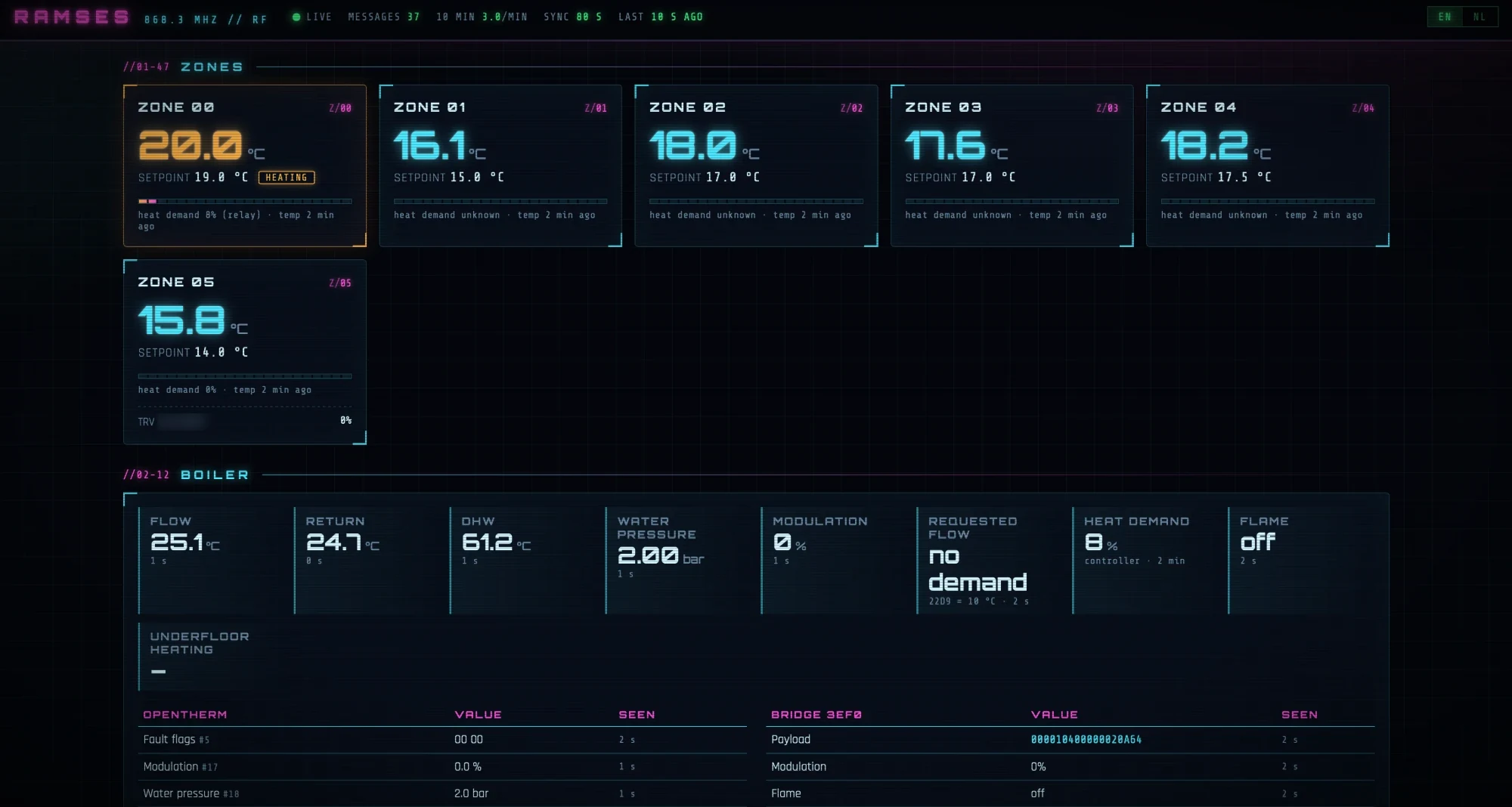
The demodulator is written in Python and NumPy and takes raw I/Q from rtl_sdr. It demodulates the FSK bursts, recovers the 38,400 baud serial stream, then Manchester decodes and checks the frames. Packets are written in the ramses_rf/evofw3 log format, and raw I/Q can be recorded and replayed. A local web dashboard shows zone temperatures, setpoints, heat demand, valve positions and OpenTherm values alongside a live packet log.

Hans tested it with an RTL-SDR Blog V4 and a dipole. Reception is passive, so no dedicated RAMSES gateway or firmware flashing is needed. The code is MIT licensed and available on GitHub, along with setup instructions and notes on the protocol and decoding.

The ramses-sdr Web Dashboard

WaveSentry: Detecting Drone Signals with a HackRF, a Neural Network and an ESP32 Handheld

Thank you to Minsu (Gabriel) Kim for writing in and sharing WaveSentry, a drone RF detection prototype built with teammates Hyeongjun Kim and Junghwan Kim for D4D, a defense hackathon in South Korea. Their project uses a HackRF to feed I/Q samples to a Windows app, which converts them into spectrograms and uses a YOLO model to spot drone signal patterns. YOLO ("You Only Look Once") is a popular family of fast neural network models for detecting objects in images, and here it treats drone transmissions in the spectrogram as objects to find and draw boxes around. An "RF Observatory" view shows the spectrum, waterfall, and detections, and alerts can be sent to "Halo", an ESP32-S3 handheld with a circular LVGL display.

In their write-up on LinkedIn, the team explains that their first model, trained on synthetic backgrounds, raised alerts on recordings made with the drone switched off. They fixed this by recording real background I/Q with the HackRF and inserting segments of recorded drone signals into it to generate labeled training data. Minsu also notes that on November 14 they recorded the drone link on the platform and aboard a crowded train at Suwon Station, a busy rail station full of Wi-Fi and Bluetooth traffic, and they are now preparing a paper on the work.

We note that WaveSentry is still a prototype. The RF detection and the handheld alerts were tested separately, and alert latency and false alarm rates over the full path from receiver to handheld have yet to be measured.

The Wavesentry UI detecting an RF drone signature

MultiPSK Will Become Free of Charge From January 2027

Recently we've seen that Patrick Lindecker (F6CTE), the author of the long-running MultiPSK decoding software, has updated the MultiPSK licence page to note that no more user keys will be sold from 1 January 2027, and that the software will be free of charge from then. Currently, a user key that unlocks the full version costs 35 Euros.

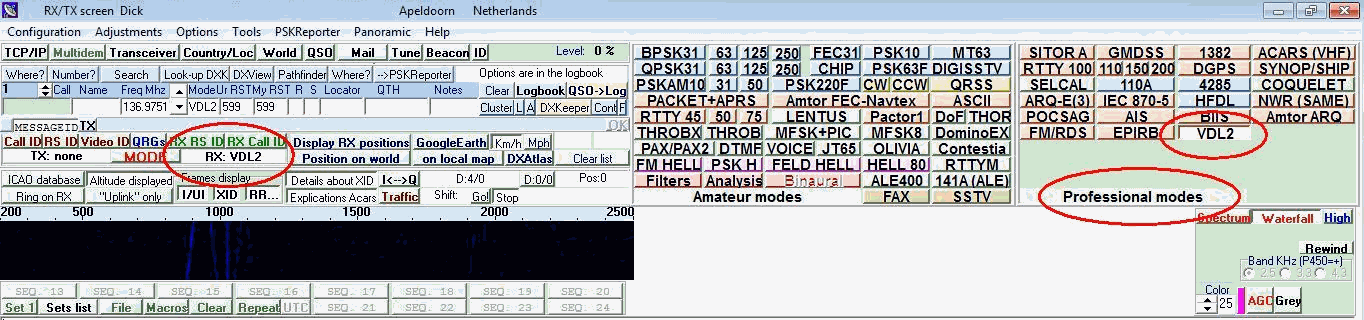
MultiPSK is a Windows program famously known for being able to decode a huge range of amateur radio and utility signals, including PSK31, RTTY, FT8, ACARS, AIS, POCSAG, DMR, ADS-B, and radiosondes. It is also infamously known for having what many consider an overwhelming, convoluted, and very 90s-style interface. It can connect directly to an RTL-SDR or take audio piped from any receiver, and it has been a popular choice with SDR users since the early days of the RTL-SDR. Over the years, we've posted about it being used to receive HFDL, VDL2, Orbcomm and DGPS. Until now, the free version has limited most professional modes to five minutes of decoding at a time.

Patrick does not give a reason for the licence change. However, we note that legacy software like MultiPSK is increasingly being replaced by newly developed AI-coded programs, as vibe coding with state-of-the-art AIs can produce a working decoder for most protocols in minutes. In our opinion, as AI improves, standalone pre-made programs may eventually fade away, replaced by asking an AI to create a custom decoder on demand.

MultiPSK Decoding VDL2

D325f-SDR LG Phone SDR Update: App 2.0, Meteor-M HRPT Reception and an SNR Comparison Against the RTL-SDR Blog V4

Back in October, we posted about D325f-SDR, a project from Logan Zarov that turns the Qualcomm cellular modem in an old LG D325 Android phone into an SDR, using the phone's own Bluetooth transmitter as a local oscillator to reach below 800 MHz. Logan has written in again about some updates to the software.

Version 2.0 of the app adds scheduled recordings with the screen off, recovery after modem failures, an IQ inversion switch, and Bluetooth channel and power settings. Logan has also received Meteor-M N2-3 HRPT at 1.7 GHz with a homemade helix feed and dish, and decoded it into an image with SatDump. MetOp-B AHRPT reaches frame sync, but Reed-Solomon decoding still fails.

Logan also compared CW SNR against our RTL-SDR Blog V4 in a shielded box. The LG came out ahead from 417 to 717 MHz and above 1 GHz, but behind below 400 MHz. Logan notes that these are preliminary, uncalibrated results. Logan also estimates the default Bluetooth LO level at about 3.5 mW, under the 10 mW EIRP limit in the EU/UK and Russia, but notes that in the US only levels 0 to 5 fit under FCC 15.249. Raw files and more results are in the project's field notes.

Logan has also posted a video showing how the phone's hardware is modified to allow for an external antenna via the phone's 3.5mm headphone jack. The video also shows how to patch the software and shows Logan receiving various signals and bands on the phone, including broadcast FM, shortwave, VHF, UHF, a 1875 MHz cell base station downlink, and finally a 1.7 GHz HRPT weather satellite image from Meteor-M N2-3.

D325F-SDR: turning an LG phone's own modem into an SDR receiver

AI Disclaimer: The project's credits note that AI tools assisted with code development and documentation.

MultiScan SDR: A Multi-Band Pseudo-Spectrum Scanner for RTL-SDR, HackRF, Airspy and SDRplay

Thanks to Mike for writing in and sharing his freeware program "MultiScan SDR". It's a fast, wideband scanner for Windows and macOS that sweeps several bands side by side and stops only on real transmissions. It supports the RTL-SDR, HackRF, Airspy, SDRplay RSP series, and Fobos SDR.

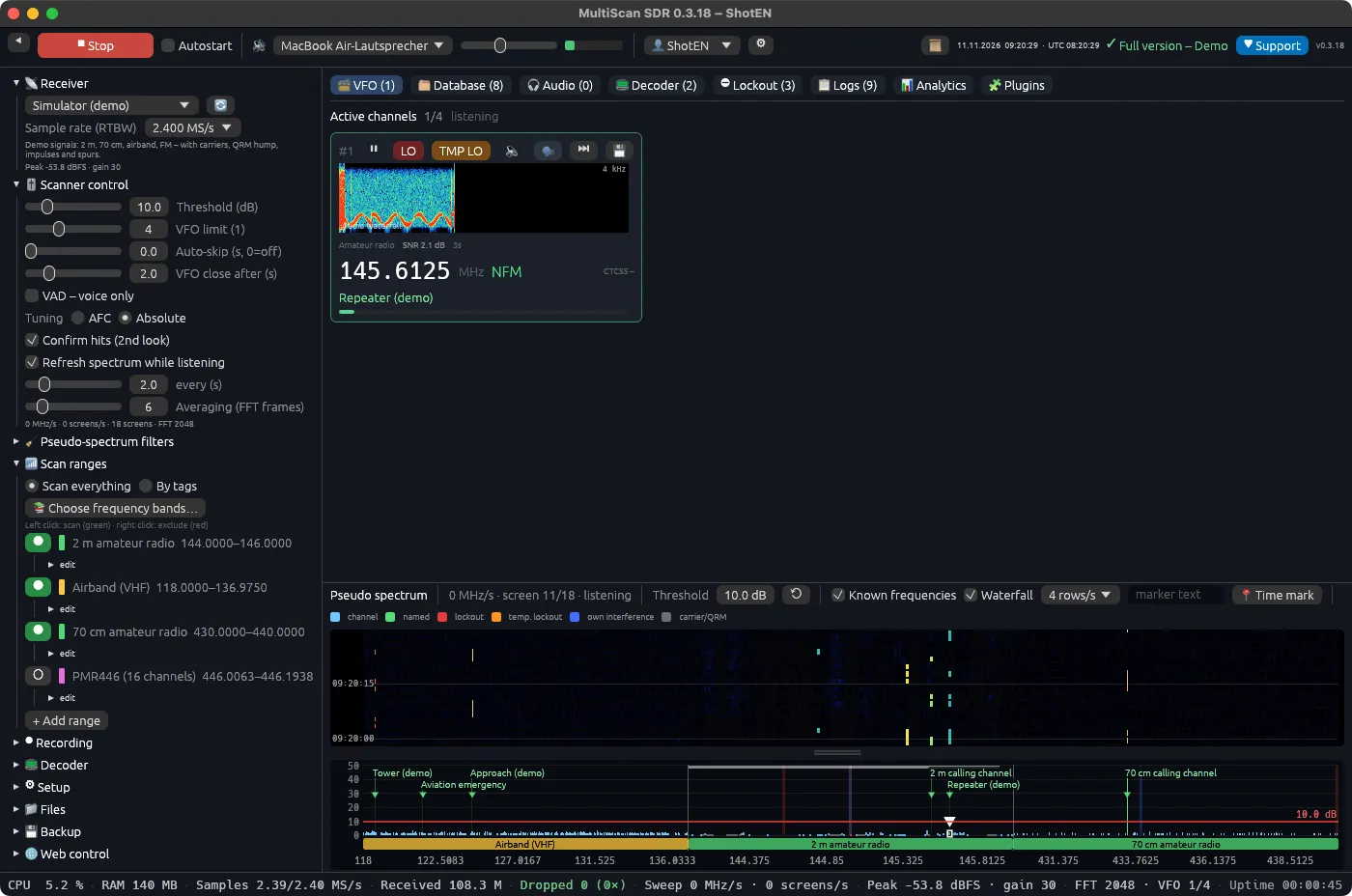
The main feature is what Mike calls a "pseudo-spectrum", which doesn't display raw power. Instead, MultiScan sets the noise floor of every frequency to 0 dB, so each channel shows how far it rises above its own local noise. A channel opens only when modulation appears, so unmodulated carriers and short wideband noise spikes are ignored. Other features include up to 10 VFOs, each with its own audio waterfall, band plans for 8 countries, SDR# frequency list import, lockouts with automatic receiver spur detection, and local speech-to-text using Whisper. It also includes ADS-B, AIS, 433 MHz sensor, ACARS, and APRS decoders, plus web control so you can listen from a phone or tablet on your home network.

We note that a basic version of the software is free, but does not appear to be open-source, and is restricted to 2 VFOs. Recording, the decoders, speech-to-text, and web control are unlocked with a support payment (€20 suggested, or any amount you choose). A PRO version that adds a signal classifier and support for multiple SDRs at once is listed as coming soon. Windows users will need to install the WinUSB driver via Zadig first. More information, including a user guide in English, German and French, can be found on the MultiScan SDR website.

Multiscan-SDR Scanner screenshot showing the pseudo-spectrum
MultiScan SDR Scanner screenshot showing the pseudo-spectrum

AI Disclaimer: The author has disclosed that this software has been created with the help of AI.