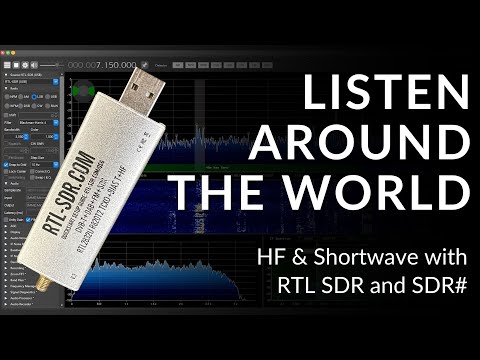
Over on YouTube, Tom the Dilettante has uploaded a video demonstrating how to receive HF signals with an RTL-SDR Blog V3 running in direct sampling mode. This is something already known to most RTL-SDR fans, but on the RTL-SDR V3 we have built in a direct sampling circuit that enables reception below 24 MHz with a simple settings change in software.
In the past and with other dongle brands, enabling direct sampling required hardware mods involving directly soldering a wire antenna to very small pins or pads. Direct sampling is not a high performance mode for HF, but in many situations it can be good enough for casual listening.
In his video Tom demonstrates HF reception with the RTL-SDR Blog V3 and an MLA-30 active loop antenna. This is a cheap loop antenna available on Aliexpress that works very well for the price.
Listen Around the World - No Internet Required (HF & Shortwave on RTL SDR)
Over on YouTube TheSmokinApe has uploaded a video showing how to use the direct sampling mode on RTL-SDR Blog V3 devices to receive HF transmissions, such as the ham bands, short wave and AM broadcast. In the video he shows how to activate direct sampling mode in SDR#, and then goes on to show reception of a few HF signals.
We note that an appropriate HF capable antenna is required to receive HF signals. The multipurpose dipole kits we sell are for VHF/UHF reception only. A simple and low cost HF antenna could just be a long wire running through your house.
Tech YouTuber Lon.TV has recently uploaded a video demonstrating how to identify and decode various digital transmissions with an RTL-SDR dongle. In the video he explains how to use VB Cable to pipe audio from SDR# into various decoders, and then goes on to show DMR, APRS, POCSAG, L-Band AERO, FT8, and JS8/JS8CALL all being decoded via an RTL-SDR Blog V3 dongle.
Software Defined Radio Part 2 - Decoding Digital Transmissions with an RTL-SDR USB Radio
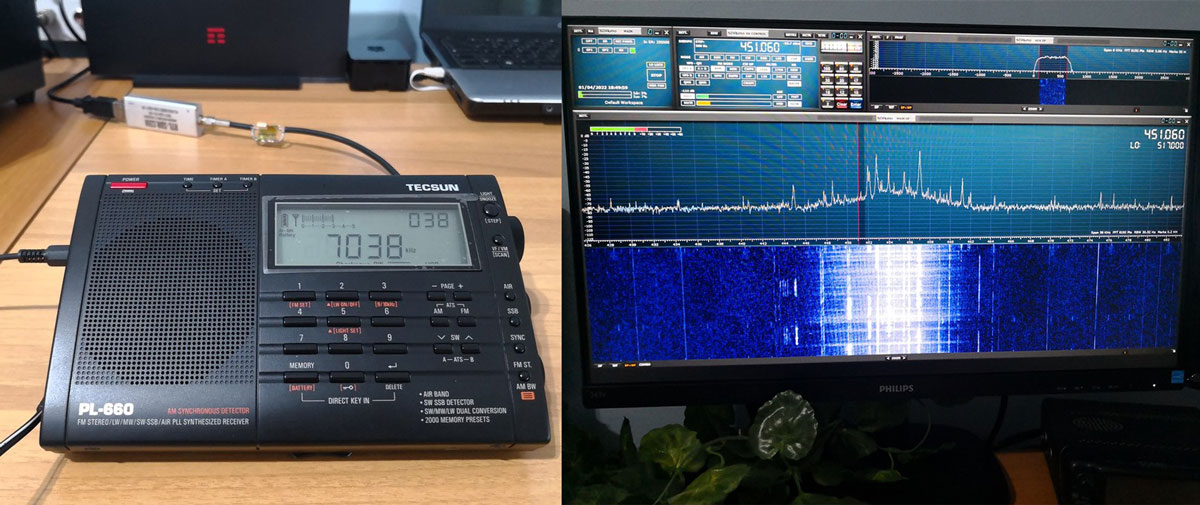
Thank you to Joseph IT9YBG for submitting his article describing how he has made an RTL-SDR based panadapter for his TECSUN PL660 portable shortwave radio. The post is a series of pictures that show how Joseph was able to open the PL660 and connect a coax cable to the IF output, and mount the connector on the plastic cover for easy access. He then connects that IF output to the RTL-SDR via a 10pF capacitor.
The result is that Joseph is able to receive the IF output of the PL660 at 451 kHz in SDRUno with his RTL-SDR Blog V3 running in Q-Branch direct sampling mode. He notes that although the IF bandwidth from the PL660 is small, it is possible to decode digital signals by passing the audio demodulated by SDRUno into decoding software.
The KK5JY Loop on Ground (LoG) antenna is a 15 feet per side square loop designed for reception of HF and lower. It simply consists of an isolation transformer and wire that as the name implies is placed somewhere on the ground in a square loop like shape. It is cheap and easy to build and compact in that it does not take up any usable space.
In his latest video Rob from the Frugal Radio YouTube channel tests out this antenna with his Airspy HF+ Discovery SDR. He uses a bit of wire lying around, and a low cost 9:1 Balun from NooElec as the isolation transformer. With this antenna he was able to pick up signals in the USA and all the way over to Australia from his home in Canada. NDB signals were also receivable.
2022 LoG (Loop on Ground antenna) for SDR radio tested on Airspy HF+ Discovery SDR KK5JY HAM radio
Over on the Techminds YouTube channel, Matt has uploaded his latest video which is a review of the GA-450 portable HF active loop antenna. The antenna costs between US$60-$80 + shipping and is available on Chinese market sites like Aliexpress and Banggood. It's advertised as covering 2.3 - 30 MHz, and uses a very portable and sturdy 20cm stainless steel loop. The active base amplifier is powered via a USB-C connector, and it even has a built in lithium battery for portable field use.
In his review Matt shows the antenna in action, noting that it's performance is quite a lot better than expected for it's small size, but it can't compare to his large half-wave end fed antenna. He notes that it appears to work best from 7 - 21 MHz, but not so well below 7 MHz. Overall he recommends it if you're looking for a small sized loop antenna.
For some time now there has been chatter about the possibility of using WSPR logs to help track the mysterious disappearance of flight MH370. WSPR or the "Weak Signal Propagation Reporter" is a protocol typically used on the HF bands by amateur radio operators. The properties of the protocol allow WSPR signals to be received almost globally despite using low transmit power. Amateur radio operators use it for making contacts, or for checking HF radio propagation conditions. MH370 is a flight that infamously vanished without a trace back in 2014.
The theory proposed by aerospace engineer Richard Godfrey is to use logs of sent and received WSPR transmissions that may have intersected the potential flight path of MH370, and to look for potential reflections or 'scatter' in the signal from the metal aircraft hull. From the reflections an approximate track of the aircraft could be calculated much in the same way that bistatic over the horizon radar systems work.
While it is an exciting theory, it is unfortunately considered by most experts as highly unlikely to yield any suitable results with the main problems being WSPR transmission power too weak to detect reflections from an aircraft, and the effect of the ionosphere too difficult to account for.
Over on his blog Nils Schiffhauer (DK8OK) has posted a thorough critique of the idea, explaining the theory, technical details and difficulties in depth, ultimately coming to the conclusion that the idea is based more in wishful thinking than in fact. Nils summarizes:
Time and again, there are news stories in the professional and popular press about the fact that log data from the WSPR data network can help locate aircraft. In particular, the effort is to determine the actual crash site of flight MH370. This effort essentially amounts to detecting "unusual" level jumps and frequency changes ("drift") in the archived WSPR log data and attributing them to reflections from specific aircraft ("aircraft scatter").
In a blog entry, Nils Schiffhauer, DK8OK, for the first time critically evaluates this theory. On the one hand, this is based on years of observation of aircraft scatter on shortwave as well as an investigation of about 30 Doppler tracks. The results of this complex analysis of more than 10,000 data in one example alone are sobering: The effects of aircraft scatter on the overall signal are almost always well below 0.3 dB.
To prove a correlation between level changes of the overall signal and aircraft scatter seems hardly possible on the basis of the WSPR data material. The reasons are manifold, but lie mainly in shortwave propagation, where level changes of 30 dB within a few seconds are the rule rather than the exception.
However, since the local and temporal state of the ionosphere is not known in previous investigations on the WSPR data material - it is recorded in parallel in professional OTH radar systems and calculated out of the received signal - level jumps can hardly be clearly assigned from the sum signal alone. This finding is supported by further arguments in the blog: https://t1p.de/t5kr
Nils demonstrates aircraft scatter on China Radio International, a 500kW transmitter.
SDRAngel is a general purpose software defined radio program that is compatible with most SDRs including the RTL-SDR. We've posted about it several times before on the blog, however we did not realize how much progress has occurred with developing various built in plugins and decoders for it.
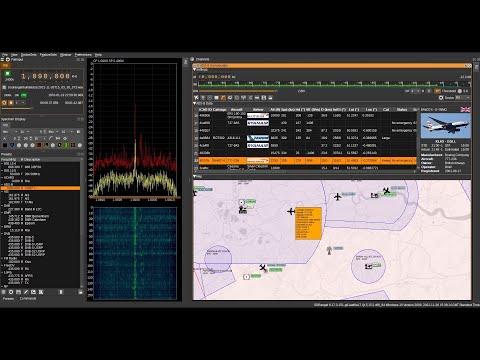
Thanks to Jon for writing in and sharing with us a demonstration video that the SDRAngel team have released on their YouTube channel. From the video we can see that SDRAngel now comes stock with a whole host of built in decoders and apps for various radio applications making it close to an all-in-one SDR platform. The built in applications include:
ADS-B Decoder: Decodes aircraft ADS-B data and plots aircraft positions on a map
NOAA APT Decoder: Decodes NOAA weather satellite images (in black and white only)
DVB-S: Decodes and plays Digital TV DVB-S and DVB-S2 video
AIS: Decodes marine AIS data and plots vessel positions on a map
VOR: Decodes VOR aircraft navigational beacons, and plots bearing lines on a map, allowing you to determine your receivers position.
DAB+: Decodes and plays DAB digital audio signals
Radio Astronomy Hydrogen Line: With an appropriate radio telescope connected to the SDR, integrates and displays the Hydrogen Line FFT with various settings, and a map of the galaxy showing where your dish is pointing. Can also control a dish rotator.
Radio Astronomy Solar Observations: Similar to the Hydrogen line app, allows you to make solar measurements.
Broadcast FM: Decoding and playback. Includes RDS decoding.
Noise Figure Measurements: Together with a noise source you can measure the noise figure of a SDR.
Graves Radar Tracker: For Europeans, track a satellite and watch for reflections in the spectrum from the French Graves space radar.
Radio Clocks: Receive and decode accurate time from radio clocks such as MSF, DCF77, TDF and WWVB.
APRS: Decode APRS data, and plot APRS locations and moving APRS enabled vehicles on a map with speed plot.
Pagers: Decode POCSAG pagers
APRS/AX.25 Satellite: Decode APRS messages from the ISS and NO-84 satellites, via the built in decoder and satellite tracker.
Channel Analyzer: Analyze signals in the frequency and time domains
QSO Digital and Analog Voice: Decode digital and analog voice. Digital voice handled by the built in DSD demodulator, and includes DMR, dPMR and D-Star.
Beacons: Monitor propagation via amateur radio beacons, and plot them on a map.
We note that the video doesn't show the following additional features such as an analog TV decoder, the SDRAngel "ChirpChat" text mode, a FreeDV decoder and several other features.